Work friends are genuinely good for you: research links workplace friendship to better well-being, stronger organizational commitment, and higher supervisor-rated performance through trust and positive mood. The same research is honest about a real cost: the more of these blended, personal-and-professional relationships someone has, the more they can also drain emotional energy and complicate daily work, so "more work friends is always better" oversells it.
Are work friends actually good for you? Mostly, yes
The short version: having work friends is genuinely linked to better outcomes, both for you and for how you perform. A statistical model built by pooling multiple prior studies on workplace friendship found a moderate-to-strong overall association between having workplace friendships and organizational commitment (how attached an employee feels to the organization), with a chunk of that connection running directly and another chunk running indirectly through employees' own sense of well-being [1]. Put simply: people with real friends at work tend to feel better at work, and feeling better at work tends to make them more committed to staying there.
The real tradeoffs: work friends are a genuine mixed blessing
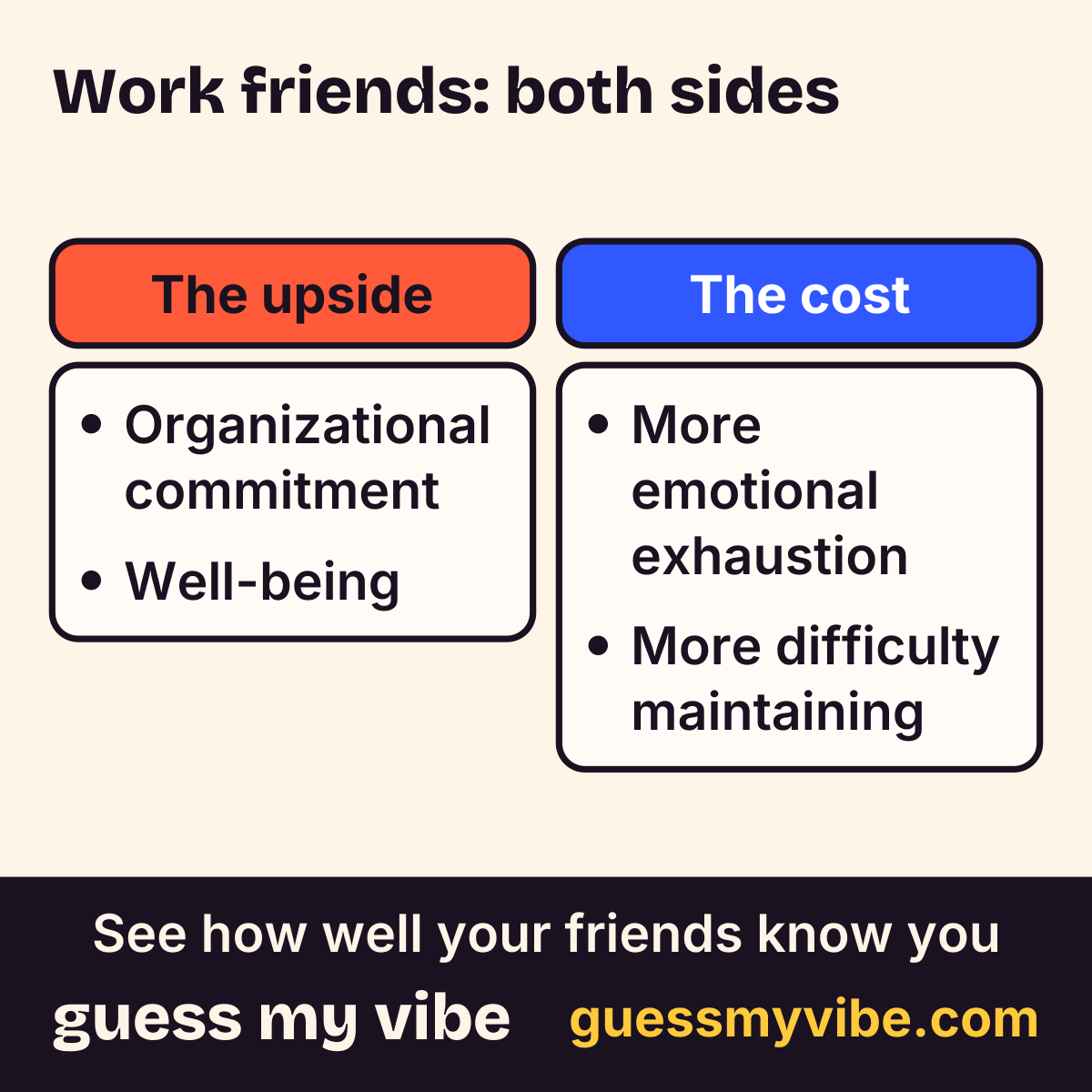
The research gets more interesting, and more honest, once it looks at what researchers call "multiplex" relationships: a coworker who is also a friend, meaning the relationship carries both a work purpose and a personal one at the same time. Two separate studies, one of insurance-company employees (168 people) and one of restaurant and retail employees (182 people), found that having more of these blended relationships was linked to higher supervisor-rated job performance, driven by trust and more positive mood at work [2]. That's the upside half of the story, and it's real.
But the same research found a second, opposite effect running at the same time: more multiplex relationships were also linked to more emotional exhaustion, and in the second study, more day-to-day difficulty actually maintaining those relationships, both of which dragged performance back down. The researchers didn't describe this as friendship being secretly bad for performance. They described it as a mixed blessing, a genuinely true tradeoff where the resources a friendship provides (trust, support, a better mood) come bundled with a real cost in energy and upkeep, not a hidden downside waiting to cancel out the good.
Worth noting: both studies measured real employees in real jobs, not students in a lab, which is part of why the finding is taken seriously in organizational research. The second study's detail about maintenance difficulty is a useful, concrete idea on its own. A friendship with no work component can go quiet for a while with no real cost. A work friendship that goes quiet still has to coexist with daily meetings, shared deadlines and a reporting structure, which is exactly the kind of upkeep a purely personal friendship doesn't require.
Cite this figure
Figure: "Work friends: both sides." Guess My Vibe (guessmyvibe.com). https://guessmyvibe.com/learn/work-friends#figure-upside-and-cost
Why mixing friendship and business is inherently tricky
A detailed review of workplace friendship research makes the case that the benefits and the costs of work friends aren't two separate things that happen to show up together, they come from the exact same source [3]. The trust, empathy and sympathy that make a work friendship valuable for your career are the same qualities that make it threaten your self-concept if your friend gets a promotion you didn't, the same qualities that make it awkward when the relationship involves an exchange that feels transactional on one side and personal on the other, and the same qualities that clash with the different norms people hold for how friends "pay each other back" versus how colleagues do.
The review adds one more finding worth knowing: in network data, people generally prefer to keep their close personal relationships and their useful professional ones in separate parts of their social network. A work friendship asks two people to hold both in the exact same relationship, which is a real structural tension, not a sign that either person is doing friendship wrong. The review frames this as one of three broad ways people and organizations try to handle the mix of intimacy and business: keeping the two worlds strictly separate (the approach behind formal gift and expense-account policies), treating them as basically the same thing (the view that every relationship is ultimately transactional), or, the authors' own preferred middle ground, openly negotiating which parts of a relationship are personal and which are business as the relationship goes along, rather than pretending the line is fixed.
Curious how your friends would answer?
Free. Answer 10 quick questions about you, then send your link. Friends play in their browser, no app needed.
Start freeWhen a work friendship turns into conflict
A coworker disagreement isn't a different species of conflict from any other. Research combining hypothetical conflict scenarios with two weeks of real daily conflict diaries found that agreeableness, out of all five major personality traits, was the one most consistently tied to how people react to conflict and whether they reach for destructive tactics, like blame or stonewalling, or more constructive ones [4]. Applied to work friends, this means a falling-out with a work best friend often has less to do with the specific disagreement (a missed deadline, a credit dispute) and more to do with each person's underlying response style under friction, the same pattern this research finds in roommates, partners and classmates alike.
Getting the upside of work friends without overpaying for it
None of this research argues for avoiding friendships at work, the overall evidence leans clearly positive. What it does argue for is being realistic about the maintenance cost: a few genuinely close work friendships, kept up deliberately, look more sustainable in this data than trying to turn the whole office into your closest circle. It also argues for naming the tension directly when it shows up, like being honest with a work friend when a professional decision (a promotion, a project assignment) is going to feel personal, rather than pretending the two sides of the relationship can be kept perfectly separate.
It's also worth separating the two studies' different settings when thinking about your own job. An insurance office and a restaurant floor don't run the same way, yet the same basic tradeoff showed up in both: more blended relationships, more upside through trust and mood, and more cost through exhaustion or upkeep. That consistency across such different workplaces is part of why researchers treat this as a general pattern about work friendship itself, not a quirk of one industry or one kind of job.
Play it with your desk neighbor
Guess My Vibe is a quick, low-stakes way to find out how well a work friend actually reads you outside of meetings and Slack messages: you answer questions about your own everyday habits and personality, they guess your answers, and you compare. It's a good fit for exactly the kind of relationship this research describes, close enough to know real things about each other, but still worth actually checking.
Key takeaways
- Pooling prior studies into one statistical model, workplace friendship had a moderate-to-strong link to organizational commitment, partly direct and partly running through how well employees said they were doing overall [1].
- Across two separate workplace studies, more "multiplex" relationships (coworkers who are also friends) went with higher supervisor-rated job performance through trust and positive mood, but also more emotional exhaustion and more day-to-day difficulty maintaining the relationships [2].
- A review of workplace friendship research argues the benefits (trust, empathy, sympathy) and the costs (threats to self-image when a friend gets ahead, clashing norms about give-and-take) come from the exact same source: mixing a personal relationship with a business one [3].
- Agreeableness is the Big Five trait most consistently tied to how people handle interpersonal conflict, which applies as much to a coworker disagreement as to any other relationship [4].
- This isn't therapy, a diagnosis, or a substitute for professional care; it's a plain-English summary of what organizational research says about friendship at work.
Questions people ask
Are work friends actually good for your career?
The overall evidence leans positive. A model pooling multiple studies found workplace friendship had a moderate-to-strong link to organizational commitment through both a direct path and one running through well-being [1], and more "multiplex" (friend-and-coworker) relationships went with higher supervisor-rated performance through trust and positive mood [2].
Do work friends have a downside?
Yes, and research is explicit about it. The same study linking work friendships to better performance also found more emotional exhaustion and more day-to-day difficulty maintaining those relationships as the number of blended friend-coworker ties increased [2].
Why is it hard to be both friends and coworkers with someone?
A review of workplace friendship research argues the benefits and the costs come from the same source: the trust and empathy that make the friendship valuable are the same qualities that create tension when a friend's business outcome differs from yours, or when the relationship's exchanges feel personal to one person and transactional to the other [3].
What personality trait is linked to how a work friendship conflict goes?
Agreeableness. Research combining hypothetical scenarios and real conflict diaries found it was the Big Five trait most consistently tied to how people react to interpersonal conflict, in any relationship, including a coworker one [4].
Should I try to be friends with everyone at work?
The research doesn't point that way. It suggests a smaller number of genuinely maintained work friendships fits the evidence on tradeoffs (benefit plus real upkeep cost) better than spreading thin across the whole office.
See how well your friends know you.
Free. Answer 10 quick questions about you, then send your link. Friends play in their browser, no app needed.
Start freeReferences
- [1] Chen, Y. C., Wang, Y. H., & Chu, H. C. (2024). Meta-Analytic Structural Equation Modeling for Exploring Workplace Friendship, Well-Being, and Organizational Commitment. Work, 79(3), 1039–1053. PubMed: 38848154 (opens in a new tab)
- [2] Methot, J. R., Lepine, J. A., Podsakoff, N. P., & Christian, J. S. (2016). Are Workplace Friendships a Mixed Blessing? Exploring Tradeoffs of Multiplex Relationships and Their Associations With Job Performance. Personnel Psychology, 69(2), 311–355. doi.org/10.1111/peps.12109 (opens in a new tab)
- [3] Ingram, P., & Zou, X. (2008). Business Friendships. Research in Organizational Behavior, 28, 167–184. doi.org/10.1016/j.riob.2008.04.006 (opens in a new tab)
- [4] Jensen-Campbell, L. A., & Graziano, W. G. (2001). Agreeableness as a moderator of interpersonal conflict. Journal of Personality, 69(2), 323–361. PubMed: 11339802 (opens in a new tab)
How we find and check these sources: how we write. Spotted an error? Report a correction.
Related
- Roommate Compatibility: What the Research Actually Says
- Roommate Conflict: The Personality Patterns Behind It
- Communication Styles and Personality: The Real Research
- How to Be a Good Friend, According to Research
- Annoying Coworker: Why Personality Clashes Happen at Work
- Social Loafing: Why People Slack Off in Groups
Cite this article
- Title
- Work Friends: What Research Says About Friendships at Work
- Publisher
- Guess My Vibe
- Updated
- URL
- https://guessmyvibe.com/
learn/ work-friends
Copy this citation
Guess My Vibe. (2026, October 3). Work Friends: What Research Says About Friendships at Work. Guess My Vibe. https://guessmyvibe.com/
To point at one section, add that section's anchor (the # link on its heading) to the URL.