An annoying coworker is usually someone whose habits clash with yours, not someone who is bad at being a person. Research on personality and conflict finds that the strongest effects of personality on conflict showed up in how two people's traits combine, such as the gap between how outgoing each is, and that people show somewhat stable tendencies in how they describe their conflicts [1]. Conflict at work is linked to worse team performance and satisfaction, so it is worth handling early [2].
An annoying coworker is almost always someone whose way of working rubs against yours: they talk when you want quiet, reply in an hour when you reply in a minute, or leave details loose when you like them nailed down. Research on personality and conflict suggests the friction is often about the match between two people, not about one person being the problem. In two studies of how people report conflict, the strongest effects of personality showed up when the researchers looked at two people together, not at individuals on their own [1]. That does not make the annoyance imaginary. It does mean the useful question is usually "what is it about the two of us" before "what is wrong with them."
What a personality clash at work usually is
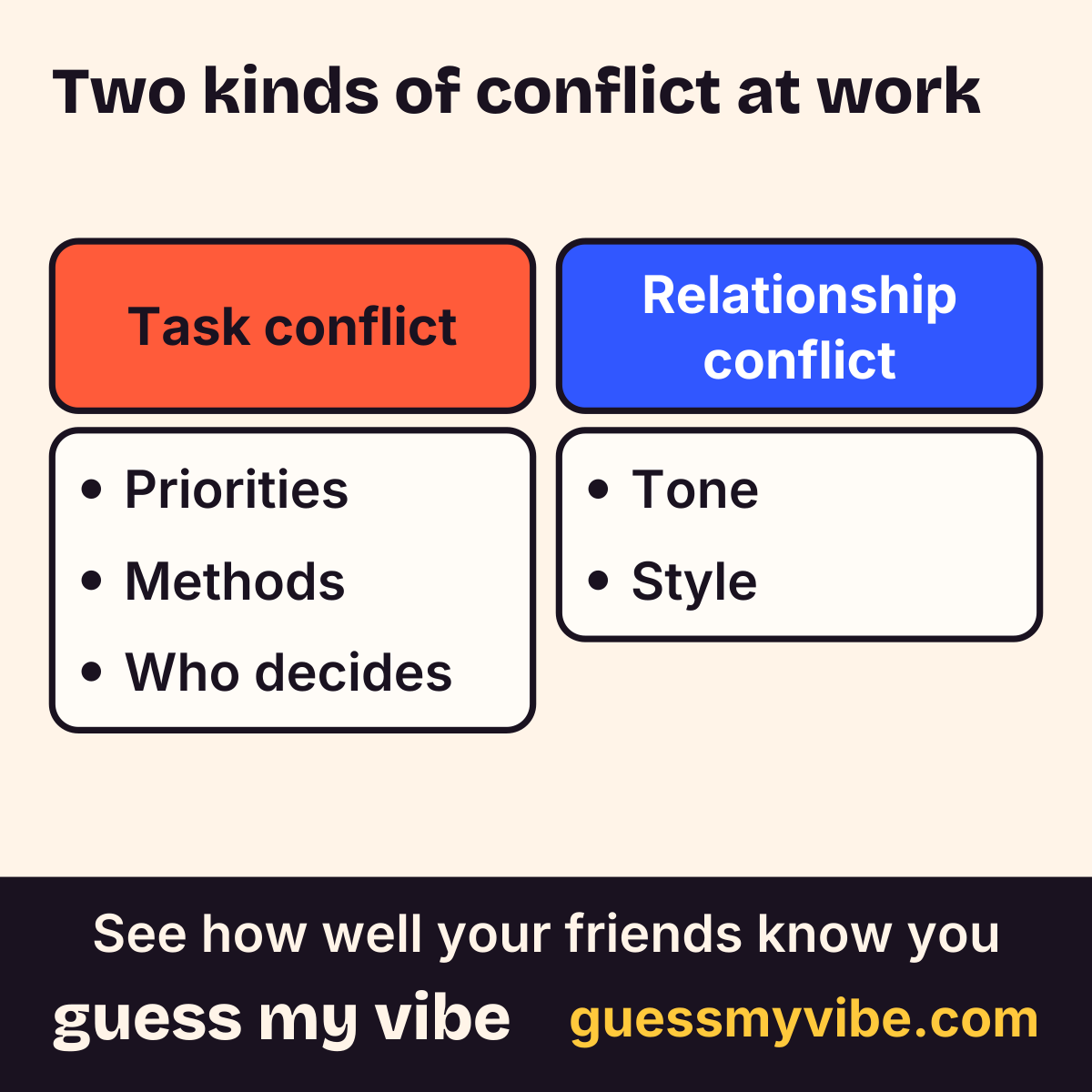
Researchers who study conflict at work separate it into two kinds. Task conflict is about the work itself: priorities, methods, who decides what. Relationship conflict is about the people: tone, style, the feeling that someone is irritating or disrespectful. A personality clash is mostly the second kind, and it often starts as the first. A disagreement about how to run a meeting turns into a feeling that this person is hard to work with.
A paper by Bono and colleagues asked how Big Five traits relate to the tendency to experience each kind. Across two studies, agreeableness and openness were related to reports of relationship conflict at the individual level. But the abstract says the strongest effects came from looking at two people together. A partner's level of extraversion and of conscientiousness were associated with a person's tendency to report relationship conflict. The average level of extraversion and conscientiousness for the two people together was too. And when two partners differed in extraversion, they had more frequent conflict and were more likely to report task-related conflict [1].
In plain words, who you sit next to showed the strongest effects in those studies, more than who you are on your own. A talkative person next to another talkative person may get along fine. The same person next to a quiet one, who needs focus time, may rub them the wrong way, and the reverse is true as well. Neither is wrong, and these examples are illustrations, since the abstract reports that differences in extraversion went with more conflict but not which combinations work. The abstract does not describe the samples, so we cannot say how closely those results map to an office, and they are patterns across many people, not forecasts for any two particular people.
Cite this figure
Figure: "Two kinds of conflict at work." Guess My Vibe (guessmyvibe.com). https://guessmyvibe.com/learn/annoying-coworker#figure-two-kinds-of-conflict
Part of it is how you read the friction
The same paper reported something that is easy to skip past. It found some support for the idea that individuals have stable tendencies in the attributions they make about their conflict experiences, across time, partners and situations [1]. Put simply, some people tend to see a disagreement as a problem with the work and others tend to see it as a problem with the person, and that habit travels with them from one coworker to the next.
This is a practical point, not a criticism. If you notice that you have found a few different coworkers annoying in the same way, it is worth asking whether the common factor is the situation or the way you tend to interpret it. The researchers also found that these conflict attributions had a meaningful impact on relationship satisfaction, so how the clash gets labeled in your head matters for how the working relationship feels over time [1].
Curious how your friends would answer?
Free. Answer 10 quick questions about you, then send your link. Friends play in their browser, no app needed.
Start freeWhy a difficult coworker is hard to read from the outside
Agreeableness gets a lot of blame in office complaints, and it does matter. Across a set of studies, agreeableness was the Big Five trait most closely associated with processes and outcomes during interpersonal conflict, and agreeableness differences were related to how people responded to conflict [4]. That study used adolescents, so treat it as supporting evidence about how the trait works, not as an office study. In one of two studies in a separate paper, people who scored low on agreeableness rated power-assertion tactics as better choices than high scorers did, although both groups rated negotiation and disengagement as better than power assertion [6].
Here is the catch. A large meta-analysis of other-ratings of personality found that being around someone more often improved accuracy, but that real closeness was needed for substantial gains, and that closeness helped only minimally for traits that are high in evaluativeness, such as agreeableness [5]. That suggests a confident verdict on how agreeable a coworker is may rest on shaky ground, even when you see them often. What looks like rudeness may be a style, and a coworker who seems pleasant may be handling things differently than you assume.
Why it is worth handling and not just enduring
Tolerating an annoying coworker feels free, but conflict goes with worse team outcomes. A meta-analysis of research on teams found strong and negative correlations between relationship conflict and both team performance and team member satisfaction. It also found that task conflict, which many people assume is healthy, was also strongly and negatively related to both, not positive as had been expected. Conflict had a stronger negative relation with performance on complex tasks than on simpler production tasks, and task conflict was less negatively related to performance when it was only weakly tied to relationship conflict [2].
A 2026 update of the team-conflict literature adds nuance. On average, all four conflict types it examined, task, relationship, process and status conflict, were negatively related to team performance. But the effects of task and relationship conflict varied a lot between situations, and the variation was partly explained by national culture, features of the team and the way conflict was measured [3]. So the research does not say all friction is damaging in every setting. It says that on average it is linked to lower performance, and that context matters.
The second finding in the older meta-analysis is useful. Task conflict was less negatively related to performance when it was kept apart from relationship conflict. That fits the practical advice below: keep a disagreement about the work from turning into a verdict about the person.
What tends to help, drawing on the research
None of the studies above tested a workplace advice plan, so these are reasonable applications of the findings, not proven fixes.
- Name the specific behavior, not the person. "I need the numbers before the meeting" is about the task. "You are so disorganized" turns task conflict into relationship conflict, and task conflict was less negatively related to performance when it stayed only weakly tied to relationship conflict [2].
- Check the match. If the friction is about pace, volume or how much talk you each want, you may be describing a difference in extraversion, which the two-person results link to more conflict [1]. A schedule or a channel can fix that better than a talk about attitude.
- Notice your own habit. If most coworkers eventually feel personal to you, that is worth knowing about your reading style [1].
- Hold off on judging how agreeable someone is. Even closeness improved accuracy only minimally for highly evaluative traits like agreeableness [5].
- Offer the easy option, such as negotiating a way to work together. In one study, people at both ends of the agreeableness range rated negotiation as a better tactic than power assertion [6].
A caveat matters here. Everything in this article is about ordinary friction between people with different styles. It does not cover harassment, discrimination or threats. Those are not personality clashes, and they are worth taking to a manager, an HR team or another proper channel.
If your coworker is also a friend
Some of the best working relationships are ones where you can talk plainly about style. If a coworker is also a friend, Guess My Vibe gives you a light way to see how you each read the other. You each answer and guess on your own, and the reveal shows where your read of them matched and where it missed, which is a low-stakes way to find out how well you know their style.
Key takeaways
- In two studies of personality and conflict, the strongest effects came from two-person combinations: partner levels of extraversion and conscientiousness, and differences between partners in extraversion, were linked to how much conflict people reported [1].
- People seem to have somewhat stable tendencies in whether they describe conflict as personal or as about the task, so part of what makes someone feel annoying may be how you tend to read friction [1].
- A meta-analysis found that both relationship conflict and task conflict were strongly and negatively linked to team performance and team satisfaction [2], and a 2026 update found the effects vary by situation [3].
- In a study of adolescents, agreeableness was the Big Five trait most closely tied to how people handle conflict, but it is a trait where knowing someone better improves other people's accuracy only minimally [4] [5].
- This isn't therapy, a diagnosis, or a substitute for professional care.
Questions people ask
Why is my coworker so annoying?
Often because their style clashes with yours. In two studies of personality and conflict, the strongest effects came from two-person combinations: partner extraversion and conscientiousness, and differences in extraversion between partners, were linked to reported conflict [1]. That points to a mismatch more than a flaw in either person.
Is it me or my coworker?
It can be both. People show somewhat stable tendencies in how they describe conflict, as about the task or about the person, across partners and situations [1]. If several people irritate you in the same way, look at how you are reading the friction, and also at the match between you.
Does personality really cause conflict at work?
It is linked to it, though these studies show association, not cause. Agreeableness is the Big Five trait most closely linked to how people respond to conflict, in a study of adolescents [4], and differences in extraversion between two people were linked to more conflict in another [1]. But these are tendencies across many people, not a way to forecast one coworker.
Is conflict at work always bad for a team?
On average it is linked to worse outcomes. A meta-analysis found relationship conflict and task conflict were both strongly and negatively linked to team performance and satisfaction [2], and a 2026 update found all four conflict types were negatively related to performance on average, with large differences between situations [3].
Can I tell if a coworker is difficult from first impressions?
Probably not with confidence for evaluative traits like agreeableness. A meta-analysis found closeness helped accuracy only minimally for highly evaluative traits, so confident verdicts about how agreeable someone is may be on shaky ground. That study did not test first impressions specifically [5].
See how well your friends know you.
Free. Answer 10 quick questions about you, then send your link. Friends play in their browser, no app needed.
Start freeReferences
- [1] Bono, J. E., Boles, T. L., Judge, T. A., & Lauver, K. J. (2002). The role of personality in task and relationship conflict. Journal of Personality, 70(3), 311–344. PubMed: 12049163 (opens in a new tab)
- [2] De Dreu, C. K. W., & Weingart, L. R. (2003). Task versus relationship conflict, team performance, and team member satisfaction: a meta-analysis. Journal of Applied Psychology, 88(4), 741–749. PubMed: 12940412 (opens in a new tab)
- [3] Yuan, Z., Yin, J., & Sun, J. (2026). The paradox of team conflict revisited: An updated meta-analysis of the team conflict-team performance relationships. Journal of Applied Psychology, 111(2), 195–224. PubMed: 40875336 (opens in a new tab)
- [4] Jensen-Campbell, L. A., & Graziano, W. G. (2001). Agreeableness as a moderator of interpersonal conflict. Journal of Personality, 69(2), 323–361. PubMed: 11339802 (opens in a new tab)
- [5] Connelly, B. S., & Ones, D. S. (2010). An other perspective on personality: Meta-analytic integration of observers' accuracy and predictive validity. Psychological Bulletin, 136(6), 1092–1122. PubMed: 21038940 (opens in a new tab)
- [6] Graziano, W. G., Jensen-Campbell, L. A., & Hair, E. C. (1996). Perceiving interpersonal conflict and reacting to it: The case for agreeableness. Journal of Personality and Social Psychology, 70(4), 820–835. PubMed: 8636901 (opens in a new tab)
How we find and check these sources: how we write. Spotted an error? Report a correction.
Related
Cite this article
- Title
- Annoying Coworker: Why Personality Clashes Happen at Work
- Publisher
- Guess My Vibe
- Updated
- URL
- https://guessmyvibe.com/
learn/ annoying-coworker
Copy this citation
Guess My Vibe. (2026, October 4). Annoying Coworker: Why Personality Clashes Happen at Work. Guess My Vibe. https://guessmyvibe.com/
To point at one section, add that section's anchor (the # link on its heading) to the URL.