Roommate conflict is common, and research links how people handle it less to being a "good" or "bad" roommate and more to one trait: agreeableness, which shapes how someone reacts to friction and whether they reach for a destructive or a constructive response. Living with someone also makes even ordinary, unresolved tension a measurable source of stress, which is one real reason small roommate issues are worth actually talking through.
Why roommate conflict happens: it's rarely one "bad roommate"
Roommate conflict is close to universal, not a sign that something went uniquely wrong with your specific living situation. It's also rarely explained by one person simply being "difficult." Personality research points to something more specific and more useful: how two people each handle friction, not just whether friction exists, shapes how a disagreement over dishes or noise or a late rent payment actually plays out.
Agreeableness: the trait most tied to how conflict actually goes
A study that combined hypothetical conflict scenarios with two full weeks of real diary entries about actual daily conflicts found that, out of all five major personality traits, agreeableness was the one most consistently connected to how people reacted to conflict and whether they used destructive tactics, like blame, stonewalling or escalation, versus more constructive ones [1]. The same study found that these differences in agreeableness, and the conflict tactics that go with them, were tied to how someone was rated on overall adjustment by people who knew them well, like teachers.
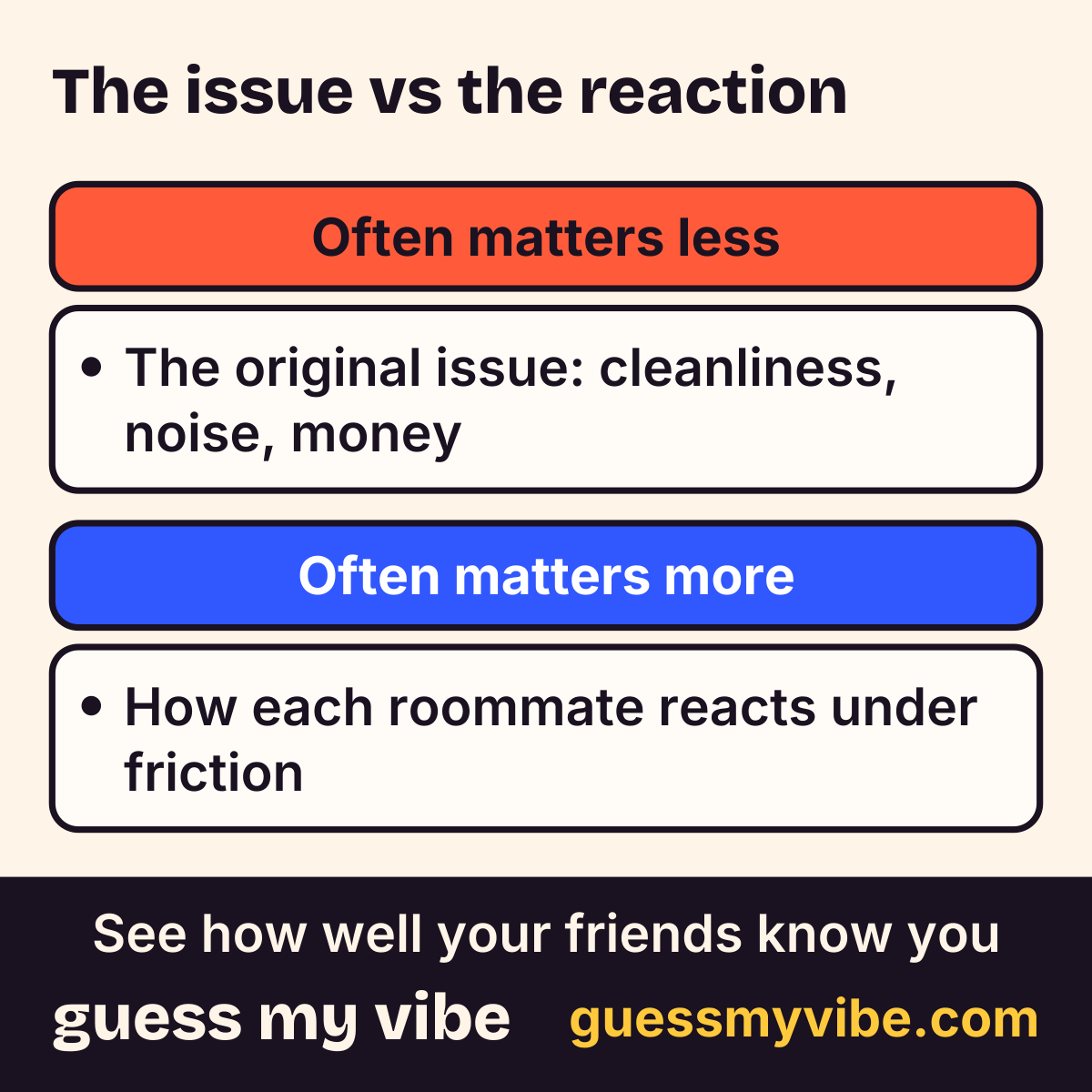
Applied to roommates, this reframes a common assumption. It's tempting to think roommate conflict is mostly about a values clash, like one person caring about cleanliness and the other not caring at all. Often it's really about response style: two roommates can care about the same things and still clash hard if one of them reaches for a sharp, destructive response under stress and the other reaches for a cooperative one. The mismatch is in the reaction, not always the original issue.
That's worth sitting with because it changes what's actually worth working on. Two roommates who are both genuinely tidy people can still end up in a cycle of sharp comments and cold silences if one of them escalates fast under stress and the other shuts down instead of saying anything. Meanwhile, two roommates with real differences in habits can coexist fine if both default to a cooperative, direct style when something comes up. The study above measured this with actual daily diary entries over two full weeks, not a one-time personality label, which is part of why it's a more useful lens than asking "are we compatible" in the abstract.
Cite this figure
Figure: "The issue vs the reaction." Guess My Vibe (guessmyvibe.com). https://guessmyvibe.com/learn/roommate-conflict#figure-issue-vs-reaction
Roommate conflict is a real, measurable source of stress
A survey of 462 college students living in residence halls, weighted to reflect the university's whole undergraduate population, asked about a wide range of stress predictors: personal, health, academic and environmental questions, plus one open-ended question about what stressed them most. Chronic illness, depression, anxiety, seasonal affective disorder, mononucleosis and sleep trouble all came up as significant stress predictors, alongside alcohol use (which went with more stress) and drug use (which, in this sample, went with less). Both an outright roommate conflict and, notably, a roommate relationship rated merely "satisfactory" (not bad, just not great) were also significant predictors of overall stress, in the same company as conflict with a faculty or staff member [2]. That second finding is worth sitting with: you don't need an open blowup for a roommate situation to be quietly costing you. A flat, unresolved, "it's fine I guess" relationship showed up in this data as its own kind of stressor, distinct from genuine conflict, and sitting right alongside health and sleep problems as something that actually registered as stress.
That's a useful, non-alarming way to think about low-grade roommate tension: it doesn't have to escalate into a fight to be worth addressing. The data above suggests that letting something sit at "satisfactory" rather than actually good isn't a neutral, cost-free choice, it's its own measurable stress factor alongside health and academic pressure.
Curious how your friends would answer?
Free. Answer 10 quick questions about you, then send your link. Friends play in their browser, no app needed.
Start freeYour roommate can usually tell when something's off, and they're often right
Part of why roommate conflict feels so loaded is that it's hard to hide from. A classic study comparing close acquaintances to total strangers found that close acquaintances agreed with each other, and with the person's own self-ratings, far more than strangers did, even though strangers who'd only seen one brief interaction still showed above-chance agreement [3]. A separate study found that a close other's rating of someone's actual daily behavior, checked against four days of unobtrusively recorded behavior, matched that recorded behavior about as well as the person's own self-rating did [4]. Put together, these findings mean a roommate who says "something's been off between us lately" usually isn't imagining a pattern. They've had the kind of sustained, close-range access to your actual behavior that research shows produces real accuracy, not guesswork.
What this means for actually talking to your roommate
None of this research hands out a script, but it does point toward a few honest, low-pressure moves. First, naming a specific behavior ("the dishes sitting for a few days") tends to go further than a broad character claim ("you're so messy"), since the research above is about response styles and specific tactics, not fixed character flaws. Second, if your own instinct under friction is to go quiet or go sharp, that's worth noticing in yourself before the conversation, since agreeableness research ties exactly that instinct to how the whole exchange tends to go. Third, don't wait for "satisfactory" to become a fight before raising it; the stress research above suggests that flat, unaddressed tension carries its own cost even without one.
It's also worth remembering that the same agreeableness research found these response-style differences connected to real outside evaluations of someone's overall adjustment, not just to how a single conflict played out. That's a reminder that handling roommate friction well is a genuinely useful, transferable skill, not a quirk that only matters inside one apartment. Getting better at raising a specific issue calmly, rather than escalating or going silent, is the same skill that shows up in how classmates, coworkers and partners rate someone later on too.
See how your roommate actually reads you
Guess My Vibe is a quick, low-stakes way to check how accurately your roommate reads your actual habits and reactions: you answer questions about yourself, they guess your answers, and you compare. It's not a conflict-resolution tool, but it's a genuinely fun way to see the same kind of close-contact accuracy the research above describes, play out in your own place.
Key takeaways
- Across hypothetical scenarios and two weeks of real daily conflict diaries, agreeableness was the Big Five trait most consistently tied to how people react to interpersonal conflict and whether they use destructive tactics [1].
- In a survey of residence-hall students, both an outright roommate conflict and a merely "satisfactory" (not great) roommate relationship were significant predictors of overall stress [2].
- Close acquaintances' personality ratings of someone agreed with each other, and with the person's self-view, far more than strangers' ratings did, which is part of why a roommate's read on "what's actually going on" tends to be more informed than an outsider's [3].
- A close other's rating of someone's actual daily behavior, tracked over four days, matched that behavior about as well as the person's own self-rating did, which is a reminder that someone who knows you well isn't guessing when they say a pattern is a pattern [4].
- This isn't therapy, a diagnosis, or a substitute for professional care; it's a plain-English summary of what personality research says about roommate friction.
Questions people ask
What personality trait is most linked to roommate conflict?
Agreeableness. Research combining hypothetical scenarios and real daily conflict diaries found agreeableness was the Big Five trait most consistently tied to how people react to conflict and whether they use destructive or constructive tactics [1].
Can a roommate relationship cause stress even without a fight?
Yes. A survey of residence-hall students found that a merely "satisfactory" (not bad, just not great) roommate relationship was itself a significant predictor of overall stress, alongside outright conflict [2].
Is roommate conflict usually about cleanliness or values?
Often the original issue (cleanliness, noise, money) is less important than how each roommate reacts under friction. Among the Big Five traits, agreeableness is the one research ties most closely to how people react once a conflict is underway, so how each roommate responds matters a lot [1].
Does my roommate actually notice when something's wrong between us?
Probably, and probably accurately. Close acquaintances agree with each other and with a person's own self-view far more than strangers do, and a close contact's rating of someone's daily behavior, tracked over days, matched that behavior about as well as the person's self-rating [3] [4].
How should I bring up a problem with my roommate?
There's no single research-backed script, but naming a specific behavior rather than a broad character claim fits the evidence above better: conflict research is about response styles and specific tactics, not fixed personality flaws.
See how well your friends know you.
Free. Answer 10 quick questions about you, then send your link. Friends play in their browser, no app needed.
Start freeReferences
- [1] Jensen-Campbell, L. A., & Graziano, W. G. (2001). Agreeableness as a moderator of interpersonal conflict. Journal of Personality, 69(2), 323–361. PubMed: 11339802 (opens in a new tab)
- [2] Dusselier, L., Dunn, B., Wang, Y., Shelley, M. C., & Whalen, D. F. (2005). Personal, Health, Academic, and Environmental Predictors of Stress for Residence Hall Students. Journal of American College Health, 54(1), 15–24. PubMed: 16050324 (opens in a new tab)
- [3] Funder, D. C., & Colvin, C. R. (1988). Friends and strangers: Acquaintanceship, agreement, and the accuracy of personality judgment. Journal of Personality and Social Psychology, 55(1), 149–158. PubMed: 3418488 (opens in a new tab)
- [4] Vazire, S., & Mehl, M. R. (2008). Knowing me, knowing you: The accuracy and unique predictive validity of self-ratings and other-ratings of daily behavior. Journal of Personality and Social Psychology, 95(5), 1202–1216. PubMed: 18954202 (opens in a new tab)
How we find and check these sources: how we write. Spotted an error? Report a correction.
Related
- Roommate Compatibility: What the Research Actually Says
- Living With Roommates: What Actually Changes
- Messy Roommate? What a Room Says About Personality
- Work Friends: What Research Says About Friendships at Work
- How to Be a Good Friend, According to Research
- One-Sided Friendship: What the Research Actually Finds
- Annoying Coworker: Why Personality Clashes Happen at Work
- Social Loafing: Why People Slack Off in Groups
Cite this article
- Title
- Roommate Conflict: The Personality Patterns Behind It
- Publisher
- Guess My Vibe
- Updated
- URL
- https://guessmyvibe.com/
learn/ roommate-conflict
Copy this citation
Guess My Vibe. (2026, October 3). Roommate Conflict: The Personality Patterns Behind It. Guess My Vibe. https://guessmyvibe.com/
To point at one section, add that section's anchor (the # link on its heading) to the URL.