Living with roommates changes how well someone knows you faster than almost any other relationship, because they're exposed to the physical evidence of your actual habits, not just the version of you that shows up in conversation. Research on judging personality from people's rooms and from recorded daily behavior finds that close, everyday contact produces real, measurable accuracy, which is also why living with an existing best friend can shift a friendship in ways that only become visible once you share a kitchen.
What actually changes when you start living with roommates
Moving from seeing someone occasionally to living with roommates changes the kind of information they have about you, not just the amount. A classmate sees how you act in a lecture hall. A roommate sees what time you actually fall asleep, how you handle a sink full of dishes you didn't make, and what you do the week before a deadline when no one's watching. Personality research backs up what that feels like intuitively: close, everyday contact produces a kind of accuracy about a person that occasional contact simply can't.
Your space reveals you, even when you're not in the room
One of the more striking findings in this area of research isn't about watching a person at all. It's about looking at their space. In a study where strangers saw only someone's bedroom or office, never the person themselves, their impressions of the occupant's personality agreed with each other and showed some accuracy against the occupant's own self-ratings and the ratings of people who actually knew them [1]. The researchers called this behavioral residue: the physical traces a person's habits leave behind, a neatly made bed, a cluttered desk, books organized by color versus thrown in a pile, carry real information, and strangers were able to read some of it correctly using valid cues in the room. The same study found these accuracy numbers were, on average, stronger than typical face-to-face first impressions between total strangers, and it also found a less flattering wrinkle worth naming honestly: part of why independent observers agreed with each other came from leaning on sex and race stereotypes about who lives in a given kind of space, not purely from reading the room correctly.
This matters directly for living with roommates because it means cohabiting doesn't just add more hours of watching each other. It adds a second, constant channel of information: your shared space itself. A roommate isn't only reading your behavior when you're both home. They're reading the residue of your habits all day, every day, whether or not you're in the room to perform them, which is a large part of why a roommate often forms an accurate picture of someone faster than a friend who only ever sees them in public, curated settings.
Cite this figure
Figure: "Two channels of information." Guess My Vibe (guessmyvibe.com). https://guessmyvibe.com/learn/living-with-roommates#figure-two-channels
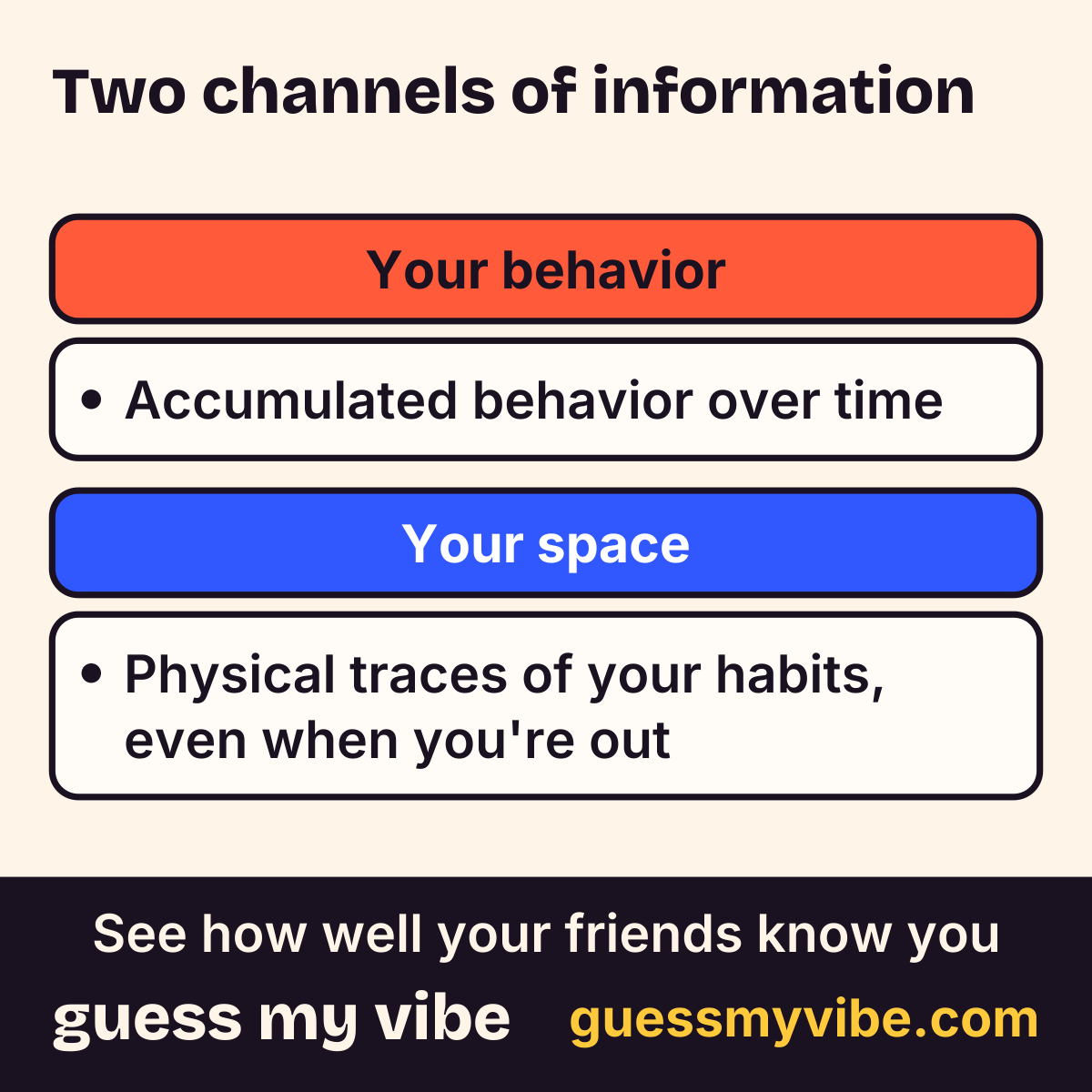
Living together turns roommates into sharp judges of daily behavior
It's not just static space, it's accumulated behavior over time. In a study where 79 people wore an audio recorder for four days, a single close contact's rating of how much that person actually talked, argued, watched TV or spent time with others matched the recorded behavior about as well as the person's own self-rating did [2]. Whoever you're living with is, functionally, running the same kind of extended observation this study built with recording equipment, just by sharing your daily routine. Notably, the researchers also tried averaging ratings from three friends instead of relying on just one, expecting the group average to beat any single rater; it didn't clearly outperform one close contact's rating, which suggests that one person who actually shares your space and routine is already a strong source of information, not a weak substitute for a larger panel of opinions.
Acquaintance itself is doing real work here, separate from closeness or affection. A classic comparison of close acquaintances to total strangers found that close acquaintances agreed with each other, and with a person's own self-ratings, far more than strangers did, even though strangers who'd only seen one brief interaction still showed above-chance agreement [3]. A large meta-analysis spanning more than 44,000 people adds the mechanism: how well an outside rating lines up with self-ratings tracks closely with how much real contact the rater has had, and that gap matters most for the traits that are hardest to observe from a distance, like how easily someone gets stressed [4]. Living with someone is about as much real contact as two people can have outside a romantic relationship, which is exactly why roommates often end up knowing things about each other that even a long-time friend who lives elsewhere doesn't.
Curious how your friends would answer?
Free. Answer 10 quick questions about you, then send your link. Friends play in their browser, no app needed.
Start freeDoes living with your best friend change the friendship?
None of the studies above were run specifically on existing best friends who move in together, so this part is an honest extrapolation, not a direct finding. But the mechanism is the same one described above: moving in together adds behavioral residue and extended daily contact on top of whatever closeness already existed. That can deepen a friendship by giving it a far more complete, accurate picture of each other. It can also surface things a friendship built on occasional hangouts never had to deal with, like actual conflict-handling style, actual cleanliness habits, or actual money habits, the things a close contact's rating turns out to track so well in the research above. Neither direction is guaranteed. What the research does support is that "we'll know each other even better once we live together" is a reasonable expectation either way, because more real contact reliably produces more accurate knowledge of someone, for better or worse.
There's a practical version of this worth naming directly: a friendship that's only ever existed in curated, public settings (dinners out, planned hangouts, a group chat) hasn't yet been tested against the same kind of ordinary, unglamorous daily contact the research above is built on. That's not a reason to avoid moving in with a close friend. It's a reason to expect the friendship to genuinely change shape, usually toward more accurate, not less, the same direction every study above points, whether or not the specific things it reveals turn out to be comfortable.
Put it to the test with the person you actually live with
Guess My Vibe is a quick way to see this research play out in your own apartment: you answer questions about your own everyday habits, your roommate guesses your answers, and you compare side by side how close they got. It's a fun, low-stakes way to find out exactly how much that shared kitchen has actually taught them about you.
Key takeaways
- Strangers who only saw someone's bedroom or office, never the person, formed somewhat accurate impressions of them by reading real physical cues left behind in the space, a pattern researchers call behavioral residue [1].
- A close contact's rating of someone's actual daily behavior, recorded over several days, matched that behavior about as well as the person's own self-rating did [2].
- Close acquaintances agree with each other and with a person's own self-view far more than strangers do, even though strangers who'd seen just one brief interaction still showed above-chance accuracy [3].
- How well someone's self-view matches an outside rating depends heavily on how much real contact that rater has had, and that gap narrows specifically for traits that are hard to observe from a distance [4].
- This isn't therapy, a diagnosis, or a substitute for professional care; it's a plain-English summary of what personality research says about cohabiting.
Questions people ask
Can someone really judge my personality from my room?
To a real, measurable degree. A study found that strangers who only saw someone's bedroom or office, never the person, formed impressions that showed some accuracy against the occupant's own self- and peer-ratings, by picking up on real physical cues [1].
Do roommates really know you better than other friends?
Often, yes, because of sheer contact. A close contact's rating of someone's actual daily behavior, tracked over several days, matched that recorded behavior about as well as the person's own self-rating did [2], and research shows accuracy climbs with real, sustained contact [4].
Does living with your best friend change the friendship?
No study has tracked this exact situation directly, but the mechanism research does support is that more daily contact and more shared space reliably produce more accurate knowledge of someone, which can deepen a friendship or surface friction it never had to handle before.
Is living alone more accurate to who you really are than living with roommates?
That's not really what this research measures. It shows that close, sustained contact with another person produces real accuracy about your behavior; it doesn't compare the experience of living alone to living with others on well-being or self-knowledge.
How fast do roommates start reading each other accurately?
The acquaintance research here points to contact building accuracy over time rather than a fixed number of days: more frequent interaction improves how accurately someone can be rated, though real closeness matters more than frequency alone [4].
See how well your friends know you.
Free. Answer 10 quick questions about you, then send your link. Friends play in their browser, no app needed.
Start freeReferences
- [1] Gosling, S. D., Ko, S. J., Mannarelli, T., & Morris, M. E. (2002). A Room With a Cue: Personality Judgments Based on Offices and Bedrooms. Journal of Personality and Social Psychology, 82(3), 379–398. PubMed: 11902623 (opens in a new tab)
- [2] Vazire, S., & Mehl, M. R. (2008). Knowing me, knowing you: The accuracy and unique predictive validity of self-ratings and other-ratings of daily behavior. Journal of Personality and Social Psychology, 95(5), 1202–1216. PubMed: 18954202 (opens in a new tab)
- [3] Funder, D. C., & Colvin, C. R. (1988). Friends and strangers: Acquaintanceship, agreement, and the accuracy of personality judgment. Journal of Personality and Social Psychology, 55(1), 149–158. PubMed: 3418488 (opens in a new tab)
- [4] Connelly, B. S., & Ones, D. S. (2010). An other perspective on personality: Meta-analytic integration of observers' accuracy and predictive validity. Psychological Bulletin, 136(6), 1092–1122. PubMed: 21038940 (opens in a new tab)
How we find and check these sources: how we write. Spotted an error? Report a correction.
Related
Cite this article
- Title
- Living With Roommates: What Actually Changes
- Publisher
- Guess My Vibe
- Updated
- URL
- https://guessmyvibe.com/
learn/ living-with-roommates
Copy this citation
Guess My Vibe. (2026, October 3). Living With Roommates: What Actually Changes. Guess My Vibe. https://guessmyvibe.com/
To point at one section, add that section's anchor (the # link on its heading) to the URL.