A messy roommate's room does carry some real signal: strangers who saw only someone's bedroom can form impressions that agree with how organized the occupant actually is [1]. But the honest version of that finding is narrower than "messy roommate = bad roommate." Tidiness and actual reliability (paying rent on time, following through on plans) are related but separate parts of conscientiousness, not the same trait wearing two faces [2], and a cluttered space isn't simply worse than a tidy one; it's linked to its own upside [3].
Does a messy roommate's room actually mean something?
Yes, to a real but limited degree. A messy roommate's space isn't neutral information: in a study where total strangers saw nothing but someone's bedroom, never the person, their impressions of that person's personality lined up with the occupant's own self-ratings well enough to count as genuine accuracy, not a lucky guess [1]. Researchers call this behavioral residue: the physical traces daily habits leave behind (a pile of clothes left on a chair, books stacked by subject versus shoved on a shelf, dishes that sat out overnight) carry real signal about the person who left them there. That's worth taking seriously before writing off "the room tells you something" as a lazy stereotype. It genuinely does, on average, across large groups of strangers rating large groups of rooms.
Where this gets oversimplified is the jump from "a messy room tells you something" to "a messy roommate is a bad roommate." The research above found a real statistical pattern across many rooms and many raters, not a dependable fact about any one specific person's reliability, kindness, or whether they'll actually pay their share of the electric bill on time. Treating a single, snapshot impression from a messy desk as a verdict on someone's whole character is exactly the kind of overreach the research itself doesn't support.
Tidiness and reliability aren't the same trait
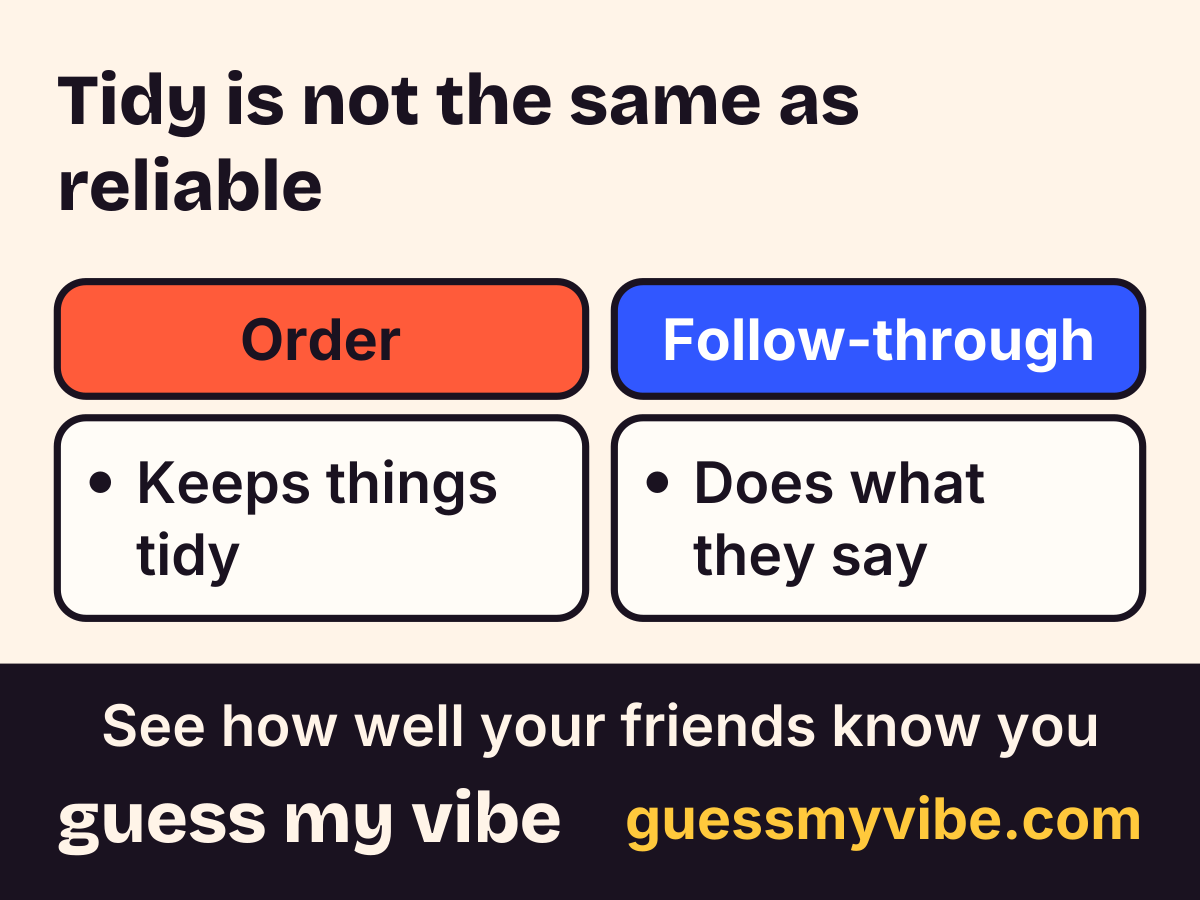
The specific trait a messy room is usually read as signaling is conscientiousness, the Big Five trait covering organization, discipline, and follow-through. A detailed factor-analysis of 75 personality facet scales across two major personality inventories found that conscientiousness isn't one single thing; it splits into two correlated but genuinely distinct parts [2]. One part tracks order and organization, roughly: does this person keep things tidy and structured. The other tracks industriousness, self-discipline and actually following through on commitments, roughly: does this person do what they say they'll do. The two parts are related (people high in one tend to be somewhat higher in the other), but they're not interchangeable, and the researchers found the two parts lined up with separate genetic factors identified in earlier work, which they took as a hint that the split may have distinct biological roots, not just a quirk of how people answered a questionnaire.
Applied to a messy roommate, that's a genuinely useful distinction, not just an academic one. A roommate whose desk is a disaster is giving you real information about the order-and-organization part of conscientiousness. That same messy desk is not, by itself, reliable information about the separate, follow-through part: whether they'll actually show up for the stuff that matters, split the cost of groceries fairly, or remember a promise. Those two things get bundled together in casual judgment ("they're so messy, I bet they're unreliable about everything") far more tightly than the actual research supports. A roommate can be genuinely disorganized about physical space and still be someone who never misses a rent payment; the honest research-backed read keeps those as two separate questions, not one.
Cite this figure
Figure: "Tidy is not the same as reliable." Guess My Vibe (guessmyvibe.com). https://guessmyvibe.com/learn/messy-roommate#figure-two-parts-of-conscientiousness
Curious how your friends would answer?
Free. Answer 10 quick questions about you, then send your link. Friends play in their browser, no app needed.
Start freeA messy space isn't just a worse version of a tidy one
There's a second, easy-to-miss piece of research worth bringing into this, because it pushes back on the assumption that order is simply better and mess is simply worse. In three lab experiments, researchers didn't look at a room's occupant at all; they looked at how a room's physical state affected whoever was placed inside it, regardless of whose space it actually was [3]. People seated in a tidy, orderly room chose healthier snacks and donated more money to a cause than people in a deliberately messy, disorderly version of the same room. But people in the messy room generated more creative, unconventional ideas than people in the tidy one, and a third experiment found the same split showed up in actual preferences: an orderly room nudged people toward a "classic" option, a disorderly one toward something labeled "new." The researchers' own framing is the useful part here: prior work mostly treated order as straightforwardly good and disorder as straightforwardly bad, and this set of experiments found a more nuanced story, where each setting produces its own distinct advantage rather than one simply beating the other.
That doesn't mean a messy roommate's chaos is secretly a productivity hack, and it isn't a reason to stop caring about shared space. It's a reason to drop the specific moral framing where tidy automatically equals better and messy automatically equals worse. The actual evidence describes two different environments with two different sets of tradeoffs, not a hierarchy with "clean" on top.
How much should you trust your own read on a messy roommate?
More than a stranger's guess, less than total certainty. Research on how accurately outside observers judge personality traits in general finds that accuracy varies a lot by which trait is being judged, and that the gap between a quick impression and a well-informed one narrows the more real contact the observer has actually had with the person [4]. A roommate isn't judging from a single look at a bedroom the way the strangers in the behavioral-residue study did. A roommate has weeks or months of watching how someone actually handles shared responsibilities, which is a fundamentally stronger basis for a read than a glimpse of clutter. If a roommate's mess genuinely comes with missed responsibilities over time, that's real, earned information. If the only evidence is a messy desk and an assumption about what that must mean about everything else, that's exactly the gap this research says to be careful about closing too fast.
See how well your roommate actually reads you
Guess My Vibe is a quick, low-stakes way to test this directly instead of guessing from a messy desk alone: you answer real questions about your own habits and personality, your roommate guesses your answers, and you compare side by side. It's a fun way to find out whether the person sharing your space has actually picked up on who you are, beyond whatever your room looks like on a given Tuesday.
Key takeaways
- Strangers who saw only someone's bedroom, never the person, formed impressions of the occupant's personality that agreed with the occupant's own self-ratings, picking up on real physical cues researchers call behavioral residue [1].
- Conscientiousness, the Big Five trait most linked to tidiness, actually splits into two related-but-distinct parts: one tracking order and organization, the other tracking self-discipline and follow-through, which is why a messy desk doesn't automatically mean someone will flake on rent [2].
- In three lab experiments, people placed in a tidy room chose healthier snacks and donated more money, while people placed in a messy room came up with more creative ideas; disorder produced its own distinct upside, not just worse behavior [3].
- How accurately any single trait gets judged by an outside observer varies a lot by trait, and the gap narrows the more real contact that observer has had, which is exactly the position a live-in roommate is in compared to a one-time visitor [4].
- This isn't therapy, a diagnosis, or a substitute for professional care; it's a plain-English summary of what personality research says about mess, not a verdict on any specific roommate.
Questions people ask
Does a messy room actually say something about someone's personality?
To a real, measurable degree. Strangers who saw only a bedroom, never the person, formed impressions that agreed with the occupant's own self-ratings, picking up on genuine physical cues left behind by daily habits [1].
Does being messy mean someone is an unreliable roommate?
Not necessarily. Conscientiousness splits into two related but separate parts: one covering order and organization, the other covering self-discipline and follow-through [2]. A messy desk is real evidence about the first; it isn't, by itself, reliable evidence about the second.
Is a tidy room always better than a messy one?
Not in every way. Lab experiments found people in tidy rooms made healthier, more conventional choices, while people in messy rooms were more creative — each environment came with its own distinct upside rather than one simply beating the other [3].
Can I trust my own judgment of a messy roommate?
More than a stranger's one-time impression, since accuracy improves with real, sustained contact [4], but it's still worth separating what you've actually observed over time from what you're assuming a messy desk must mean.
What should I actually say to a messy roommate?
The research here doesn't hand out a script, but it does support naming a specific behavior (dishes, shared surfaces) rather than a broad character claim like "you're lazy," since tidiness and reliability are genuinely separate things, not one trait in disguise.
See how well your friends know you.
Free. Answer 10 quick questions about you, then send your link. Friends play in their browser, no app needed.
Start freeReferences
- [1] Gosling, S. D., Ko, S. J., Mannarelli, T., & Morris, M. E. (2002). A Room With a Cue: Personality Judgments Based on Offices and Bedrooms. Journal of Personality and Social Psychology, 82(3), 379–398. PubMed: 11902623 (opens in a new tab)
- [2] DeYoung, C. G., Quilty, L. C., & Peterson, J. B. (2007). Between facets and domains: 10 aspects of the Big Five. Journal of Personality and Social Psychology, 93(5), 880–896. PubMed: 17983306 (opens in a new tab)
- [3] Vohs, K. D., Redden, J. P., & Rahinel, R. (2013). Physical order produces healthy choices, generosity, and conventionality, whereas disorder produces creativity. Psychological Science, 24(9), 1860–1867. PubMed: 23907542 (opens in a new tab)
- [4] Connelly, B. S., & Ones, D. S. (2010). An other perspective on personality: Meta-analytic integration of observers' accuracy and predictive validity. Psychological Bulletin, 136(6), 1092–1122. PubMed: 21038940 (opens in a new tab)
How we find and check these sources: how we write. Spotted an error? Report a correction.
Related
Cite this article
- Title
- Messy Roommate? What a Room Says About Personality
- Publisher
- Guess My Vibe
- Updated
- URL
- https://guessmyvibe.com/
learn/ messy-roommate
Copy this citation
Guess My Vibe. (2026, October 3). Messy Roommate? What a Room Says About Personality. Guess My Vibe. https://guessmyvibe.com/
To point at one section, add that section's anchor (the # link on its heading) to the URL.