Conscientiousness is one of the Big Five personality traits. It describes how organized, dependable, hardworking and self-disciplined a person tends to be, and it sits on a sliding scale, not in a box. Higher scores go with less procrastination [1], healthier habits [2] and better school performance [3], though none of those links is a guarantee.
Want to take it for real? Make a friendship quiz and see how friends rate your Structure
Conscientiousness meaning: what the word covers
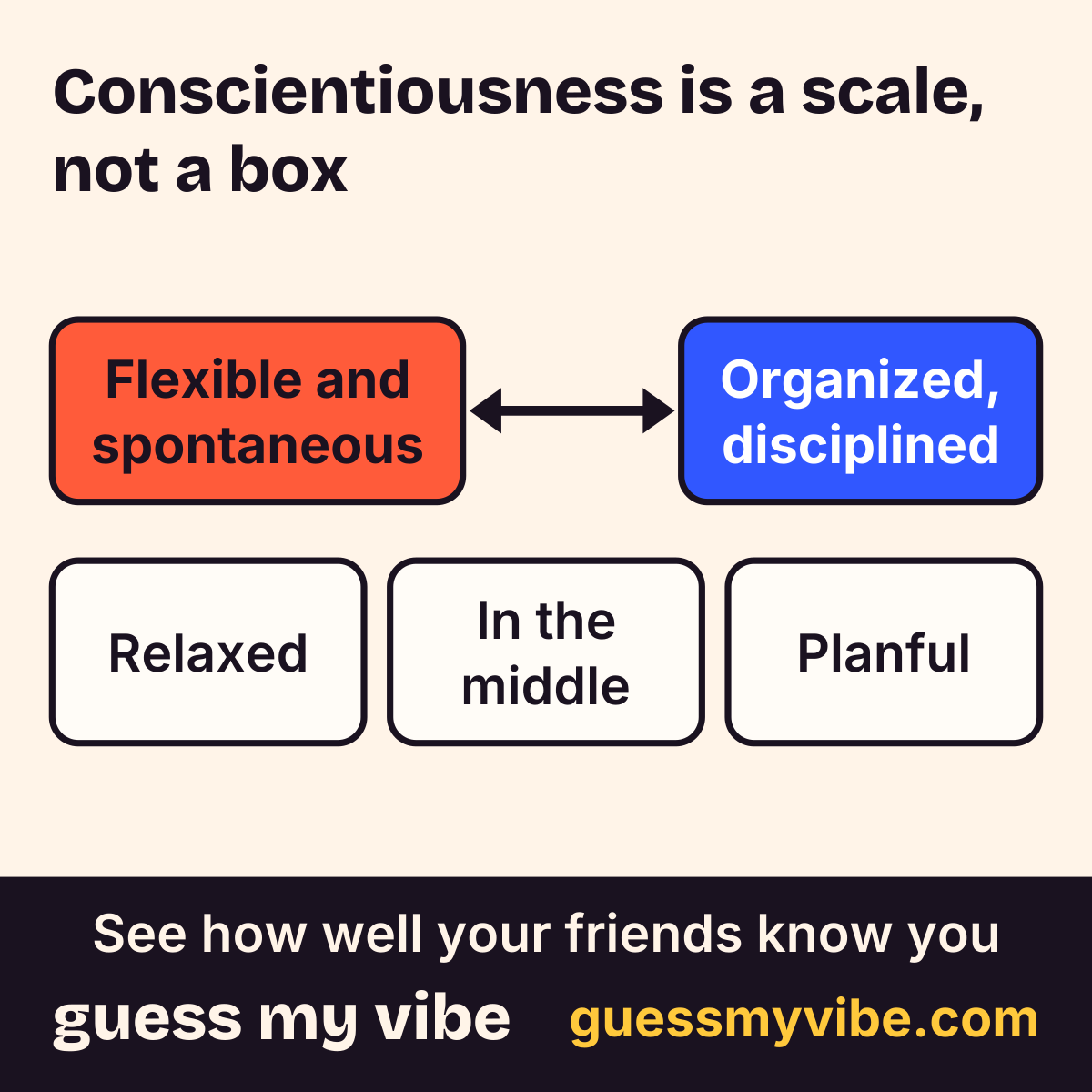
Conscientiousness is the Big Five trait that describes how organized, dependable, hardworking and self-controlled a person tends to be. It is measured on one continuous scale. One end is flexible, spontaneous and relaxed about plans. The other end is tidy, punctual, planful and persistent. Most people land somewhere in the middle, and where you sit is a tendency across many situations, not a rule about every day. In plain words, it is the trait behind "gets things done and follows through". Guess My Vibe calls it Structure.
The scientific name is a little misleading. In everyday English, "conscientious" sounds like "careful about doing the right thing", which is close to kindness or honesty. As researchers use it, the word is about organization and self-discipline. Whether someone is kind belongs to a different Big Five trait, which our article on agreeableness covers. A person can be extremely organized and not especially warm, or warm and chronically disorganized.
Cite this figure
Figure: "Conscientiousness is a scale, not a box." Guess My Vibe (guessmyvibe.com). https://guessmyvibe.com/learn/conscientiousness-meaning#figure-scale-not-a-box
What conscientiousness is made of
Like every Big Five trait, conscientiousness is a summary of things that tend to go together. A factor analysis of 75 facet scales in a community sample of 481 people found that every Big Five domain splits into two distinct but correlated aspects, which sit between the broad trait and its narrow facets [6]. That is why two equally conscientious people can look different. One keeps a spotless desk and a color-coded calendar. Another has a messy room but never misses a deadline.
A meta-analysis of 20 samples looked at specific facets in relation to long life and found the links were strongest for the achievement facet (persistent, industrious) and the order facet (organized, disciplined) [4]. Those two words are a good everyday summary of the trait: pushing through, and keeping things in order.
What conscientiousness goes with
The first, and best studied, link is procrastination. A meta-analysis of 691 correlations found that conscientiousness and its facets, including self-control, distractibility, organization and achievement motivation, were strong and consistent predictors of how much people put things off. Task aversiveness, task delay, low self-efficacy and impulsiveness mattered too [1]. Read that two ways. High scorers tend to start earlier. And procrastination is not only a trait, because how unpleasant a task is matters as much.
School is the next place it shows up. A meta-analysis with cumulative samples of over 70,000 found that academic performance correlated significantly with agreeableness, conscientiousness and openness. Where the researchers could test it, the conscientiousness link was largely independent of intelligence, and once earlier school performance was accounted for, conscientiousness added as much to forecasting later university performance as intelligence did [3]. The paper also found that the size of the links varied with the level of schooling and the age of the students, so it is not one fixed number.
Health habits are a third. A meta-analysis of 194 studies found conscientiousness-related traits were negatively related to every risky health behavior examined, including tobacco use, excessive alcohol use, risky driving and drug use, and positively related to beneficial ones such as healthy diet and activity [2]. A separate review of 20 samples found that higher conscientiousness went with longer life, with a correlation of .11 [4]. That correlation is small. It means conscientiousness is one modest factor among many, not a forecast for any person.
A broader review of studies that followed people over time, limited to those that controlled for background factors, concluded that the effects of personality traits on death, divorce and occupational attainment were indistinguishable in size from the effects of socioeconomic status and cognitive ability [7]. That covers personality in general, not conscientiousness alone. All of these findings are correlations. Nothing here shows that an organized person lives longer because of the organization.
Curious how your friends would answer?
Free. Answer 10 quick questions about you, then send your link. Friends play in their browser, no app needed.
Start freeIs more conscientiousness always better?
Not necessarily. In two workplace samples, the relationship between conscientiousness and job performance was generally curvilinear: it rose, then flattened past a point. The point where the benefit disappeared was lower in simple jobs than in complex ones, which suggests that very high levels helped more in complicated work [5]. That is a hiring-and-performance finding from workplaces, so it should not be stretched into a claim about friendship or happiness. It does show that "more" and "better" are different things.
There is also a short-term cost. In a 12-day study of 48 people who reported on their behavior five times a day, acting conscientiously went with a better mood and less tiredness at that moment, but with more tiredness about three hours later. Whether the person had a goal in mind helped explain the link, and the pattern was not changed by how conscientious the person was as a trait [8]. With 48 people, treat it as an interesting lead. It fits a common experience: a productive day feels good, then you crash.
Does conscientiousness change?
On average, yes, and mostly upward. A meta-analysis of 92 longitudinal samples found that people increase in conscientiousness, along with social dominance and emotional stability, especially in young adulthood, roughly ages 20 to 40 [9]. These are averages across groups of people, so any one person may move more, less or the other way. Our article on whether your personality can change goes further into what moves traits and what does not.
How conscientiousness looks from outside
A trait that shows in habits is one friends can see. A meta-analysis of 263 samples found that other people's ratings of personality carry real information, and that they forecast outcomes such as job performance and achievement beyond what self-ratings alone captured [10]. The paper's headline is that accuracy grows with how well the other person knows you, which is good news for close friends.
One small and fun finding fits the point. In a confirmatory sample of more than 600 people, those who regularly wore a wristwatch scored higher on conscientiousness, and in a third study of 85 people, watch wearers arrived earlier to appointments [11]. A watch is not a personality test, and plenty of organized people never wear one. It simply shows that the trait leaks into small visible habits, which is exactly what a friend notices.
What to do with this
If you score high, the research says your habits probably serve you well, and it also says to watch for rigidity and for the tiredness that follows long runs of productive effort. If you score lower, the research does not say you are doomed to be late. It says that some things, like starting boring tasks, take more deliberate systems. Our article on low conscientiousness covers that end in detail. For a friend or partner on the other end of the scale from you, the useful move is to ask what they actually need, such as a reminder or a shared calendar, rather than to read the difference as a character flaw.
See your Structure through a friend's eyes
Because conscientiousness shows up in habits, a friend can often tell where you sit. Guess My Vibe has a friend guess your answers on Structure and the other traits, then shows you where they landed close and where they missed. It is a fun comparison of your view and theirs, not a measure of the trait.
Key takeaways
- Conscientiousness is a scale from flexible and spontaneous to organized and disciplined. In Guess My Vibe the same trait is called Structure.
- It is made of parts. A longevity review found the links were strongest for the achievement (persistent, industrious) and order (organized, disciplined) facets [4].
- Higher conscientiousness goes with less procrastination across 691 correlations [1], and with healthier behavior across 194 studies [2].
- The links with long life are real but small: a correlation of .11 across 20 samples [4].
- More is not always better. In two workplace samples the benefit of high conscientiousness leveled off, especially in simpler jobs [5].
- This isn't therapy, a diagnosis, or a substitute for professional care.
Questions people ask
What does conscientiousness mean?
It is the Big Five trait describing how organized, dependable, hardworking and self-disciplined a person tends to be. It runs on a continuous scale from flexible and spontaneous to planful and persistent, and most people sit in the middle.
Is conscientiousness the same as being conscientious about doing right?
Not quite. In research the word is about organization and self-discipline, not about being kind or moral. Kindness belongs to a separate Big Five trait, agreeableness.
Is high conscientiousness good?
It goes with less procrastination [1], healthier behavior [2] and better school performance [3]. But in two workplace samples the benefit leveled off at high levels [5], so more is not always better.
Do conscientious people live longer?
On average, a little. A review of 20 samples found a correlation of .11 between conscientiousness and longevity, which is small [4]. It is a correlation, not proof that organization causes long life.
Does conscientiousness change with age?
On average it increases, especially in young adulthood, roughly ages 20 to 40, in a meta-analysis of 92 longitudinal samples [9]. Individual people vary around that average.
Can friends tell how conscientious I am?
Friends' ratings carry real information, and accuracy grows with closeness [10]. A habit like being on time is easy for a friend to see.
See how well your friends know you.
Free. Answer 10 quick questions about you, then send your link. Friends play in their browser, no app needed.
Start freeReferences
- [1] Steel, P. (2007). The nature of procrastination: A meta-analytic and theoretical review of quintessential self-regulatory failure. Psychological Bulletin, 133(1), 65–94. PubMed: 17201571 (opens in a new tab)
- [2] Bogg, T., & Roberts, B. W. (2004). Conscientiousness and health-related behaviors: A meta-analysis of the leading behavioral contributors to mortality. Psychological Bulletin, 130(6), 887–919. PubMed: 15535742 (opens in a new tab)
- [3] Poropat, A. E. (2009). A meta-analysis of the five-factor model of personality and academic performance. Psychological Bulletin, 135(2), 322–338. PubMed: 19254083 (opens in a new tab)
- [4] Kern, M. L., & Friedman, H. S. (2008). Do conscientious individuals live longer? A quantitative review. Health Psychology, 27(5), 505–512. PubMed: 18823176 (opens in a new tab)
- [5] Le, H., Oh, I.-S., Robbins, S. B., Ilies, R., Holland, E., & Westrick, P. (2011). Too much of a good thing: Curvilinear relationships between personality traits and job performance. Journal of Applied Psychology, 96(1), 113–133. PubMed: 20939656 (opens in a new tab)
- [6] DeYoung, C. G., Quilty, L. C., & Peterson, J. B. (2007). Between facets and domains: 10 aspects of the Big Five. Journal of Personality and Social Psychology, 93(5), 880–896. PubMed: 17983306 (opens in a new tab)
- [7] Roberts, B. W., Kuncel, N. R., Shiner, R., Caspi, A., & Goldberg, L. R. (2007). The power of personality: The comparative validity of personality traits, socioeconomic status, and cognitive ability for predicting important life outcomes. Perspectives on Psychological Science, 2(4), 313–345. PubMed: 26151971 (opens in a new tab)
- [8] Leikas, S., & Ilmarinen, V. J. (2017). Happy Now, Tired Later? Extraverted and Conscientious Behavior Are Related to Immediate Mood Gains, but to Later Fatigue. Journal of Personality, 85(5), 603–615. PubMed: 27281444 (opens in a new tab)
- [9] Roberts, B. W., Walton, K. E., & Viechtbauer, W. (2006). Patterns of mean-level change in personality traits across the life course: A meta-analysis of longitudinal studies. Psychological Bulletin, 132(1), 1–25. PubMed: 16435954 (opens in a new tab)
- [10] Connelly, B. S., & Ones, D. S. (2010). An other perspective on personality: Meta-analytic integration of observers' accuracy and predictive validity. Psychological Bulletin, 136(6), 1092–1122. PubMed: 21038940 (opens in a new tab)
- [11] Ellis, D. A., & Jenkins, R. (2015). Watch-wearing as a marker of conscientiousness. PeerJ, 3, e1210. PubMed: 26334540 (opens in a new tab)
How we find and check these sources: how we write. Spotted an error? Report a correction.
Related
- Conscientiousness in Relationships: What the Research Says
- Low Conscientiousness: Costs, Upsides and What Helps
- Big Five Personality Traits: A Plain-Words Guide
- Can Your Personality Change? What the Evidence Shows
- Why Some People Are Always Late
- Agreeableness: The Trait Closeness Barely Helps Friends Read
- Flaky Friends: The Personality Science of Canceling Plans
- Messy Roommate? What a Room Says About Personality
Cite this article
- Title
- Conscientiousness Meaning: What the Trait Is and Isn't
- Publisher
- Guess My Vibe
- Updated
- URL
- https://guessmyvibe.com/
learn/ conscientiousness-meaning
Copy this citation
Guess My Vibe. (2026, October 7). Conscientiousness Meaning: What the Trait Is and Isn't. Guess My Vibe. https://guessmyvibe.com/
To point at one section, add that section's anchor (the # link on its heading) to the URL.