Being always late most plausibly traces to conscientiousness, the Big Five trait behind planning, structure, and follow-through, rather than to how much someone cares about you. People who habitually wear a watch, a simple everyday marker of conscientiousness, have been found to arrive earlier to real appointments than people who don't [1], and the same trait is one of the strongest, most consistent predictors of procrastination in general [2].
Why some people are always late and others never are comes down, most consistently, to one Big Five trait: conscientiousness, the trait behind planning, structure, and follow-through. People who habitually wear a wristwatch, a small everyday marker researchers have used as a conscientiousness signal, were found in one study to arrive significantly earlier to actual appointments than people who don't wear one [1]. The same trait shows up as one of the strongest, most consistent predictors of procrastination generally, across hundreds of studies [2]. Lateness, in other words, usually isn't about a person's feelings. It's a structure problem.
The trait behind chronic lateness
Conscientiousness covers things like organization, self-discipline, planning ahead, and following through on intentions once you've made them. Research connecting it to actual timekeeping behavior, not just self-reported habits, comes from a study on something simpler: wearing a wristwatch. Across an exploratory sample of more than 100 people and a confirmatory sample of more than 600, people who regularly wore a watch scored higher on conscientiousness than people who didn't. A third study went further, measuring real behavior: 85 people's arrival times to an actual appointment, and watch-wearers arrived significantly earlier than non-wearers [1]. That's a small, simple habit (strapping on a watch) connecting to a real, observable outcome (showing up earlier), and it's a reasonable stand-in for the harder-to-study question of lateness directly.
"If they cared, they'd be on time" doesn't hold up
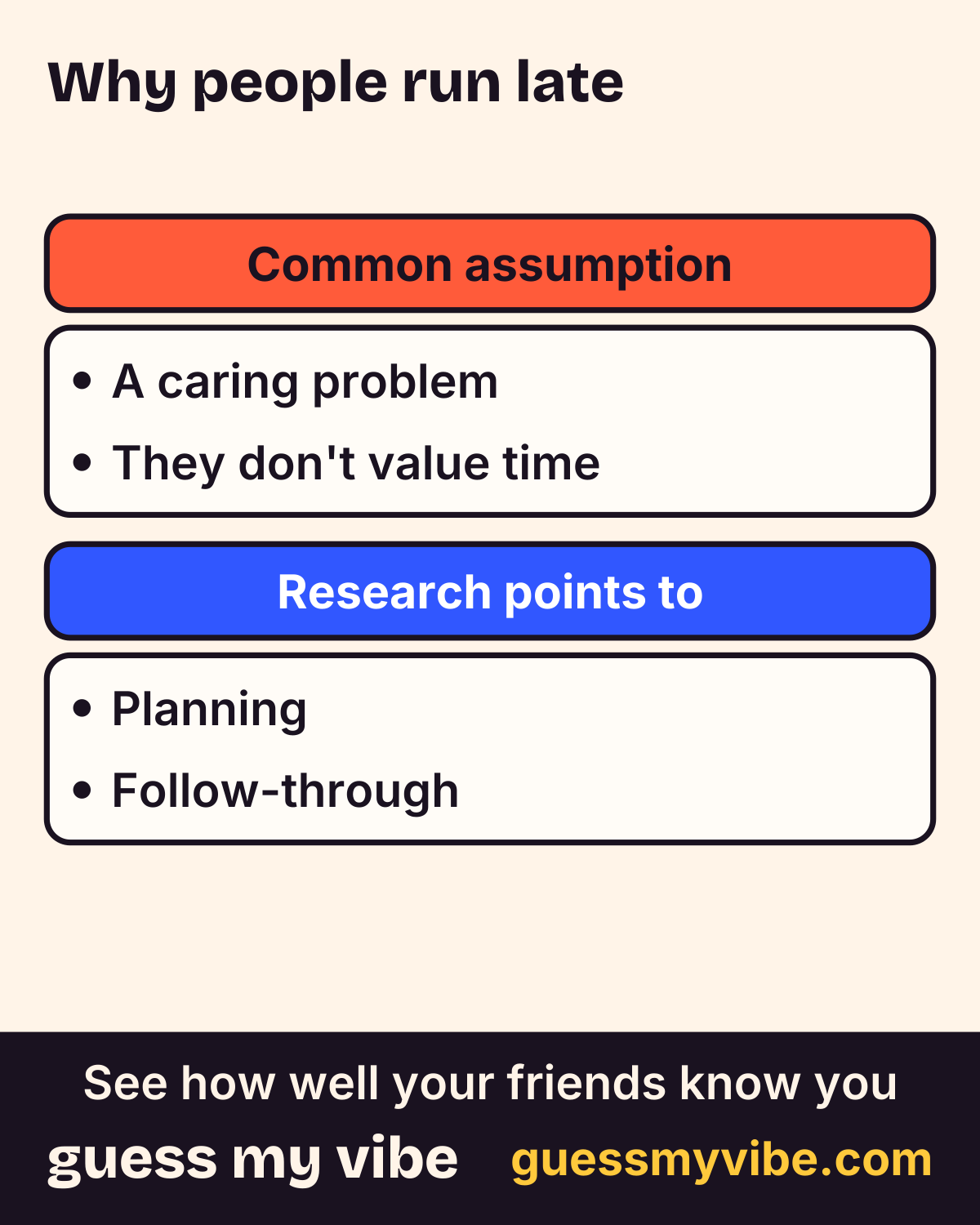
A common assumption treats chronic lateness as a caring problem: if someone really valued your time, they'd manage to show up on time for you. The research on the closest studied pattern, procrastination, points somewhere else. A meta-analysis of 691 correlations looked at what's actually linked to procrastination and found conscientiousness and its specific facets, self-control, distractibility, organization, and achievement motivation, among the strongest and most consistent predictors. Neuroticism, rebelliousness, and sensation-seeking showed only a weak connection [2]. If lateness ran mainly on anxiety, neuroticism would show up as a strong predictor here. They don't. The stronger, more consistent story is about planning and follow-through, a structural skill, not a measure of affection.
Cite this figure
Figure: "Why people run late." Guess My Vibe (guessmyvibe.com). https://guessmyvibe.com/learn/always-late#figure-caring-vs-planning
Lateness and procrastination run on the same engine
The same meta-analysis found other factors mattered too, alongside conscientiousness: how unappealing the task felt (task aversiveness), how far off the deadline was, low confidence in pulling it off, and general impulsiveness [2]. Running late to something follows a similar shape: leaving late because the errand before it felt tedious, misjudging how long getting ready will actually take, or genuinely not believing the consequences of being a few minutes late will matter this time. None of that is a direct study of lateness itself, so it's worth being precise about what's established and what's a reasonable extension: the conscientiousness-and-self-regulation link is well documented for procrastination broadly, and the watch-wearing study above is the most direct evidence connecting the same trait to real-world punctuality specifically.
Curious how your friends would answer?
Free. Answer 10 quick questions about you, then send your link. Friends play in their browser, no app needed.
Start freeDoes chronic lateness get better with age?
There's a reasonable case that it does, on average. A meta-analysis of 92 longitudinal samples found people tend to increase in conscientiousness as they move through adulthood, with the steepest rise happening in young adulthood, roughly ages 20 to 40 [3]. That's a population-level average, not a guarantee for any one person, but it's a genuinely hopeful piece of context for anyone who's spent their twenties being the friend who's always ten minutes behind: the trait most tied to punctuality is one of the ones that tends to improve with time, on average, without anyone having to do anything dramatic about it.
Do your friends actually know you're always late?
Probably, and it's not just a vague reputation. A meta-analysis covering more than 44,000 people found that other people's ratings of someone's personality aren't just a weaker copy of that person's own self-report. Other-ratings had their own predictive validity, meaning they connected to real outcomes, like job performance, independently of what the person said about themselves [4]. A friend who's watched you show up late to the last six things isn't guessing based on a vibe. They've got a real, repeated behavioral track record to go on, which is exactly the kind of evidence this research says other people are reasonably good at using.
Why some people are only late to certain things
A detail that trips people up: someone who's chronically late to brunch can still show up early for a flight or a job interview. That's not a contradiction, and it doesn't mean conscientiousness is the wrong explanation. The same procrastination meta-analysis found task aversiveness, how unappealing a task feels, was one of the strongest factors alongside conscientiousness itself [2]. A flight carries a real, immediate cost for lateness and usually doesn't feel optional. Brunch with a friend who'll wait anyway carries a much softer one. The underlying trait doesn't change by the hour; what changes is how much the specific task pulls against it, which is exactly why "they're never late for work" and "they're always late to see me" can both be true of the same, genuinely conscientious person.
What actually helps, based on the research above
- Treat lateness as a planning problem to engineer around, not a character flaw to fix through willpower alone: build in a buffer before the task you always underestimate, not just before the thing you're late to.
- Make the next step visible to yourself the way a watch makes time visible: a phone alarm set for "leave now", not "event starts now", closes the exact gap the research points to.
- If stress or anxiety isn't the real driver for you, as the research above suggests it usually isn't, look at structure instead: the specific step (getting dressed, finding your keys, the drive itself) that keeps running long.
- If you're the friend waiting, the honest research doesn't back "they don't value my time" as the explanation. It points at planning and follow-through, a frustrating pattern to be on the receiving end of, but a different one to address than a caring problem.
A smaller, daily way to show up on time
A full hangout takes planning, which is exactly the part that trips up a less-structured friend. Guess My Vibe runs on something smaller: a daily round that takes a couple of minutes, with no specific time or place to be late to, so the friend who's always ten minutes behind in person can still show up for the thing that actually keeps a friendship going day to day.
Key takeaways
- People who habitually wear a wristwatch score higher in conscientiousness, and in a separate study, watch-wearers arrived significantly earlier to real appointments than non-wearers did [1].
- A meta-analysis of 691 correlations found conscientiousness and its facets (self-control, distractibility, organization, achievement motivation) were among the strongest, most consistent predictors of procrastination, while neuroticism, rebelliousness, and sensation seeking were only weakly connected [2].
- People tend to increase in conscientiousness on average across young adulthood, especially between ages 20 and 40, which suggests chronic lateness often eases somewhat with time, though not for everyone [3].
- Other people's ratings of someone's personality aren't just a weaker copy of their own self-report; they independently track real outcomes, part of why a friend's "you're always late" observation is reasonably trustworthy data, not just a vague impression [4].
- This isn't therapy, a diagnosis, or a substitute for professional care.
Questions people ask
Is being late a sign someone doesn't care about you?
The research doesn't back that up. A large meta-analysis found the strongest, most consistent predictors of procrastination (a closely related pattern) were conscientiousness and its facets, not neuroticism, rebelliousness, or sensation seeking, which were only weakly connected [2]. Lateness tracks more with planning and follow-through than with how much someone values you.
Can someone who's always late actually become more punctual?
The trait most tied to punctuality, conscientiousness, tends to rise on average across young adulthood, especially between ages 20 and 40, so it often gets at least somewhat better with time on its own [3]. The watch study only compared watch-wearers with non-wearers, so it doesn't show a watch itself fixes lateness, but structural fixes like making the next step visible target the same planning gap [1].
Is there real research linking personality to punctuality?
Yes, though the most specific study on this exact question wasn't accessible to verify directly. The best available direct evidence comes from a study on wristwatch habits: people who regularly wear a watch score higher in conscientiousness, and in a follow-up study, watch-wearers arrived significantly earlier to real appointments than non-wearers [1].
Do people get less late as they get older?
On average, yes. A meta-analysis of 92 longitudinal samples found conscientiousness, the trait most linked to planning and follow-through, rises across adulthood, with the steepest increase in young adulthood [3]. That's a population average, not a guarantee for any one person.
Can friends really tell who's going to be late?
Usually, yes, and it's not just a vague impression. Research on how accurately people judge each other's personality found other-ratings independently track real outcomes, beyond what someone says about themselves [4]. A friend's read on your lateness is built on a real, repeated track record, not a guess.
See how well your friends know you.
Free. Answer 10 quick questions about you, then send your link. Friends play in their browser, no app needed.
Start freeReferences
- [1] Ellis, D. A., & Jenkins, R. (2015). Watch-wearing as a marker of conscientiousness. PeerJ, 3, e1210. PubMed: 26334540 (opens in a new tab)
- [2] Steel, P. (2007). The nature of procrastination: A meta-analytic and theoretical review of quintessential self-regulatory failure. Psychological Bulletin, 133(1), 65–94. PubMed: 17201571 (opens in a new tab)
- [3] Roberts, B. W., Walton, K. E., & Viechtbauer, W. (2006). Patterns of mean-level change in personality traits across the life course: A meta-analysis of longitudinal studies. Psychological Bulletin, 132(1), 1–25. PubMed: 16435954 (opens in a new tab)
- [4] Connelly, B. S., & Ones, D. S. (2010). An other perspective on personality: Meta-analytic integration of observers' accuracy and predictive validity. Psychological Bulletin, 136(6), 1092–1122. PubMed: 21038940 (opens in a new tab)
How we find and check these sources: how we write. Spotted an error? Report a correction.
Related
- Flaky Friends: The Personality Science of Canceling Plans
- Friendship Psychology: What the Research Actually Says
- How to Make Friends as an Adult
- How to Make Friends in College
- Conscientiousness in Relationships: What the Research Says
- Conscientiousness Meaning: What the Trait Is and Isn't
- Low Conscientiousness: Costs, Upsides and What Helps
Cite this article
- Title
- Why Some People Are Always Late
- Publisher
- Guess My Vibe
- Updated
- URL
- https://guessmyvibe.com/
learn/ always-late
Copy this citation
Guess My Vibe. (2026, October 3). Why Some People Are Always Late. Guess My Vibe. https://guessmyvibe.com/
To point at one section, add that section's anchor (the # link on its heading) to the URL.