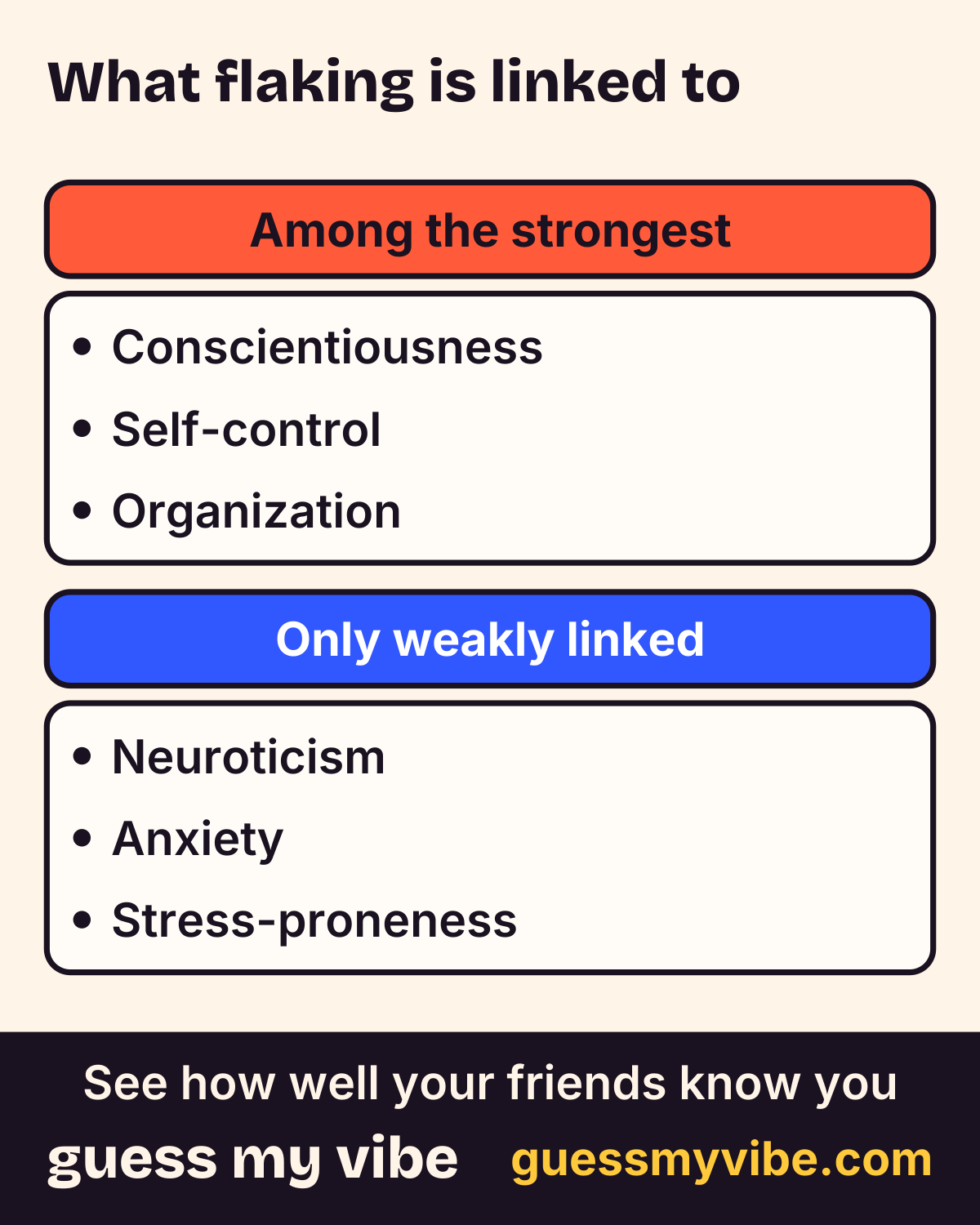
Being flaky, canceling plans or backing out last minute, is linked in personality research mostly to conscientiousness (the trait behind structure, follow-through, and self-control), not to how much someone cares about you. A large meta-analysis found conscientiousness and its facets were among the strongest, most consistent predictors of this kind of self-regulatory slip, while anxiety and stress were only weakly connected [1].
Flaky gets thrown around as a character judgment, but the research behind it points somewhere more specific and a lot less personal: canceling plans, especially last minute, tracks closely with one Big Five trait, conscientiousness, the one behind structure, follow-through, and self-control. It has less to do with how much someone values the friendship than popular opinion assumes, and it's worth looking at the actual evidence before deciding what a canceled plan says about anyone.
What being flaky is actually about
A large meta-analysis pulling together 691 correlations looked at what's actually linked to procrastination, the broader pattern that canceling plans at the last minute usually falls under. The strongest and most consistent predictors were conscientiousness and its specific facets: self-control, distractibility, organization, and achievement motivation, alongside how unappealing the task felt, how far off the deadline was, low confidence in pulling it off, and general impulsiveness. Neuroticism, rebelliousness, and sensation-seeking only showed a weak connection [1].
That last part is worth sitting with, because it cuts against a common assumption. It's easy to guess that someone who flakes a lot must be more anxious or overwhelmed underneath it. The evidence here says structure and self-control explain a lot more of the pattern than stress does. Flaking on plans looks more like a self-regulation habit than a window into how someone secretly feels.
The same meta-analysis found the pattern fits a specific model of why delay happens: people tend to weigh how much they want to do something against how confident they are they'll pull it off, then discount all of that more steeply the further away it is in time. A plan two weeks out barely gets discounted at all; the same plan tonight gets discounted hard the moment something more appealing or less effortful shows up [1]. That's a mechanism, not an excuse, but it explains why "just commit more" rarely works as advice on its own.
Cite this figure
Figure: "What flaking is linked to." Guess My Vibe (guessmyvibe.com). https://guessmyvibe.com/learn/flaky-friend#figure-what-flaking-links-to
Why everyone cancels plans sometimes
Part of what the procrastination research captures is how a plan feels different up close than it did when you made it, and it's worth remembering that before writing off a friend who bails. A plan made a week out costs nothing to agree to. The same plan, the night before, competes with how tired you actually are, how unappealing it suddenly feels, and whatever else is now due sooner. That gap between the far-off plan and the close-up one is exactly the kind of task delay and task aversiveness the meta-analysis above found is linked to bailing. It happens to almost everyone sometimes; the difference between people is how often, not whether.
Curious how your friends would answer?
Free. Answer 10 quick questions about you, then send your link. Friends play in their browser, no app needed.
Start freeDoes flakiness change as people get older?
Often, yes. A meta-analysis of 92 longitudinal samples tracking personality over the lifespan found that people increase, on average, in conscientiousness, especially in young adulthood, roughly ages 20 to 40 [2]. Since conscientiousness is the trait most tied to following through on plans, a pattern of flaking that feels constant at 19 isn't necessarily a fixed trait. For a lot of people, it's a stage that structure and self-control catch up to over time, not a permanent setting.
The small habits linked to showing up
One small, specific study makes the structure link concrete. Comparing people who regularly wear a wristwatch to those who don't, across an exploratory sample of over 100 people and a confirmatory sample of over 600, watch-wearers scored higher on conscientiousness. In a third study of 85 people, watch-wearers also arrived significantly earlier to appointments than non-wearers [4]. Nobody needs to start wearing a watch to keep plans, but the finding points at something useful: small, visible habits that track time and structure tend to travel with the same trait that's linked to actually showing up.
Your friends can usually tell
A pattern of canceling plans isn't as private as it might feel. A meta-analysis of 263 samples and more than 44,000 people found that friends' ratings of someone's personality, including conscientiousness-related behavior like being organized and reliable, agree with that person's own self-rating at a real, meaningful level, not just by chance [3]. The same research found that agreement gets noticeably stronger the closer the two people actually are, since real closeness gives someone more chances to notice the pattern than a passing acquaintance ever gets. A flaky pattern, in other words, tends to be visible to the people around you well before anyone says it out loud, and a close friend is usually the first to clock it.
A few things that actually help, based on the mechanism above
- Lock plans in closer to the day, not weeks out, since the research above ties flaking to how steeply a far-off plan gets discounted as it gets closer.
- Make the plan itself smaller and lower-effort, since task aversiveness (how unappealing the thing feels) was one of the strongest predictors of bailing.
- Put it somewhere visible, a calendar, a reminder, the same kind of structure-supporting habit the watch-wearing study points to, rather than trusting memory alone.
- If you're going to cancel, say so earlier rather than later. It won't undo the letdown, but it respects the other person's time in a way a last-minute no-show doesn't.
What this isn't
None of this is a reason to treat canceling plans as proof of anything about a person's character or how much they care. The research above links flaking to a trait and a set of habits, structure, self-control, task aversiveness, not to affection or loyalty. Someone can be a genuinely good friend and still be the one who bails more often than the group would like; the useful move is noticing the pattern with a little curiosity, not turning it into a label, and definitely not a diagnosis.
Lower the cost of showing up
Part of why plans get canceled is that a full hangout is a real commitment on a day that didn't plan for one. Guess My Vibe runs on something smaller: a daily round that takes a couple of minutes, so there's a lot less to cancel and a lot less to feel bad about skipping, for whichever one of you is more likely to flake on the bigger plan.
Key takeaways
- A meta-analysis of 691 correlations found conscientiousness and its facets (self-control, distractibility, organization, achievement motivation) were among the strongest, most consistent predictors of flaking on plans and other follow-through failures [1].
- The same research found neuroticism (anxiety, stress-proneness) only weakly connected, which pushes back on the common assumption that someone who's flaky is secretly more stressed than everyone else [1].
- Conscientiousness tends to rise with age, especially in young adulthood, so flakiness that feels constant in your early twenties often eases on its own over time [2].
- Friends' ratings of how organized and reliable someone is agree with that person's own self-rating at a real, meaningful level, so a flaky pattern is usually visible to the people around you, whether or not it's ever named out loud [3].
- This isn't therapy, a diagnosis, or a substitute for professional care.
Questions people ask
Is being flaky a personality trait?
It's linked to one: conscientiousness, the Big Five trait behind structure, follow-through, and self-control. A large meta-analysis found conscientiousness and its facets were among the strongest predictors of the kind of last-minute bailing "flaky" describes [1].
Does being flaky mean someone doesn't care about the friendship?
Not based on the research. The strongest predictors of flaking on plans were structure and self-control, not affection or stress. A flaky pattern says more about habits and follow-through than about how much someone values the friendship [1].
Is flakiness really about being anxious or overwhelmed?
The evidence doesn't support that as strongly as people assume. The same meta-analysis found neuroticism (anxiety, stress-proneness) only weakly connected to procrastination and follow-through failures, while conscientiousness was a far stronger and more consistent predictor [1].
Does someone get less flaky as they get older?
Often, yes. Personality research tracking people over time found conscientiousness rises on average, especially between ages 20 and 40, which is the trait most tied to following through on plans [2].
Can friends tell if someone is flaky, or does it go unnoticed?
Friends tend to notice. Research on how accurately people judge each other found friends' ratings of how organized and reliable someone is agree with that person's own self-rating at a real, meaningful level, not just by chance [3].
See how well your friends know you.
Free. Answer 10 quick questions about you, then send your link. Friends play in their browser, no app needed.
Start freeReferences
- [1] Steel, P. (2007). The nature of procrastination: A meta-analytic and theoretical review of quintessential self-regulatory failure. Psychological Bulletin, 133(1), 65–94. PubMed: 17201571 (opens in a new tab)
- [2] Roberts, B. W., Walton, K. E., & Viechtbauer, W. (2006). Patterns of mean-level change in personality traits across the life course: A meta-analysis of longitudinal studies. Psychological Bulletin, 132(1), 1–25. PubMed: 16435954 (opens in a new tab)
- [3] Connelly, B. S., & Ones, D. S. (2010). An other perspective on personality: Meta-analytic integration of observers' accuracy and predictive validity. Psychological Bulletin, 136(6), 1092–1122. PubMed: 21038940 (opens in a new tab)
- [4] Ellis, D. A., & Jenkins, R. (2015). Watch-wearing as a marker of conscientiousness. PeerJ, 3, e1210. PubMed: 26334540 (opens in a new tab)
How we find and check these sources: how we write. Spotted an error? Report a correction.
Related
- How to Make Friends: What the Research Says
- How to Be a Good Friend, According to Research
- One-Sided Friendship: What the Research Actually Finds
- Long Distance Friendship: Does It Actually Last?
- Introvert vs Extrovert: What the Research Actually Shows
- Conscientiousness in Relationships: What the Research Says
- Conscientiousness Meaning: What the Trait Is and Isn't
- Low Conscientiousness: Costs, Upsides and What Helps
Cite this article
- Title
- Flaky Friends: The Personality Science of Canceling Plans
- Publisher
- Guess My Vibe
- Updated
- URL
- https://guessmyvibe.com/
learn/ flaky-friend
Copy this citation
Guess My Vibe. (2026, October 3). Flaky Friends: The Personality Science of Canceling Plans. Guess My Vibe. https://guessmyvibe.com/
To point at one section, add that section's anchor (the # link on its heading) to the URL.