Team dynamics are the patterns in how team members work with and feel about each other, and personality mix appears to shape them. In a study of 652 employees in 51 work teams, teams higher in conscientiousness, agreeableness, extraversion and emotional stability got higher supervisor ratings for performance, and extraversion and emotional stability were linked to team viability through social cohesion [1].
Team dynamics is the study of how the people on a team interact, how they feel about each other, and how that adds up to outcomes. One of the clearest studies looked at 652 employees in 51 work teams and measured their ability and personality, how socially cohesive each team was, and how the team did. Teams higher in conscientiousness, agreeableness, extraversion and emotional stability received higher supervisor ratings for performance, and extraversion and emotional stability were linked to team viability through social cohesion [1]. In short, who is on the team is linked to how the team works, though the story has several twists.
This article is about personality composition, cohesion and the evidence on both. If your question is about a group project where someone is not pulling their weight, we cover that in separate articles on group projects and social loafing.
What team dynamics means in research
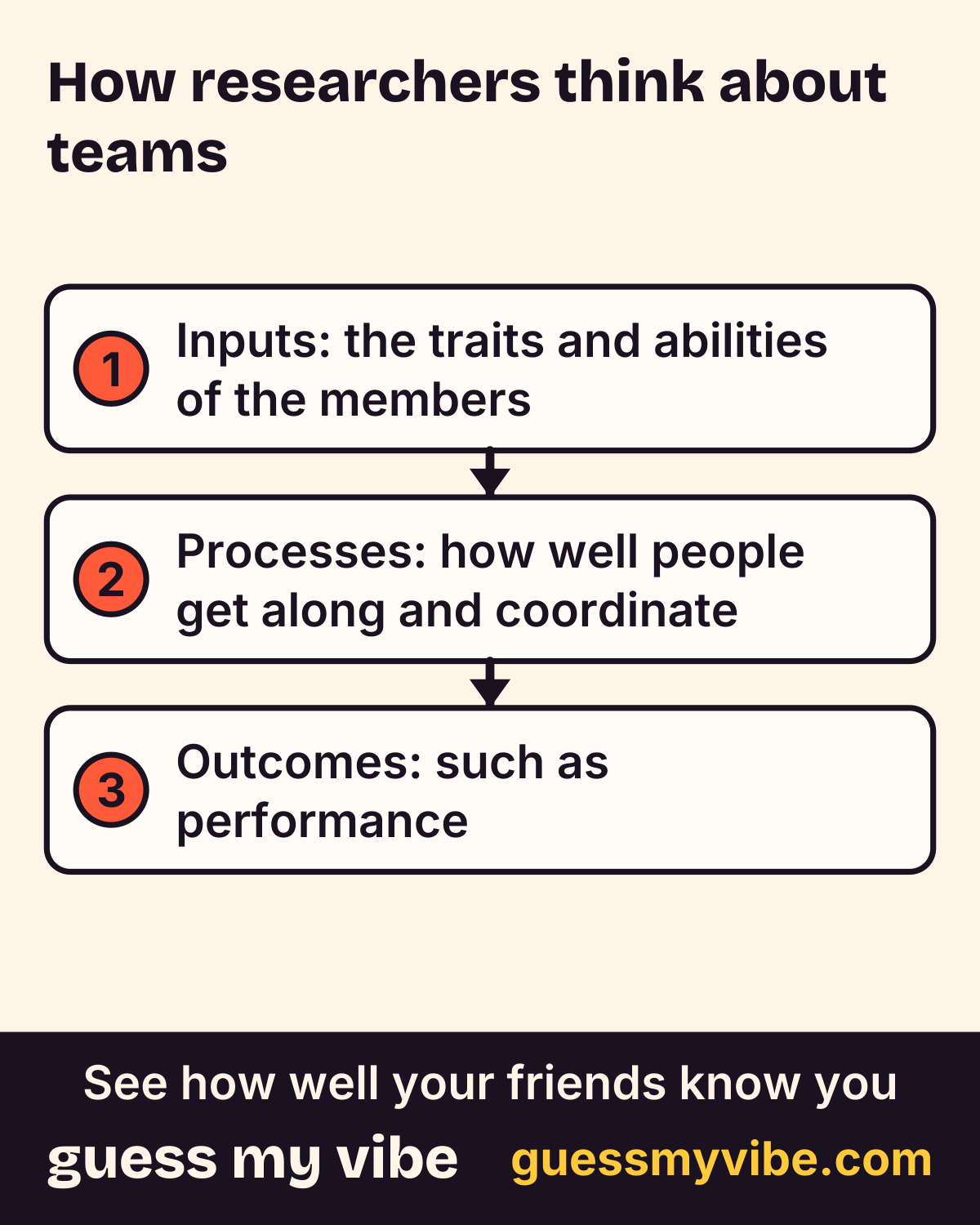
Researchers often think about teams in three steps. Inputs, such as the traits and abilities of the members, shape processes, such as how well people get along and coordinate, and the processes shape outcomes, such as performance. The 1998 study was built on that logic. It tested team composition (ability and personality), a team process (social cohesion) and two outcomes (team viability and team performance) [1].
Viability is a term worth explaining. It is usually understood as whether a team can stay together and keep working well, for example whether members would want to continue as a group. In that study, both viability and performance were rated by supervisors, which is a useful real-world view and also a limit, since supervisors can be biased and see only part of what happens [1].
Cite this figure
Figure: "How researchers think about teams." Guess My Vibe (guessmyvibe.com). https://guessmyvibe.com/learn/team-dynamics#figure-inputs-processes-outcomes
How the team's personality mix was measured
A team does not have a single personality, so the researchers had to turn individual scores into team scores. They used four methods, the mean (the average member), the variance (how different the members are from each other), the minimum (the lowest-scoring member) and the maximum (the highest-scoring member) [1]. The choice matters, because one team with an average level of agreeableness can have everyone sitting near the middle, and another can have two very warm people and one very cold one.
The study's abstract reports that teams higher in general mental ability, conscientiousness, agreeableness, extraversion and emotional stability received higher supervisor ratings for team performance. For viability, teams higher in general mental ability, extraversion and emotional stability were rated higher [1]. The abstract does not say which of the four scoring methods went with which trait, so we cannot tell you whether the weakest member or the average was doing the work for any one of them. It also describes teams that scored higher, not a cause, so it does not show that changing a team's mix would change its outcomes.
A meta-analysis of the team composition literature helps with the scoring question. The analysis found that the strength of the relationships depended on the study setting, lab or field, and on how the team composition variable was built. In field studies of real teams, team minimum agreeableness and team mean conscientiousness, openness to experience, collectivism and preference for teamwork emerged as strong predictors of team performance, while in lab settings the personality effects were negligible [2]. Together the two papers suggest two things. Personality seems to matter more in real, ongoing teams than in short lab tasks, and the weakest link may deserve attention as well as the average.
Curious how your friends would answer?
Free. Answer 10 quick questions about you, then send your link. Friends play in their browser, no app needed.
Start freeCohesion: the part between personality and outcomes
In the 1998 study, extraversion and emotional stability were associated with viability through social cohesion [1]. That is a reasonable picture of how a trait could shape a team. A steady, sociable person may help a team feel like a team, and a team that feels like one is a team people want to stay on. The study design is correlational, so the pathway is a pattern in the data and not proof of cause.
Does a closer team perform better? A later meta-analysis says it depends. Correlations between cohesion and performance were stronger when performance was defined as behavior and not as outcome, when it was measured with efficiency and not effectiveness measures, and as patterns of team workflow became more intensive. The three main components of cohesion were also each independently related to the various performance domains [3]. One reasonable reading is that a team that works side by side all day has more to gain from getting along than a team of people who hand off pieces of a task and rarely interact. And a close team is not automatically a high-performing one.
The "smart team" idea and why it is contested
A widely discussed 2010 paper took a different angle, and it deserves a mention because you will see it online. In two studies with 699 people working in groups of two to five, the authors reported a general collective intelligence factor that explained a group's performance across a wide variety of tasks. It was not strongly correlated with the average or maximum individual intelligence of the members. It was correlated with the average social sensitivity of members, with equality in how conversational turns were distributed, and with the proportion of women in the group [4].
The finding is appealing, because it suggests that a team of average people who listen and take turns can beat a team of stars. It is also contested. A re-analysis of six previously published samples concluded that the general factor explains only little variance in performance on many group tasks, that two statistical artifacts may have inflated the covariation that exists, and that support for the construct is insufficient [5]. Treat the idea as an interesting hypothesis, not a settled rule. The more modest point that turn-taking and social sensitivity are worth paying attention to is easier to defend from the other studies in this article, but that is our reading and not something those papers tested directly.
What this means for a team you are on
Group-level research describes patterns across many teams, and it does not tell you what any one person on your team is like. With that caution, a few practical ideas follow from the evidence. They are our reasoning and not tested interventions.
- Look at the weakest link before the average. In the field studies, team minimum agreeableness (the score of the least agreeable member) emerged as a strong predictor of team performance, so it is worth looking at the weakest fit and not only the average [2].
- Treat reliability and follow-through as a team asset. Team conscientiousness was linked to better supervisor-rated performance in work teams [1], and its team average was among the strong predictors in the field studies [2].
- Invest in cohesion in proportion to how closely people work together. The cohesion and performance link was stronger as workflow became more intensive [3].
- Watch who gets to talk. Even if the collective intelligence idea is contested [5], an evenly shared conversation is a cheap thing to try, and it needs no personality test.
- Don't label teammates from a trait. Team averages and minimums are statistical summaries, and the same person can be a very different teammate in a different team.
One more idea. Many team problems start with two people having different pictures of each other. If you work with friends, or want a team that starts with real trust, Guess My Vibe gives you and a friend a daily round where you each guess how the other would answer. It is a low-pressure way to find out how well you read each other before a deadline makes it matter.
Key takeaways
- In 51 work teams, teams higher in general mental ability, conscientiousness, agreeableness, extraversion and emotional stability received higher supervisor ratings for team performance [1].
- Extraversion and emotional stability were linked to team viability through social cohesion, which fits a picture in which personality is tied to how teammates feel about each other, though the pattern is correlational [1].
- How you combine members' scores matters. A meta-analysis found the strength of composition effects depended on the setting (lab or field) and on how the team score was built [2].
- Cohesion is linked to performance, but more strongly for some definitions of performance than others, and more as team workflow becomes more intensive [3].
- A much-publicized idea that groups have a general intelligence tied to turn-taking and social sensitivity [4] has been questioned by a re-analysis that found weak support [5].
- This isn't therapy, a diagnosis, or a substitute for professional care.
Questions people ask
What are team dynamics?
Team dynamics are the patterns in how members interact, how cohesive they feel and how that relates to performance. Research on 51 work teams tested links among team composition (ability and personality), social cohesion, viability and performance [1].
Which personality traits make a good team?
In 51 work teams, teams higher in conscientiousness, agreeableness, extraversion and emotional stability received higher supervisor ratings for performance [1]. A meta-analysis of field studies pointed to team minimum agreeableness and team mean conscientiousness, openness, collectivism and preference for teamwork as strong predictors [2].
Does team cohesion improve performance?
It depends on how you define performance. A meta-analysis found stronger correlations when performance was defined as behavior rather than outcome, when measured by efficiency rather than effectiveness, and as workflow became more intensive [3].
Is a team of very smart people better than a team of average people?
Not necessarily on measures of general ability alone. One widely discussed study found a group performance factor that was not strongly tied to the average or maximum intelligence of members [4], but a re-analysis of six samples found the evidence for that factor weak [5]. The question is not settled.
Can you build a team from personality scores?
Not with confidence. The studies describe group-level patterns, and their findings depended on the setting and on how team scores were calculated [2]. They also did not test whether changing a team's mix improves its outcomes.
See how well your friends know you.
Free. Answer 10 quick questions about you, then send your link. Friends play in their browser, no app needed.
Start freeReferences
- [1] Barrick, M. R., Stewart, G. L., Neubert, M. J., & Mount, M. K. (1998). Relating member ability and personality to work-team processes and team effectiveness. Journal of Applied Psychology, 83(3), 377-391. doi.org/10.1037/0021-9010.83.3.377 (opens in a new tab)
- [2] Bell, S. T. (2007). Deep-level composition variables as predictors of team performance: A meta-analysis. Journal of Applied Psychology, 92(3), 595–615. PubMed: 17484544 (opens in a new tab)
- [3] Beal, D. J., Cohen, R. R., Burke, M. J., & McLendon, C. L. (2003). Cohesion and performance in groups: A meta-analytic clarification of construct relations. Journal of Applied Psychology, 88(6), 989-1004. PubMed: 14640811 (opens in a new tab)
- [4] Woolley, A. W., Chabris, C. F., Pentland, A., Hashmi, N., & Malone, T. W. (2010). Evidence for a collective intelligence factor in the performance of human groups. Science, 330(6004), 686-688. PubMed: 20929725 (opens in a new tab)
- [5] Crede, M., & Howardson, G. (2017). The structure of group task performance: A second look at 'collective intelligence': Comment on Woolley et al. (2010). Journal of Applied Psychology, 102(10), 1483-1492. PubMed: 29016184 (opens in a new tab)
How we find and check these sources: how we write. Spotted an error? Report a correction.
Related
- Group Projects: Why They Go Wrong and Who Does the Work
- Social Loafing: Why People Slack Off in Groups
- Work Friends: What Research Says About Friendships at Work
- Annoying Coworker: Why Personality Clashes Happen at Work
- Agreeableness: The Trait Closeness Barely Helps Friends Read
- Emotional Stability: What It Means and Why It Helps Friends
- Emergent Leadership: Who Becomes the Leader in a Group?
Cite this article
- Title
- Team Dynamics: How Personality Mix Shapes a Team
- Publisher
- Guess My Vibe
- Updated
- URL
- https://guessmyvibe.com/
learn/ team-dynamics
Copy this citation
Guess My Vibe. (2026, October 4). Team Dynamics: How Personality Mix Shapes a Team. Guess My Vibe. https://guessmyvibe.com/
To point at one section, add that section's anchor (the # link on its heading) to the URL.