Emergent leadership is when someone becomes the leader of a group without being appointed, and research points most consistently at extraversion as the personality trait that goes with it. A meta-analysis of 73 samples found extraversion the most consistent Big Five correlate of leadership, across leader emergence and leader effectiveness combined [1]. But who emerges is not always who leads best, and the effect can fade as the group works together.
Emergent leadership is what happens when a group with no assigned leader ends up with one anyway: the person who starts organizing the group project, runs the meeting, or just becomes the one everyone looks to. Research on who becomes a leader finds a fairly consistent answer at the top, extraversion, and a more interesting one underneath: dominant people are rated as more competent even after their actual abilities are accounted for, and an early status advantage can wear off. This article explains what studies show about who emerges, why, and how to read the findings without turning them into a stereotype.
What emergent leadership is, and why it differs from being appointed
An appointed leader has the job because someone gave it to them. An emergent leader has influence because the group gave it informally: through who talks, who proposes the plan, who others defer to. This happens in college project groups, new teams, roommate households and friend groups deciding where to go for dinner. It is not the same as being a good leader, a distinction that comes up repeatedly below, because the traits that help a person get noticed are not guaranteed to be the traits that help a group do well.
Who becomes a leader: the Big Five picture
The broadest evidence is a meta-analysis that combined 222 correlations from 73 samples to relate the Big Five personality traits to leadership. The overall correlations were extraversion .31, conscientiousness .28, openness .24, neuroticism negative .24 (so lower neuroticism went with more leadership), and agreeableness .08 [1]. Those are modest relationships, not strong ones: extraversion explains only a portion of why anyone ends up leading.
Two points make the result more useful. Extraversion was the most consistent correlate of leadership across settings and across both outcomes studied, leader emergence and leader effectiveness. And for neuroticism, extraversion, openness and conscientiousness, more than 90% of the individual correlations were above zero, which the authors describe as the relationships generalizing [1]. Note that these figures combine emergence and effectiveness, so they don't isolate who steps up in leaderless groups, and they come from a range of study settings rather than one kind of group. Agreeableness had the weakest correlation of the five traits.
A study of status in real social groups points the same way. In three studies of fraternity, sorority and dormitory groups, high extraversion substantially went with higher status, meaning the respect, influence and prominence a member had in others' eyes, for both sexes, while high neuroticism went with lower status in men [5]. Status is related to leadership but not identical to it, so read this as a nearby result.
Why dominant people emerge: looking competent
A puzzle in this field is why dominant, assertive people so often gain influence, when most theories say you need real skills to earn it. One answer comes from two studies of task groups. People higher in trait dominance were rated as more competent by fellow group members, by outside observers and by research staff, even after the researchers controlled for individuals' actual abilities. They also performed more competence-signaling behaviors, and those behaviors were linked to the competence ratings [2].
In plain words, behaviors that signal competence, such as speaking up with confidence, went with being rated as more competent. The authors proposed that this can happen even when competence is lacking, but the ratings were controlled for measured ability rather than shown to be unearned. A large meta-analysis of status research reached a similar overall picture. Looking across more than 100 years of work, 1,064 effects from 276 samples with 56,153 participants, the authors found correlations largely in line with a path they call micropolitics, meaning that people gain status by enhancing their apparent competence or virtue, through behaving assertively, being extraverted or self-monitoring. They found tentative support for competence and virtue paths and only partial support for a dominance path, and the moderator analyses were mixed and inconclusive [6]. Leadership emergence was one of the outcomes pooled in that review, along with respect, influence and popularity.
Curious how your friends would answer?
Free. Answer 10 quick questions about you, then send your link. Friends play in their browser, no app needed.
Start freeThe emergent-leader advantage can fade
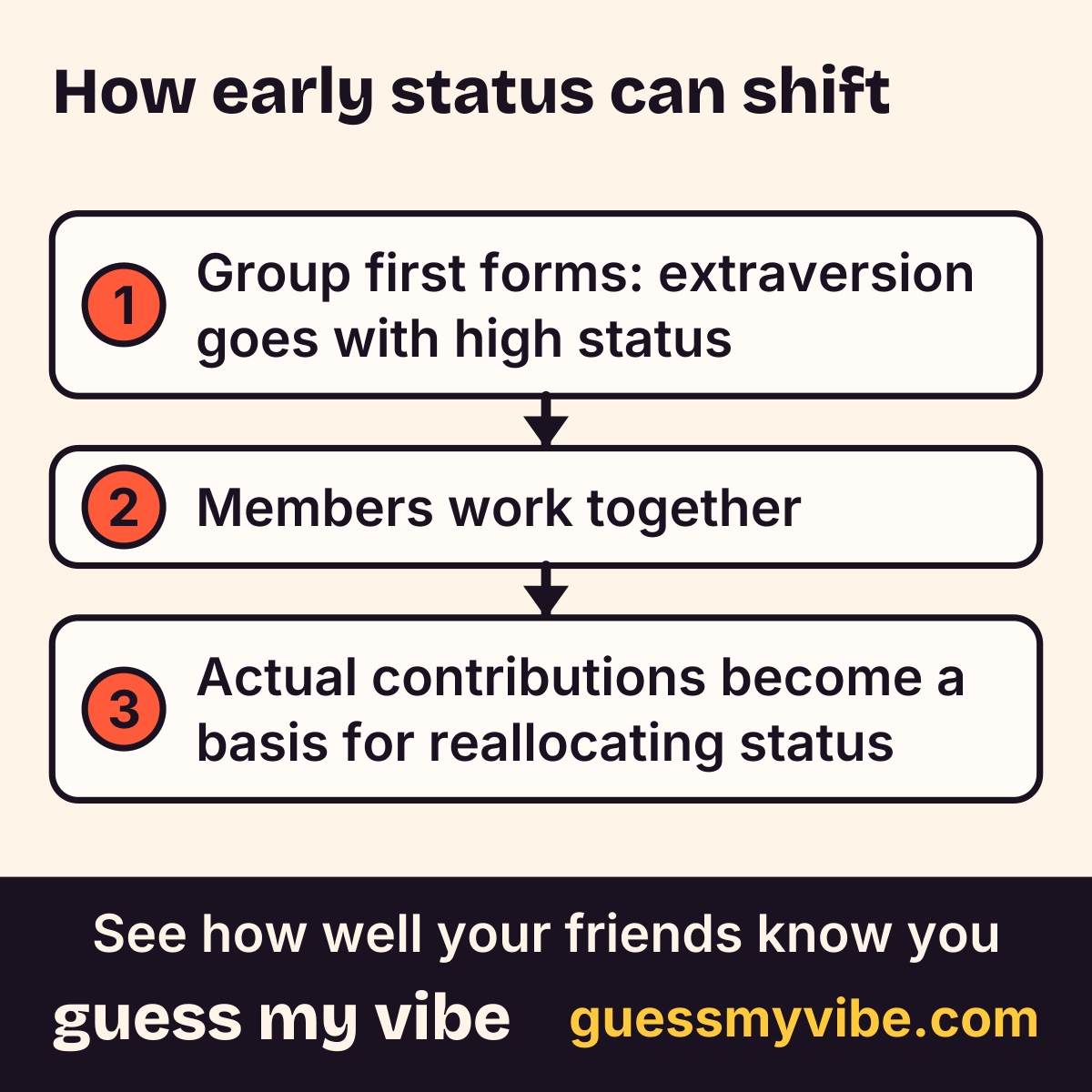
Here the research gets more interesting for anyone who has seen the loudest person lose steam. Two studies on newly formed task groups, one in the field and one an experiment, found that extraversion is associated with high status when a group first forms, but over time extraversion was associated with status losses and with disappointing expectations for contributions to the group task. Neuroticism, which tends to go with lower status at first, was associated with status gains from surpassing expectations [3].
The authors' explanation is that personality can shape status through perceived competence when a group first forms, but as members work together interdependently, actual contributions become an important basis for reallocating status [3]. That doesn't mean extraverts are bad leaders or anxious people are good ones. It means first impressions set the early order, and what people really do can reset it. The abstract doesn't give effect sizes, so how large the shifts were is not something we can report.
Cite this figure
Figure: "How early status can shift." Guess My Vibe (guessmyvibe.com). https://guessmyvibe.com/learn/emergent-leadership#figure-status-can-shift
More assertive is not always better
One last complication is assertiveness. Three studies, using qualitative and quantitative approaches, found support for the idea that people seen as markedly low in assertiveness or as high in assertiveness were generally appraised as less effective leaders. The authors link this to a tradeoff: high assertiveness worsens relationships, while low assertiveness limits goal achievement [4]. That is about perceived effectiveness, not who emerges, but it hints at why the boldest person in the room does not always get to stay in charge.
What this means if you want to lead, or avoid being overlooked
A few practical takeaways follow, kept inside what the studies support. They are our reading of the evidence, not tested advice.
- Speak early, and make it useful. Competence-signaling behaviors went with higher competence ratings [2], so, as our suggestion, offering a concrete plan early gives the group something to judge you on.
- Contribute where it counts. Status shifted toward people who contributed to the task over time [3], so doing real work is how a quiet member can gain standing.
- Watch the balance. Too little assertiveness limits goals and too much strains relationships [4].
- Don't assume the person who emerged is the best fit. Emergence and effectiveness were studied as two separate leadership criteria [1]. If your group is stuck with a poor fit, you can ask for roles to be shared.
- If you're quieter, you are not at a fixed disadvantage. Correlations of .3 leave most of the picture unexplained [1], and the extravert's edge faded in new groups over time [3].
A note for quieter people: nothing here says leading is only for extraverts. The competence-signaling finding is about behaviors that make someone seem competent [2]. Behaviors can be practiced even if a trait is stable, but that is our reading, not something those studies tested. A reasonable takeaway is that quiet people who contribute real work, and say so clearly at the right moments, are not shut out, especially as a group gets to know what each member really does [3].
What the research can't tell you
These are group-level averages and they come with limits. The main personality meta-analysis mixes emergence with effectiveness [1]. The status review pools different outcomes and found its moderator results mixed [6]. Several of the studies involve task groups formed for the research or social groups such as dormitories, not workplaces. We also haven't covered gender, since we couldn't verify the main study on it, and gender stereotypes shape who is seen as a leader in ways this article doesn't try to settle. None of this tells you who should lead your group, or that any one person's personality sets how they will behave.
If you're curious how your friends see your leadership style, Guess My Vibe asks them to guess how you would answer questions about yourself. The gaps between how you see yourself and how they read you are a gentle way to learn whether you come across as the one who steps up or the one who waits.
Key takeaways
- Across 73 samples, extraversion was the most consistent Big Five correlate of leadership, and the five traits together had a multiple correlation of .48 with leadership [1].
- People high in trait dominance were rated as more competent by group members even after controlling for their actual abilities, and they enacted more competence-signaling behaviors [2].
- In new task groups, extraverts' status advantage did not persist: extraversion was associated with status losses over time, and actual contributions to the task were an important basis for reallocating status [3].
- Being seen as too assertive or not assertive enough both cost leaders in perceived effectiveness [4].
- This isn't therapy, a diagnosis, or a substitute for professional care, and a trait that helps someone emerge says nothing about whether they should lead.
Questions people ask
What is emergent leadership?
It is when someone becomes the leader of a group informally, without being appointed. Research finds extraversion the most consistent Big Five correlate of leadership, across emergence and effectiveness combined [1].
Which personality traits go with becoming a leader?
In a meta-analysis of 73 samples, correlations with leadership were extraversion .31, conscientiousness .28, openness .24, neuroticism negative .24 and agreeableness .08, which are modest relationships [1].
Why do dominant people become leaders?
Partly because they appear competent. In two task-group studies, people higher in trait dominance were rated as more competent even after controlling for their actual abilities, and they showed more competence-signaling behaviors [2].
Do extraverts stay leaders?
Not always. In new task groups, extraversion was associated with status losses over time and with disappointing expectations for contributions, while actual contributions became a bigger basis for status [3].
Is the person who emerges as leader the best leader?
Not necessarily. Emergence and effectiveness are separate leadership criteria, and perceived assertiveness that is too low or too high went with being seen as a less effective leader [4].
See how well your friends know you.
Free. Answer 10 quick questions about you, then send your link. Friends play in their browser, no app needed.
Start freeReferences
- [1] Judge, T. A., Bono, J. E., Ilies, R., & Gerhardt, M. W. (2002). Personality and leadership: A qualitative and quantitative review. Journal of Applied Psychology, 87(4), 765–780. PubMed: 12184579 (opens in a new tab)
- [2] Anderson, C., & Kilduff, G. J. (2009). Why do dominant personalities attain influence in face-to-face groups? The competence-signaling effects of trait dominance. Journal of Personality and Social Psychology, 96(2), 491–503. PubMed: 19159145 (opens in a new tab)
- [3] Bendersky, C., & Shah, N. P. (2013). The downfall of extraverts and rise of neurotics: The dynamic process of status allocation in task groups. Academy of Management Journal, 56(2), 387-406. doi.org/10.5465/amj.2011.0316 (opens in a new tab)
- [4] Ames, D. R., & Flynn, F. J. (2007). What breaks a leader: the curvilinear relation between assertiveness and leadership. Journal of Personality and Social Psychology, 92(2), 307-324. PubMed: 17279851 (opens in a new tab)
- [5] Anderson, C., John, O. P., Keltner, D., & Kring, A. M. (2001). Who attains social status? Effects of personality and physical attractiveness in social groups. Journal of Personality and Social Psychology, 81(1), 116–132. PubMed: 11474718 (opens in a new tab)
- [6] Grosz, M. P., van Aert, R. C. M., & Back, M. D. (2024). A meta-analytic review of the associations of personality, intelligence, and physical size with social status. Psychological Bulletin, 150(3), 253–283. PubMed: 38330345 (opens in a new tab)
How we find and check these sources: how we write. Spotted an error? Report a correction.
Related
Cite this article
- Title
- Emergent Leadership: Who Becomes the Leader in a Group?
- Publisher
- Guess My Vibe
- Updated
- URL
- https://guessmyvibe.com/
learn/ emergent-leadership
Copy this citation
Guess My Vibe. (2026, October 4). Emergent Leadership: Who Becomes the Leader in a Group?. Guess My Vibe. https://guessmyvibe.com/
To point at one section, add that section's anchor (the # link on its heading) to the URL.