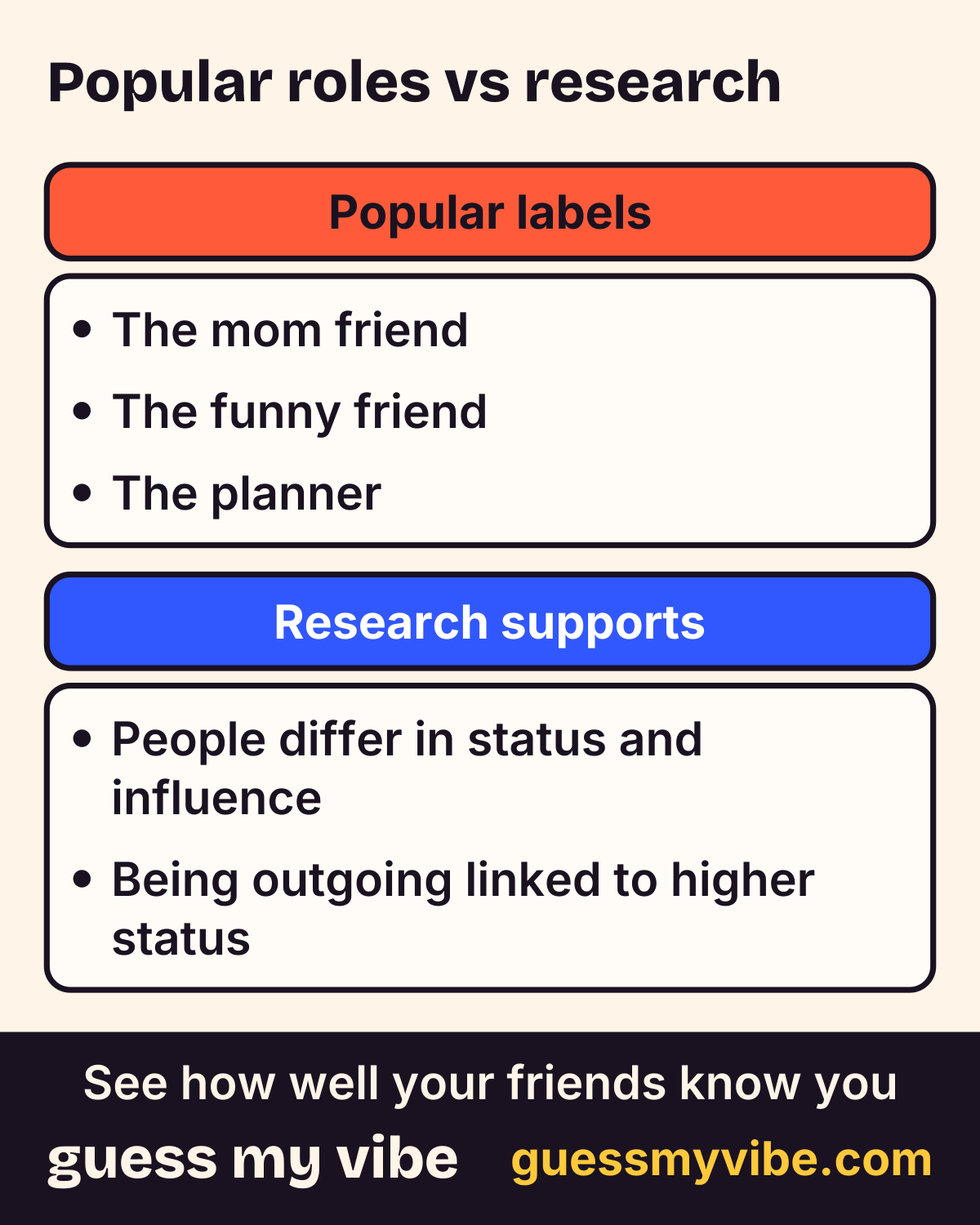
Friend group roles such as the mom friend, the funny one and the planner are popular labels, not categories researchers have tested. What research does support is narrower. Groups do sort people by status and influence, and in studies of face-to-face groups, being outgoing is one of the clearest personality links to it [1] [2].
Friend group roles are the informal labels people give each other: the mom friend who carries snacks and Band-Aids, the funny one, the planner, the one who always picks the restaurant. They are fun and they usually ring true, but they are pop typologies, not research categories, and we found no study that tests "the mom friend" or "the funny one" as a role. What research does support is more specific. In face-to-face groups, people really do end up with different amounts of status and influence, and some personality traits go with who does [1] [2]. This article separates the two, so you can enjoy the labels without treating them as science.
The pop friend group roles, and why they feel accurate
The usual cast shows up in memes and group chats. The mom friend looks after everyone. The funny friend keeps the mood up. The planner makes the reservation. The therapist friend listens. The wild one says yes to everything. Some groups add the quiet observer, the peacemaker or the one who stays out of drama. There is no official list, and the names change from one corner of the internet to another.
These labels feel accurate for a simple reason. Each one picks out something a person does a lot and turns it into a short description everyone can use. Once a group agrees on the label, it becomes easy to notice every time the person fits it and easy to overlook the times they do not. That is a reasonable explanation of why the labels feel true, but it is our reading, not a result from the studies below. A label that is fun and easy to remember can still be a poor description of how a group works.
What research does support: status in groups
The strongest body of work is not about named roles at all. It is about status, meaning how much respect, influence and prominence each person has in the eyes of the others. In three studies of real groups (a fraternity, a sorority and dormitory residents), the Big Five traits and physical attractiveness were related to peer ratings of status. High extraversion was substantially linked to higher status for both sexes. High neuroticism was linked to lower status in men only. None of the other Big Five traits was linked to status, and these effects held up independent of attractiveness [1].
That is one set of studies on campus groups, so it is worth checking against the largest summary available. A 2024 meta-analysis pulled together 1,064 effects from 276 samples with 56,153 participants, covering over 100 years of research on face-to-face groups. Its findings were largely in line with a "micropolitics" path, tentatively in line with competence and virtue paths, and only partly in line with a dominance path. The authors read that as meaning status depends not only on someone's competence and virtue but also on how they can enhance their apparent competence or virtue by behaving assertively, being extraverted or self-monitoring. They also report that their moderator analyses, such as the type of group task and culture, gave mixed and inconclusive results [2].
In plain words, the person who comes across as assertive and outgoing tends to end up with more standing in the group, and that pattern shows up in the research, though the meta-analysis found it only partly lines up with a dominance path. It does not map neatly onto "the funny one" or "the planner." It is a ranking, not a menu of roles.
Cite this figure
Figure: "Popular roles vs research." Guess My Vibe (guessmyvibe.com). https://guessmyvibe.com/learn/friend-group-roles#figure-pop-roles-vs-research
Curious how your friends would answer?
Free. Answer 10 quick questions about you, then send your link. Friends play in their browser, no app needed.
Start freeWhy seeming competent gets you influence
One study asked why dominant personalities get so much influence, given that most group theories say assertiveness alone should not be enough. In two studies of task groups, people higher in trait dominance were rated as more competent by fellow members, outside observers and research staff, even after the researchers controlled for actual ability. Dominant people also acted in ways that signal competence, and that behavior in turn went with the competence ratings [3].
This connects to everyday groups in a quiet way. The friend who speaks up first and sounds sure about the plan often becomes the planner, whether or not they are the best at planning. The label then sticks. That is our application of the finding to a friend group, not something the study tested. It was done in task groups, which are not the same as friends deciding where to eat.
Researchers also separate two routes to influence that look different and feel different. One study of a group of previously unacquainted people found that both a dominance strategy (using force and intimidation) and a prestige strategy (sharing expertise to earn respect) led to more perceived and real influence, but people using prestige were liked while people using dominance were not [4]. If your friend group has someone everyone defers to, it is worth asking whether you defer to them because you respect them or because it is easier.
Traits and who leads
A meta-analysis of 222 correlations from 73 samples looked at the Big Five and leadership. Extraversion was the most consistent correlate across settings and across both leader emergence and leader effectiveness, with a correlation of .31. Conscientiousness was .28, openness was .24, neuroticism was negative at -.24 and agreeableness was small at .08. Together, the five traits had a multiple correlation of .48 with leadership [5].
Read loosely, that gives a plausible link to a couple of the pop roles. A planner who keeps the group organized sounds like high conscientiousness, and someone who naturally takes the lead sounds like high extraversion. Those are guesses, not tested links. A correlation of .3 is real but leaves most of the story to other things, so any one person will often not fit the pattern. And the mom friend, the funny one and the peacemaker are not leadership roles at all, so this research does not speak to them.
Why named-role systems deserve some caution
Pop role typologies have a cousin in the workplace, where Belbin's team roles have been used for decades to sort people into team types. A 1993 psychometric study of the Belbin inventory is a useful caution. It gave the inventory to over 100 people from varied backgrounds and then to full-time managers, and found that the reliability figures for the roles were not impressive, factor analysis did not clearly support the proposed structure, and the roles' scores were not related to each other as the model expected [6].
That is a 1993 study of one work inventory, so it does not speak to every role idea, and later work may have refined it. But it shows the general problem. A set of role names can be easy to use and easy to like without the underlying categories being measurable. The friend group versions are even less tested, because nobody has built a validated scale for them.
How to use friend group roles without boxing people in
- Treat the labels as nicknames. They describe what someone does often, not everything they are.
- Watch for the cost of a label. The mom friend may be tired of being the one who remembers everything. Ask rather than assume.
- Notice who has the most say and why. If it is mostly the loudest or most confident person, the group may be missing good ideas from quieter people. The meta-analysis suggests assertive and extraverted behavior can raise how competent someone seems, which is not the same as how competent they are [2].
- Remember that the same person may take a different place in a different group. The studies above measure status within particular groups at particular times and do not show whether a role follows someone from group to group.
- Let people step out of their role sometimes. A funny friend is allowed to have a bad day.
See how your friends see your role
A role is partly how others see you, and that is also the part you can check. In Guess My Vibe, you and a friend each answer questions about yourselves and guess each other's answers, then the reveal shows where your guesses matched and where they did not. It will not tell you your role, but it is a quick way to find out how well your friends read you.
Key takeaways
- Named roles like the mom friend or the funny one are pop typologies, and we found no study that tests them as categories.
- In three studies of real groups, high extraversion was substantially linked to higher peer-rated status for both sexes, high neuroticism was linked to lower status in men, and none of the other Big Five traits was linked to status [1].
- A meta-analysis of 276 samples found status depends on competence and virtue and also on how competent or virtuous someone seems, which assertiveness, extraversion and self-monitoring can raise [2].
- In task groups, people high in trait dominance were rated as more competent even after controlling for their actual abilities, and they showed more competence-signaling behavior [3].
- This isn't therapy, a diagnosis, or a substitute for professional care.
Questions people ask
What are the common friend group roles?
The ones people name most are the mom friend, the funny friend, the planner, the therapist friend and the wild one. They are pop labels from social media and group chats, not categories from research, and we found no study that tests them as roles.
Is there research on roles in friend groups?
Not on named roles like the mom friend. There is research on status and influence in face-to-face groups, which found extraversion was the only Big Five trait tied to higher status in three campus-group studies [1] and ties extraversion and assertiveness to status in a large meta-analysis [2], and on who ends up leading, where extraversion is also the most consistent correlate [5].
How do people get influence in a friend group?
Partly by seeming competent. In task groups, people high in trait dominance were rated as more competent even after controlling for actual ability, and they showed more competence-signaling behaviors, which went with those ratings [3]. Another study found people using a prestige strategy were liked and influential, while people using dominance were influential but not liked [4].
Does personality decide which role you get?
It plays a part but does not decide it. The leadership meta-analysis found traits together correlated .48 with leadership, a sizable link that still leaves a lot to other factors [5]. For named friend roles, no one has tested it.
Are team role tests like Belbin's reliable?
A 1993 psychometric study of the Belbin inventory found modest reliability for the roles, and factor analysis did not clearly support the proposed structure [6]. That is a single older study of one inventory, so treat it as a reason for caution, not a final verdict.
See how well your friends know you.
Free. Answer 10 quick questions about you, then send your link. Friends play in their browser, no app needed.
Start freeReferences
- [1] Anderson, C., John, O. P., Keltner, D., & Kring, A. M. (2001). Who attains social status? Effects of personality and physical attractiveness in social groups. Journal of Personality and Social Psychology, 81(1), 116–132. PubMed: 11474718 (opens in a new tab)
- [2] Grosz, M. P., van Aert, R. C. M., & Back, M. D. (2024). A meta-analytic review of the associations of personality, intelligence, and physical size with social status. Psychological Bulletin, 150(3), 253–283. PubMed: 38330345 (opens in a new tab)
- [3] Anderson, C., & Kilduff, G. J. (2009). Why do dominant personalities attain influence in face-to-face groups? The competence-signaling effects of trait dominance. Journal of Personality and Social Psychology, 96(2), 491–503. PubMed: 19159145 (opens in a new tab)
- [4] Cheng, J. T., Tracy, J. L., Foulsham, T., Kingstone, A., & Henrich, J. (2013). Two ways to the top: Evidence that dominance and prestige are distinct yet viable avenues to social rank and influence. Journal of Personality and Social Psychology, 104(1), 103–125. PubMed: 23163747 (opens in a new tab)
- [5] Judge, T. A., Bono, J. E., Ilies, R., & Gerhardt, M. W. (2002). Personality and leadership: A qualitative and quantitative review. Journal of Applied Psychology, 87(4), 765–780. PubMed: 12184579 (opens in a new tab)
- [6] Furnham, A., Steele, H., & Pendleton, D. (1993). A psychometric assessment of the Belbin Team-Role Self-Perception Inventory. Journal of Occupational and Organizational Psychology, 66(3), 245–257. doi.org/10.1111/j.2044-8325.1993.tb00535.x (opens in a new tab)
How we find and check these sources: how we write. Spotted an error? Report a correction.
Related
Want to try it with your own friends? Make a friendship quiz for your friend group
Cite this article
- Title
- Friend Group Roles: Pop Labels vs. What Research Shows
- Publisher
- Guess My Vibe
- Updated
- URL
- https://guessmyvibe.com/
learn/ friend-group-roles
Copy this citation
Guess My Vibe. (2026, October 4). Friend Group Roles: Pop Labels vs. What Research Shows. Guess My Vibe. https://guessmyvibe.com/
To point at one section, add that section's anchor (the # link on its heading) to the URL.