Popularity isn't one thing. Researchers split it into social status (how much respect, influence, and visibility someone has in a group) and likability (how much people actually enjoy being around them). The two overlap, but they're driven by different traits: status tracks closely with extraversion, while likability goes more with prosocial, prestige-style behavior (sharing know-how, earning respect) than with dominance. That's why almost everyone can picture someone who's clearly "popular" in the status sense without being especially well liked.
Popularity is actually two different things
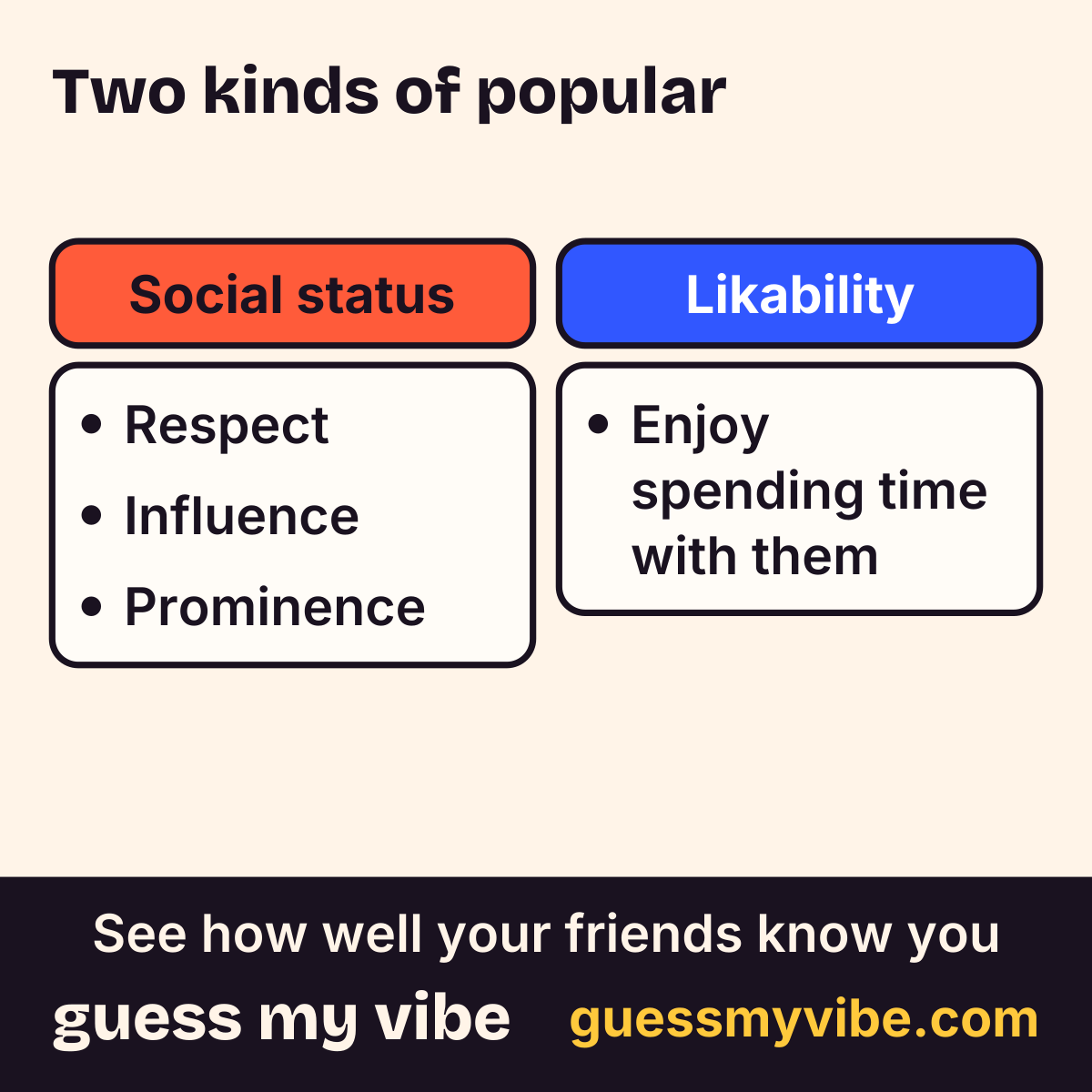
Ask someone to name the "most popular" person they knew growing up, and ask them separately who they'd call their favorite person from that same group, and you'll often get two different names. That's not a fluke. Researchers studying popularity treat it as two measurably distinct things: social status (how much respect, influence, and prominence a person has in the group's eyes) and likability (how much people actually enjoy spending time with them). They're correlated, since being well liked does tend to raise your standing some, but the correlation is far from 1.0, and the two have different personality fingerprints.
This matters beyond trivia. "Why are some people popular" has a more useful answer once you split the question: popular in the sense of having real pull in the group, or popular in the sense of being genuinely liked? The research on each points to a different trait.
Cite this figure
Figure: "Two kinds of popular." Guess My Vibe (guessmyvibe.com). https://guessmyvibe.com/learn/popularity#figure-status-vs-likability
What goes with status: extraversion, almost by itself
The clearest evidence comes from a set of three studies that measured status the way it actually plays out: peer ratings of real status (respect, influence, prominence) inside fraternities, sororities, and dorms, places where people genuinely live and interact daily, not survey vignettes about strangers. Across all three groups and both sexes, high Extraversion substantially went with higher status. Of the other four Big Five traits, only Neuroticism mattered, and only for men (more on that below); Agreeableness, Conscientiousness and Openness did not line up with status at all [1].
Two other findings from the same research are easy to miss and worth keeping. First, physical attractiveness also went with higher status, but only in men, and it worked independently of extraversion rather than explaining it away. Second, high Neuroticism (being more easily stressed or anxious) went with lower status, but only in men too, likely because it clashes with the confident, unflappable image masculine gender norms reward. Women's status rankings ended up just as stable as men's over time, they simply took longer to settle [1].
Extraversion's edge for status isn't limited to college social scenes, either. A meta-analysis of 222 correlations across 73 samples on personality and leadership (a related kind of social standing, just in a different setting) found a similar headline: Extraversion was the trait most consistently linked to who emerges as a leader and who's seen as effective at it, ahead of Conscientiousness and Openness. Agreeableness, the trait closest to plain warmth, was the weakest link of the five [4]. Same story, different rooms: showing up, talking, and taking initiative reliably buys status. Being nice, on its own, mostly doesn't.
Curious how your friends would answer?
Free. Answer 10 quick questions about you, then send your link. Friends play in their browser, no app needed.
Start freeBeing liked and being "popular" aren't the same nomination
A study that asked kids directly to nominate peers for different categories found something that explains a lot about how popularity actually feels from the inside. Nominations for "liked" tracked prosocial behavior, being kind, cooperative, helpful. Nominations for "disliked" tracked antisocial behavior. But nominations for perceived popularity tracked both prosocial AND antisocial behavior at the same time [2]. In other words, kids could point to someone who was clearly high-status and visible in the group while also being capable of real unkindness, and they rated that person as popular anyway, a separate judgment from whether they actually liked them.
That gap between status and likability has a name in adult research too. Two studies built on a group task among previously unacquainted adults and tracked how two different strategies played out: Dominance (using force, intimidation, or fear to get your way) and Prestige (sharing real expertise or know-how to earn respect). Both strategies worked, in the narrow sense that each one increased a person's actual and perceived influence over the group, and each drew more visual attention from onlookers watching video of the interactions later. But only one of them made people actually like the person doing it. Prestige-strategy people were seen as likable. Dominance-strategy people were not [3].
Put the two studies together and the shape of "popularity" gets a lot clearer: status can be earned through genuine contribution (prestige) or taken through intimidation (dominance), and either one can produce someone a group treats as high-status. Only the first kind tends to also make that person well liked. If you've ever wondered how someone who isn't especially kind can still run a friend group, this is most of the answer: status and likability are correlated, but they're not the same currency, and a group can hand out plenty of the first without much of the second.
Why the distinction is worth keeping straight
"Popularity" gets used as a vague compliment or a vague insult, depending on who's talking, which makes it hard to actually learn anything from it. Splitting it into status (who has influence and visibility) and likability (who people genuinely enjoy) turns a fuzzy social judgment into two separate, honest questions: Do I want more say in what the group does? Or do I want people to enjoy being around me more? The research above says those pull on different levers. More talking, more initiative, more visibility, the extraverted playbook, moves the first one. Warmth, generosity, and actually sharing what you know, the prestige playbook, moves the second, and research finds the second one is the one people end up liking you for.
None of this says introverts can't have status, or that extraverts are automatically unlikable. The correlations above are real but moderate: Extraversion substantially goes with status on average, it doesn't guarantee it for any one person, and plenty of extraverts are also genuinely well liked for reasons that have nothing to do with how loud they are in a room.
See which one your friends actually guess about you
Guess My Vibe scores how close a friend's guess lands to your real answers on the same Big Five traits this research is built on, including how outgoing you actually are versus how warm you actually are. It won't tell you your group's social hierarchy, but it's a quick, honest way to see whether the people around you read your social battery and your warmth the same way you'd rate them yourself.
Key takeaways
- Popularity splits into two things research measures separately: status (respect, influence, visibility) and likability (how much people enjoy being around you). They correlate, but not strongly, and not always in the same direction.
- Extraversion is the Big Five trait that reliably tracks with higher status in real groups, across both sexes; the only other trait that mattered was Neuroticism, and only for men [1].
- Kids can tell the two apart: in one study, being nominated as "liked" tracked prosocial behavior, while being nominated as "popular" tracked both prosocial AND antisocial behavior at once [2].
- There are two separate, equally real routes to social rank: earning it through actual expertise and generosity (prestige), or taking it through intimidation (dominance). Only people using the prestige route were seen as likable [3].
- This isn't therapy, a diagnosis, or a substitute for professional care.
Questions people ask
Is popularity the same as being well liked?
No. Research treats them as related but distinct: status is about respect, influence, and visibility in a group, while likability is about how much people actually enjoy being around someone. A study of kids' peer nominations found "popular" tracked both prosocial and antisocial behavior, while "liked" tracked only prosocial behavior [2].
What personality trait makes someone popular?
For status specifically, Extraversion is the trait most clearly linked to it across real groups like fraternities, sororities, and dorms, and the only other Big Five trait that went with status was Neuroticism, in men only, in that research [1]. For being liked, a prestige-based approach (sharing expertise, earning respect) went with being viewed as likable in one study, while a dominance-based one did not [3].
Can someone be popular without being nice?
Yes, and research backs this up directly: a dominance-based strategy (intimidation, force) increased people's actual and perceived influence in a group, as a prestige-based strategy did, even though dominant people weren't well liked [3].
Do introverts have lower social status?
On average, yes, extraversion substantially went with higher status in the research above, in both sexes and across three different real-world groups [1]. But that's an average pattern, not a guarantee for any individual, and it says nothing about likability, which runs on different traits.
Does physical attractiveness explain popularity?
It plays a role, but it's not the whole story and it doesn't work the same for everyone. In the same research, attractiveness went with higher status only in men, and it worked independently of personality rather than being the real reason extraversion looked important [1].
Why does my friend group have a popular person who isn't the nicest?
Because status and likability are separate judgments that can diverge. Someone can gain real influence in a group through dominance rather than warmth, and groups will still treat them as high-status even while not particularly liking them [3].
See how well your friends know you.
Free. Answer 10 quick questions about you, then send your link. Friends play in their browser, no app needed.
Start freeReferences
- [1] Anderson, C., John, O. P., Keltner, D., & Kring, A. M. (2001). Who attains social status? Effects of personality and physical attractiveness in social groups. Journal of Personality and Social Psychology, 81(1), 116–132. PubMed: 11474718 (opens in a new tab)
- [2] LaFontana, K. M., & Cillessen, A. H. N. (2002). Children's perceptions of popular and unpopular peers: A multimethod assessment. Developmental Psychology, 38(5), 635–647. PubMed: 12220043 (opens in a new tab)
- [3] Cheng, J. T., Tracy, J. L., Foulsham, T., Kingstone, A., & Henrich, J. (2013). Two ways to the top: Evidence that dominance and prestige are distinct yet viable avenues to social rank and influence. Journal of Personality and Social Psychology, 104(1), 103–125. PubMed: 23163747 (opens in a new tab)
- [4] Judge, T. A., Bono, J. E., Ilies, R., & Gerhardt, M. W. (2002). Personality and leadership: A qualitative and quantitative review. Journal of Applied Psychology, 87(4), 765–780. PubMed: 12184579 (opens in a new tab)
How we find and check these sources: how we write. Spotted an error? Report a correction.
Related
- Friend Group Psychology: How Groups of Friends Actually Work
- Agreeableness: The Trait Closeness Barely Helps Friends Read
- Introvert vs Extrovert: What the Research Actually Shows
- Friendship Psychology: What the Research Actually Says
- Social Battery: The Science of Why Socializing Drains You
- Friend Group Roles: Pop Labels vs. What Research Shows
- Emergent Leadership: Who Becomes the Leader in a Group?
Want to try it with your own friends? Make a friendship quiz for your friend group
Cite this article
- Title
- Popularity: What Research Says About Status vs. Being Liked
- Publisher
- Guess My Vibe
- Updated
- URL
- https://guessmyvibe.com/
learn/ popularity
Copy this citation
Guess My Vibe. (2026, October 3). Popularity: What Research Says About Status vs. Being Liked. Guess My Vibe. https://guessmyvibe.com/
To point at one section, add that section's anchor (the # link on its heading) to the URL.