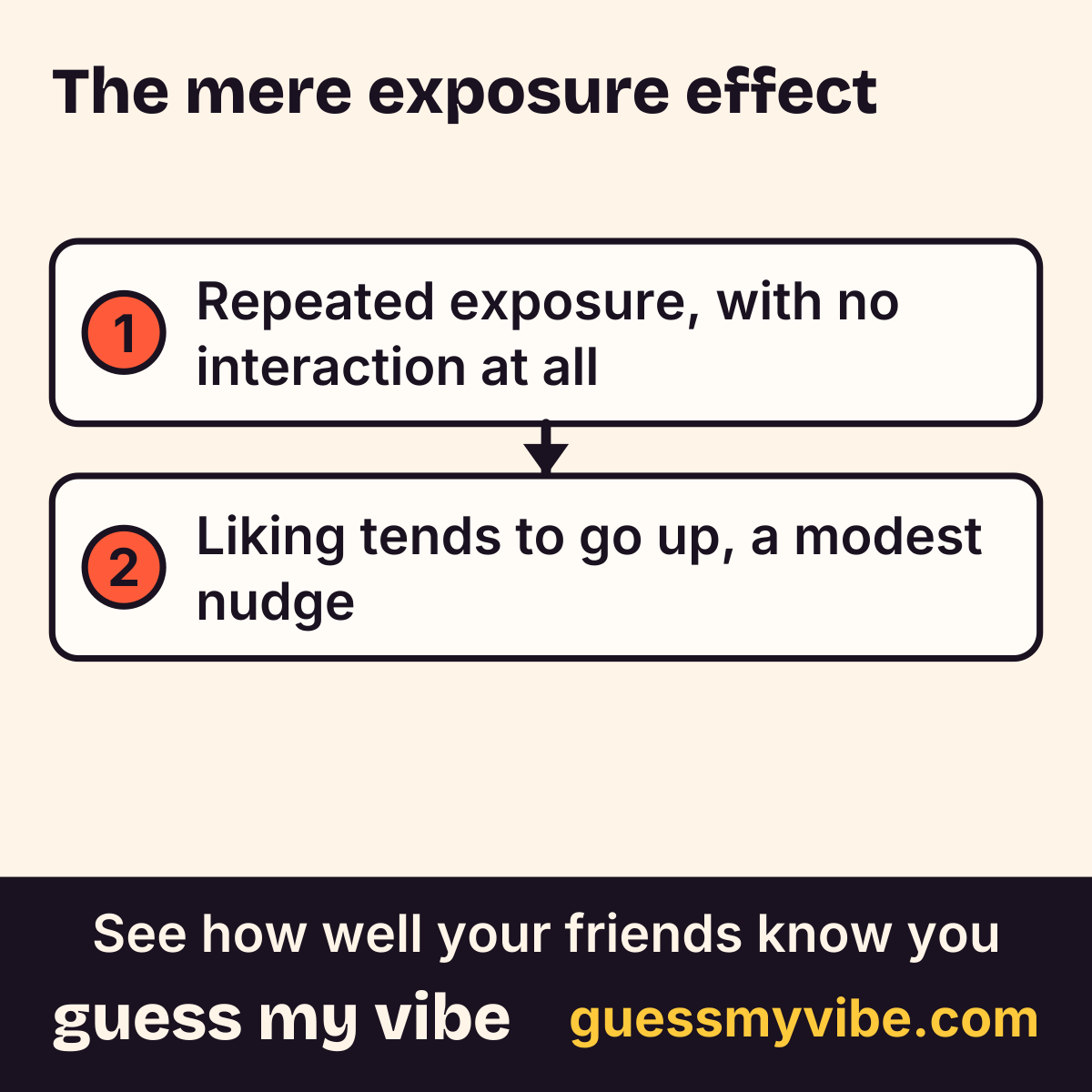
The mere exposure effect is the finding that simply being repeatedly exposed to something, or someone, with no interaction at all, makes you like it more. The original research showed this with words and nonsense symbols [1]. A classroom study later showed it works on real people: students rated silent, non-interacting classmates as more attractive the more class sessions those classmates had attended, with no conversation ever taking place [2].
What the mere exposure effect actually is
The mere exposure effect is the finding that simply encountering something repeatedly, a word, a face, a song, a classmate who sits a few rows over, tends to make you like it more, even with zero interaction. "Mere" is doing real work in that name: the claim isn't that getting to know someone better makes you like them more, which would be obvious. It's that just being exposed, on its own, with nothing else going on, is enough to nudge liking upward. That's a stranger, more specific claim, and it's held up across decades of research.
Cite this figure
Figure: "The mere exposure effect." Guess My Vibe (guessmyvibe.com). https://guessmyvibe.com/learn/mere-exposure-effect#figure-exposure-to-liking
Where it comes from: Zajonc's 1968 monograph
The hypothesis was formally proposed and tested by psychologist Robert Zajonc in a 1968 research monograph [1]. Zajonc built his case in layers. He first pointed to a correlational pattern: words that appear more often in English tend to carry a more positive meaning than rarer words. He then ran controlled experiments, repeatedly exposing people to nonsense words and unfamiliar symbols a different number of times each, and found that the more often a given nonsense word or symbol had been shown, the more positively people rated it afterward. The core claim he drew from this: repeated exposure to a stimulus, by itself, with no reward, reinforcement, or new information attached, is a sufficient condition for people to like it more.
The classroom study: liking a stranger you've never spoken to
Zajonc's original work centered on words, nonsense words and symbols, so a natural question is whether the same effect holds for actual human faces in a real social setting. A 1992 study answered that directly, and cleverly [2]. Four women of similar appearance were secretly planted in a large college course as pretend students. They never spoke to anyone, never interacted with a single classmate, and simply sat in on class sessions, each attending a different number of times: zero, five, ten, or fifteen sessions over the term. At the end of the term, the real students in the class were shown photos of all four women and asked to rate how familiar, attractive, and similar to themselves each one seemed. The number of sessions attended barely moved how familiar the women felt, but it had a strong effect on how attractive and similar they were rated. The women who'd silently attended the most sessions were liked the most, despite a complete absence of any conversation, shared activity, or even a single direct interaction. The authors' causal analyses suggested exposure raised attraction first, and attraction then lifted perceived familiarity and similarity.
Does it hold up? A 20-year meta-analysis says yes, with nuance
A single clever study is a good start, not the whole case. A meta-analysis of mere-exposure studies from 1968 to 1987 found that repeated exposure reliably increases liking [3]. It also found the effect isn't a flat, one-size-fits-all boost: its strength shifted depending on how complex the stimulus was, how long each individual exposure lasted, the order stimuli were presented in, how well people recognized the stimulus, how old the participants were, and how much time passed between the exposure and the final rating. None of those nuances erase the core finding. They sharpen it: repeated exposure reliably raises liking, and a handful of specific, now well-studied conditions determine how strong that boost ends up being in any given case.
Curious how your friends would answer?
Free. Answer 10 quick questions about you, then send your link. Friends play in their browser, no app needed.
Start freeA real limit: exposure needs a stable context too
Being honest about this research means covering where it breaks down, not just where it works. A more recent set of experiments tested what happens when the same total number of exposures to a face gets spread across many different surrounding contexts instead of one consistent one [4]. Each face was repeatedly shown together with a specific nonsense-word "context" cue during exposure. At test, the liking boost showed up clearly when a face was tested alongside the same context cue it had been shown with before, and disappeared almost entirely when exposure to that same face had been spread thin across many different, inconsistent contexts, even though the total number of times the face itself had been seen was identical either way. In plain terms, mere exposure isn't just counting how many times you've crossed paths with someone. The surrounding situation needs to stay reasonably familiar too, and it may help explain why a face seen in one steady setting could build more liking than the same face seen across many unrelated ones. That is an extrapolation: the study used face images and nonsense-word cues, not real classmates.
Why repetition builds liking at all
The papers above document the effect more firmly than they settle why it happens. One common idea is that familiar things are easier for the mind to process, and that ease feels mildly good, but none of the studies cited here tested that explanation. What they do show is that repetition alone, with no conversation, can raise liking, which is worth keeping in mind before assuming every warm feeling toward a familiar face reflects something you've learned about who they are.
What this research can't tell you
A few honest limits. The classroom study used four women and one course, so it shows the effect can happen with real people, not how big it is for everyone. The experiments with faces and nonsense words were run on screens, not in friendships. And liking someone you've merely seen is a different thing from trusting them or wanting them around. The research supports a modest, early nudge toward liking. It doesn't say familiarity beats a bad first conversation, or that seeing someone more always helps. Treat it as one small force among several, not a rule for who becomes a friend.
What this means for actually making friends
The practical takeaway isn't to go stand near people on purpose. It's that showing up around the same people, consistently, in the same setting, is doing real psychological work before a single real conversation happens, the same way it quietly worked on the students rating those silent classmates in 1992. That's genuinely useful to know if you're trying to turn a familiar face, a regular at the gym, someone in a weekly class, into an actual friendship: the liking groundwork may already be partly laid before you ever say hello. It's also a reason not to overread that early warmth as something deeper than it is. A good feeling built on repetition alone is a real starting point, not a finished friendship, and what happens after you actually talk is where it either becomes one or doesn't.
Key takeaways
- The effect was first proposed and tested in 1968: repeated exposure to a stimulus, with no reward or reinforcement attached, reliably raised how much people liked it [1].
- A real classroom study found students rated silent, non-interacting women as more attractive and more similar to themselves the more class sessions those women had attended, purely from exposure [2].
- A 20-year meta-analysis of mere-exposure research confirmed the effect is reliable, though its strength shifts with the type of stimulus, how long each exposure lasts, and other factors [3].
- The effect has real limits: it depends partly on the context around the stimulus staying familiar too, not just the raw number of times you've seen it [4].
- This isn't therapy, a diagnosis, or a substitute for professional care; it's a plain-English summary of what research says about familiarity and liking.
Questions people ask
What is the mere exposure effect?
It's the finding that simply being repeatedly exposed to something or someone, with no interaction or reward involved, is enough on its own to make you like it more [1].
Does the mere exposure effect work on people, not just words or images?
Yes. A classroom study found students rated silent classmates who never spoke to anyone as more attractive the more class sessions those classmates had attended, with zero real interaction [2].
Do you have to consciously remember seeing something for the effect to work?
Not necessarily. In the classroom study, exposure barely moved how familiar the women felt but strongly raised attraction [2]. The meta-analysis lists stimulus recognition as one factor that changes the effect's size [3].
Does seeing someone more always make you like them more?
Not unconditionally. Research shows the effect depends partly on the surrounding context staying familiar too; spreading the same number of exposures across many inconsistent settings can eliminate the boost [4].
How is the mere exposure effect different from just getting to know someone?
Getting to know someone involves real interaction and new information. The mere exposure effect is specifically about repetition alone raising liking, with no conversation or shared activity required, as shown in a classroom study where the women never interacted with anyone [2].
See how well your friends know you.
Free. Answer 10 quick questions about you, then send your link. Friends play in their browser, no app needed.
Start freeReferences
- [1] Zajonc, R. B. (1968). Attitudinal effects of mere exposure. Journal of Personality and Social Psychology Monograph Supplement, 9(2, Pt. 2), 1–27. doi.org/10.1037/h0025848 (opens in a new tab)
- [2] Moreland, R. L., & Beach, S. R. (1992). Exposure effects in the classroom: The development of affinity among students. Journal of Experimental Social Psychology, 28(3), 255–276. doi.org/10.1016/0022-1031(92)90055-O (opens in a new tab)
- [3] Bornstein, R. F. (1989). Exposure and affect: Overview and meta-analysis of research, 1968–1987. Psychological Bulletin, 106(2), 265–289. doi.org/10.1037/0033-2909.106.2.265 (opens in a new tab)
- [4] de Zilva, D., Newell, B. R., & Mitchell, C. J. (2016). Multiple context mere exposure: Examining the limits of liking. Quarterly Journal of Experimental Psychology, 69(3), 521–534. PubMed: 26120936 (opens in a new tab)
How we find and check these sources: how we write. Spotted an error? Report a correction.
Related
Want to try it with your own friends? Make a friendship quiz to play with your friends
Cite this article
- Title
- The Mere Exposure Effect: Why Familiar Faces Grow on You
- Publisher
- Guess My Vibe
- Updated
- URL
- https://guessmyvibe.com/
learn/ mere-exposure-effect
Copy this citation
Guess My Vibe. (2026, October 3). The Mere Exposure Effect: Why Familiar Faces Grow on You. Guess My Vibe. https://guessmyvibe.com/
To point at one section, add that section's anchor (the # link on its heading) to the URL.