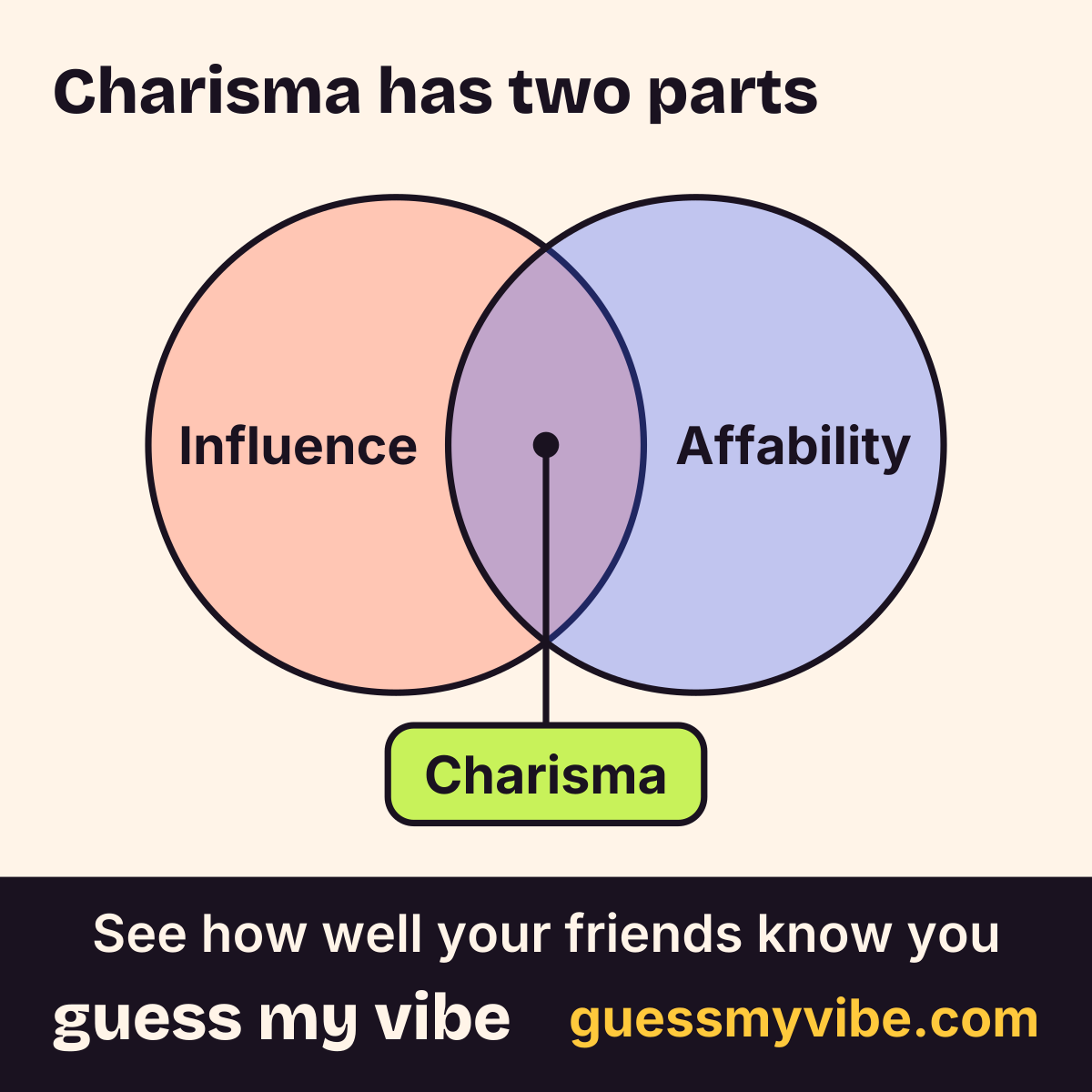
In everyday life, charisma looks like two things at once: influence, the ability to guide other people, and affability, the ability to make people feel comfortable and at ease [1]. It is also something others can see, not just a private feeling, and in two training studies, ratings of charisma went up after people were taught specific behaviors [2].
Charisma, defined: influence plus affability
Charisma is one of the most searched personality words there is, and the research answer is simpler than most of the advice. In everyday life, charisma seems to be made of two ingredients: influence, which is the ability to guide other people, and affability, which is the ability to make other people feel comfortable and at ease [1]. Someone with a lot of one and little of the other tends to feel different from someone with both. The rest of this article explains where that definition comes from, what it does and doesn't show, and what the research says about whether you can get better at it.
A quick note on scope. Charisma here means the everyday kind you notice at a party, in a class, or on a team, not the kind that fills stadiums. That distinction turns out to matter, because most earlier research on charisma was about famous or powerful leaders.
Why charisma was so hard to pin down
Before 2018, charisma had a strange problem for a trait everyone talks about. The authors of the key paper note that relatively few theorists had tried to define it, and that most of the empirical work focused on leadership, and even there on what charisma does rather than what it is [1]. In other words, researchers had plenty of studies on what happens when a leader is called charismatic, and very few on what the word means.
That gap is why charisma advice online is so contradictory. One article says it is confidence, another says it is listening, a third says it is a deep voice. Without a definition you can measure, every writer gets to pick their own favorite ingredient. The 2018 paper tried to fix that by testing a specific, checkable definition of everyday charisma instead of adding another opinion.
The two parts of charisma in plain words
The researchers proposed that everyday charisma is made of two interpersonally focused dimensions [1]. Here is what each one looks like outside a lab.
- Influence: the ability to guide others. Think of the person in a group chat whose suggestion becomes the plan, or the classmate people turn to when the group is stuck. They aren't necessarily the loudest. Others just tend to go where they point.
- Affability: the ability to make other people feel comfortable and at ease. Think of the person who somehow makes a stranger relax in the first two minutes. You feel less judged around them.
Across a series of studies, the team used factor analyses (a statistical way of seeing which questions cluster together) to build a short six-item measure they called the General Charisma Inventory [1]. Both ingredients matter for the definition. Influence without affability might come across as pushy. Affability without influence might come across as pleasant but easy to overlook. Those two sketches are our illustration of the idea, not findings from the paper. The research frames charisma as the combination, which is why it feels different from being merely nice or merely forceful.
There is a family resemblance to something older. Social psychologists have long argued that when people size up anyone, they ask two questions fast: does this person mean me well, and can they act on that intention? Those two dimensions are called warmth and competence, and people seen as high on both draw uniformly positive reactions [3]. Affability sounds a lot like warmth and influence sounds a bit like competence. That is our comparison, not a claim from either paper, and the two research lines measured different things, but the overlap helps explain why the two-part definition feels intuitive.
Cite this figure
Figure: "Charisma has two parts." Guess My Vibe (guessmyvibe.com). https://guessmyvibe.com/learn/charisma#figure-influence-and-affability
Curious how your friends would answer?
Free. Answer 10 quick questions about you, then send your link. Friends play in their browser, no app needed.
Start freeCharisma lives in other people's eyes
A trait you can only feel from the inside would be hard to study. The 2018 team reported that charisma is observable and interpersonal. In one study they used round-robin evaluations, where every person in a group rates every other person, along with informant reports from people who knew the targets, to show that charisma is something that exists between people rather than only inside one head [1]. They also found that lay people share a common idea of what charisma is, and that charisma is distinct from other concepts psychologists already measure, such as leadership constructs [1].
They also tested whether it mattered. The authors report that assessments of charisma were linked to real-world outcomes, including how persuasive someone seemed from their voice [1]. We only have the abstract of that last finding, so it is best read as a sign that charisma is not just a flattering label: people who come across as charismatic seem to change how others respond to them.
Because charisma is defined by how others experience you, other people are the natural way to measure it. That fits a bigger pattern in personality research: a meta-analysis of 44,178 people rated across 263 samples found that ratings from other people, such as friends and family, are strong indicators of behavior and add to what self-ratings alone can tell you [4]. The same analysis found that closeness mattered most for traits that are hard to see from outside [4]. Charisma is about as outward-facing as traits get, so our reading is that a friend's view is the natural check on yours, though no study we opened tested that directly.
How to be charismatic: can it be taught?
Most readers searching for charisma are really asking how to be charismatic. The most direct evidence comes from two experiments on whether people can be taught to act more charismatically [2]. In the first, 34 middle-level managers were randomly assigned to a training group or a control group, and the researchers collected coworker ratings three months later. In the second, 41 business-school students were videotaped giving a speech, taught charismatic behaviors, and then gave the speech again about six weeks later, with 135 independent assessors rating the speeches [2].
The training had significant effects on ratings of charisma, with a mean effect size of .62 [2]. In plain words, that is a noticeable shift in how observers rated people, but not a personality transplant. The authors also reported that the charisma ratings affected how well people were seen as fitting the picture of a leader and whether they emerged as leaders [2].
Some honest limits apply. Both studies were small. Both were set in leadership and public-speaking contexts, not friendships, dating or dorm life. And the outcome was how other people rated the behavior, not whether anyone became a better friend. So the safe reading is narrow: specific, teachable behaviors can change how charismatic people look to observers. The study doesn't tell you which tips online work, and it doesn't show charisma is a switch you can flip.
What this means for you day to day
If you take the two-part definition seriously, the practical question changes from "how do I become magnetic" to two smaller ones. First, do people feel at ease around me? Second, do people tend to follow my lead when I offer one? Most of us are stronger on one than the other, and which one is stronger isn't obvious from the inside.
The research also hints at why the usual tips are so hit or miss. Advice like "smile more" or "stand tall" targets how you feel, but the studies measure how you come across to others. Those can drift apart, because people tend to overestimate how closely others are watching them in the first place, a pattern called the spotlight effect that we cover in our article on what people think of you. The most reliable feedback loop is still a person who sees you in real life and tells you honestly.
That is the part Guess My Vibe is built for. It doesn't score charisma, and the game is built on the Big Five traits, not on influence and affability. But it does line up what you say about yourself next to what your friends guess about you, so you can see where your own read differs from theirs. If the question behind your search is how you actually come across, that gap is the most honest place to start.
Key takeaways
- One research team proposed that everyday charisma has two parts, influence (guiding others) and affability (putting people at ease), and built a short six-item scale around them [1].
- Charisma is observable: it shows up in how other people rate you, and in the study it was linked to how persuasive someone's voice sounded [1].
- Two training experiments, one with managers and one with business students, found that charisma ratings went up after people were taught charismatic behaviors, though both were small and set in leadership settings [2].
- Charisma echoes the two things people judge first in anyone, warmth and competence, but those studies were about social judgment in general, not charisma by name [3].
- Ratings from other people carry real information: across 263 samples, observer ratings were strong indicators of behavior, and for job performance they added to what self-ratings could tell you [4].
- This isn't therapy, a diagnosis, or a substitute for professional care.
Questions people ask
What is charisma, according to psychology?
One research team defines everyday charisma as a combination of influence, the ability to guide others, and affability, the ability to make people feel comfortable and at ease [1]. It is treated as something other people perceive, not only a private quality.
Can you learn to be charismatic?
Partly, according to two experiments: teaching people specific charismatic behaviors raised how charismatic observers rated them, with a significant average effect on ratings [2]. The studies were small and set in leadership and speaking situations, so they don't prove it works the same way in friendships.
Is charisma the same as being extroverted?
The research we opened doesn't treat them as the same thing. The 2018 paper reports that charisma is distinct from other constructs psychologists study [1], and its two parts, influence and affability, describe how you affect other people rather than how much social energy you have.
How do I know if I am charismatic?
Because charisma is defined by how others experience you [1], the most direct way to find out is to ask people who know you. Ratings from people who know you carry real information beyond your own self-view [4], so several honest friends beat a guess made alone.
How is charisma different from being likable?
Likability mostly overlaps with the affability half. Charisma, as defined in the research, also needs influence, the ability to guide others [1]. Someone can be well liked without people tending to follow their lead.
See how well your friends know you.
Free. Answer 10 quick questions about you, then send your link. Friends play in their browser, no app needed.
Start freeReferences
- [1] Tskhay, K. O., Zhu, R., Zou, C., & Rule, N. O. (2018). Charisma in everyday life: Conceptualization and validation of the General Charisma Inventory. Journal of Personality and Social Psychology, 114(1), 131–152. PubMed: 28737418 (opens in a new tab)
- [2] Antonakis, J., Fenley, M., & Liechti, S. (2011). Can charisma be taught? Tests of two interventions. Academy of Management Learning & Education, 10(3), 374–396. doi.org/10.5465/amle.2010.0012 (opens in a new tab)
- [3] Fiske, S. T., Cuddy, A. J., & Glick, P. (2007). Universal dimensions of social cognition: warmth and competence. Trends in Cognitive Sciences, 11(2), 77-83. PubMed: 17188552 (opens in a new tab)
- [4] Connelly, B. S., & Ones, D. S. (2010). An other perspective on personality: Meta-analytic integration of observers' accuracy and predictive validity. Psychological Bulletin, 136(6), 1092–1122. PubMed: 21038940 (opens in a new tab)
How we find and check these sources: how we write. Spotted an error? Report a correction.
Related
- Likability: What Actually Makes People Like You
- What Makes Someone a Warm Person?
- First Impressions: How Fast and How Accurate They Are
- How to Make a Good First Impression, According to Research
- Self-Perception vs. How Others See You
- How to Be Approachable, According to Research
- Warmth and Competence: The Two Things People Judge First
Cite this article
- Title
- Charisma: What It Is and What Research Says Makes It
- Publisher
- Guess My Vibe
- Updated
- URL
- https://guessmyvibe.com/
learn/ charisma
Copy this citation
Guess My Vibe. (2026, October 4). Charisma: What It Is and What Research Says Makes It. Guess My Vibe. https://guessmyvibe.com/
To point at one section, add that section's anchor (the # link on its heading) to the URL.