Assertive communication means saying what you want or think directly while still leaving room for the other person. Research on how people are perceived finds a sweet spot: in three studies, people seen as markedly low or as high in assertiveness were generally seen as less effective leaders, and the authors linked that to a trade-off in which high assertiveness worsens relationships and low assertiveness limits goal achievement [1].
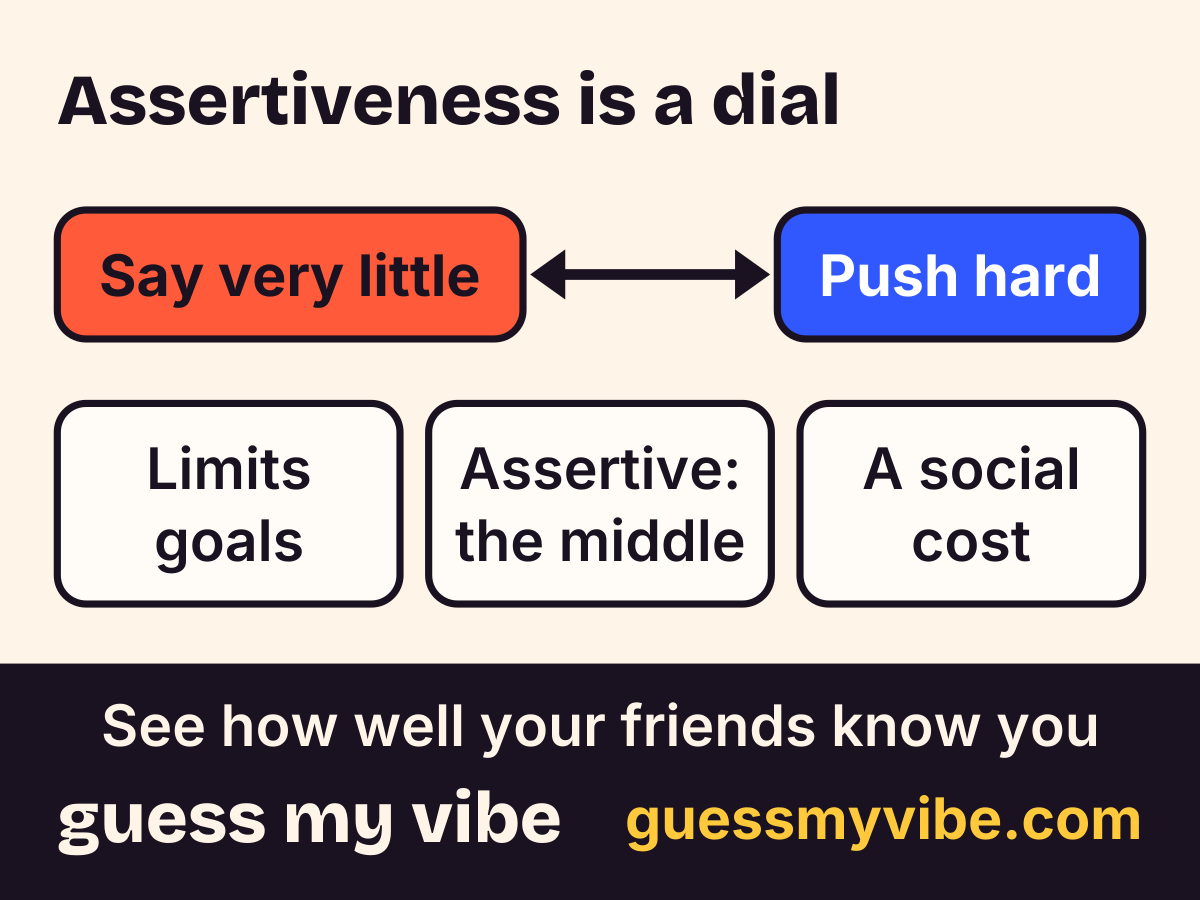
Assertive communication is the middle of a dial. At one end you say very little about what you want, and at the other you push hard. The research that tests this directly finds that both ends cost something. In three studies, people seen as markedly low in assertiveness, and people seen as high in it, were generally appraised as less effective leaders, and the authors tied that to a trade-off: a lot of assertiveness worsens relationships, while very little limits how much you get done [1]. That is the short version of why assertive communication matters, and why "be more assertive" is only half of good advice.
What assertive communication means
In everyday use, assertive communication means stating your needs, opinions or limits clearly and calmly, without running over the other person and without hiding what you think. Popular guides usually sort people into four boxes: passive, aggressive, passive-aggressive and assertive. Those boxes are handy for conversation, but the studies in this article do not use them. They treat assertiveness as an amount, a point along a line from very low to very high, which is a more honest picture of how most people actually behave from one situation to the next. For the research view of communication traits more broadly, see our article on communication styles.
One more point on terms. Assertiveness is not the same as being loud, and it is not the same as being outgoing. A person can be quiet, warm and direct about what they need. A person can also be chatty and never once say what they want. Keep that in mind, because most of the research below is about how assertive someone is perceived to be by the people around them.
The curved effect: too little and too much both cost
One test of the sweet spot is a set of three studies using both qualitative and quantitative methods. The authors argued that earlier work had looked for straight-line effects, where more assertiveness is always better or always worse. They proposed a curve instead, with people seen as markedly low or as high in assertiveness appraised as less effective leaders, and they found support for that account across the three studies [1].
The reasoning matters more than the shape. High assertiveness tends to worsen relationships, which the authors call a social cost. Low assertiveness limits goal achievement, an instrumental cost. Those two costs pull in opposite directions, which is how the authors explain why both extremes looked worse [1]. Here is what that looks like in ordinary life. The friend who never says where she wants to eat keeps the peace, and also ends up at places she doesn't like. The friend who always decides gets his way, and slowly finds that people stop offering ideas.
Two cautions apply. The finding is about how people appraise leaders, so it speaks to perceived effectiveness and not to how happy anyone feels, and it comes from work and leadership settings. Whether the same curve describes a friend group is a reasonable guess, but these studies did not test it.
Cite this figure
Figure: "Assertiveness is a dial." Guess My Vibe (guessmyvibe.com). https://guessmyvibe.com/learn/assertive-communication#figure-assertiveness-dial
Why it is hard to tell where you land
If there is a sweet spot, the obvious next question is whether people know when they are outside it. A later set of four studies, mostly using negotiations, looked at exactly that. Study 1 found only a modest link between how assertive people thought they were and how assertive their counterparts thought they were. People seen as under-assertive and people seen as over-assertive were both likely to see themselves as appropriately assertive [2].
The same studies turned up a second pattern that cuts the other way. Many people whom counterparts saw as appropriately assertive wrongly believed they had been seen as over-assertive. The authors named this the line crossing illusion. They suggested part of the cause may be strategic umbrage, where counterparts put on displays of discomfort, and they found evidence of such displays in real-world negotiations. In the final study, the illusion was linked to how the negotiation turned out [2]. These were negotiation samples, so treat the details as an example and not a rule for every conversation.
Put the two together and you get an awkward mix. Some people who push too hard think they are fine. Some people who are fine worry they pushed too hard. The common thread is that your own sense of your assertiveness is not a reliable gauge. That is a good argument for asking someone who has watched you in real situations, not for trusting how a past conversation felt.
Curious how your friends would answer?
Free. Answer 10 quick questions about you, then send your link. Friends play in their browser, no app needed.
Start freeWhy assertive people often get more influence
There is a reason the pull toward being forceful is strong. In two studies of task groups, people higher in trait dominance, a close relative of assertiveness, were rated as more competent by fellow group members, by outside peer observers and by research staff, even after the researchers controlled for how able those people actually were. People higher in dominance also did more of the behaviors that signal competence, and those behaviors in turn went with the competence ratings [3].
So acting assertive can make you look capable, whether or not you are. That is a benefit for people who show up that way and a quiet problem for people who don't. If you tend to hold back, your good ideas may get less credit than they deserve, and that is a cost to your goals even when nobody means any harm.
What about gender and assertiveness?
Searches for assertiveness often come with a gender question, so here is what a large source says. Using personality questionnaire data from 26 cultures (23,031 people), the authors found that gender differences were small relative to the variation within each gender. Men reported themselves as higher in assertiveness on average, women reported higher warmth and agreeableness, and the size of the differences varied by culture [4].
Two limits are worth stating. These are self-reports, so the data cannot tell you whether people differ in how they behave or only in how they describe themselves. And a small average gap leaves plenty of overlap between individual men and women. Your own spot on the dial is a personal fact, not something your gender settles.
How to be more assertive without overshooting
None of the studies above tested a training program, so what follows is practical reasoning built on what they found, not a proven method. Treat it as a set of ideas to try.
- Aim for the middle, not the far end. The curved pattern suggests the goal is a clear request that leaves the other person room to answer, not a win.
- Say the request itself in one plain sentence ("I'd rather do Thursday"), then stop. Explaining at length is a common way quiet people dilute what they asked for.
- Check your read with someone who has seen you in action. Your own sense of how pushy or passive you were is a shaky guide [2].
- If you tend to over-apologize, remember that in one negotiation study many people seen as appropriately assertive wrongly believed they had gone too far. Visible discomfort from the other person can be a display, as the strategic umbrage findings suggest, so it is not proof you crossed a line [2].
- If you tend to take over, ask for a second opinion before you decide. Acting dominant can earn competence ratings even apart from actual ability [3], while very high assertiveness was linked to worse relationships in the leadership studies [1].
Assertiveness between friends
Friendships raise the stakes on the relationship side of the trade-off. At work you may never see a colleague again after the project. A friend you steamroll is a friend you live with. Because the research is built on leaders and negotiators, treat its sweet spot as a starting hypothesis for friendships and not a measured fact. The self-awareness finding is the part most likely to carry over, since friends watch you in far more situations than a negotiation partner does.
That is where a friend's view helps. In Guess My Vibe, you and a friend each guess how the other would answer, and the reveal shows where your read of them and their read of themselves differ. If you want a low-stakes check on whether you come across as more pushy or more passive than you think, ask a friend to play a round and compare.
Key takeaways
- People seen as markedly low in assertiveness or as high in assertiveness were generally judged less effective as leaders, a curved pattern tied to a trade-off between relationships and getting things done [1].
- Self-awareness about your own assertiveness is shaky: in one negotiation study, people seen as under- or over-assertive tended to see themselves as appropriately assertive [2].
- Many people seen as appropriately assertive wrongly believed they had come across as over-assertive, so worrying about being too pushy can be a misread of the room [2].
- In two task-group studies, people higher in trait dominance, a close relative of assertiveness, were rated as more competent even after controlling for their actual abilities [3].
- Across 26 cultures, self-reported gender differences in personality were small relative to individual variation within genders, with men reporting higher Assertiveness on average [4].
- This isn't therapy, a diagnosis, or a substitute for professional care.
Questions people ask
What is assertive communication?
It means stating what you want, think or need clearly and calmly, while leaving room for the other person's view. Researchers who study it treat assertiveness as an amount, from very low to very high, and find that people seen as at either extreme were generally appraised as less effective leaders [1].
Can you be too assertive?
Research suggests yes. In studies of leadership, people seen as high in assertiveness were generally judged less effective, tied to a cost that high assertiveness places on relationships [1]. People in negotiations who were seen as over-assertive also tended to see themselves as appropriately assertive, so it can be hard to notice from the inside [2].
Why do I worry that I came across as too pushy?
In one negotiation study, many people whom counterparts saw as appropriately assertive wrongly believed they were seen as over-assertive, a pattern the authors called the line crossing illusion. Counterparts' staged displays of discomfort may be part of the reason [2]. It does not mean you are always misreading the room, only that the worry is not good evidence by itself.
Are men more assertive than women?
On self-report questionnaires across 26 cultures, men scored higher on assertiveness on average, but overall gender differences were small relative to the differences among people of the same gender [4]. The data are self-reports, so they do not show how anyone behaves in a given moment.
Does being assertive make people think you are more competent?
In two studies of task groups, people higher in trait dominance were rated as more competent even after controlling for their actual abilities, and they did more of the behaviors that signal competence, which went with those ratings [3]. That is a reason to notice when quieter people's ideas are getting less credit than they deserve.
See how well your friends know you.
Free. Answer 10 quick questions about you, then send your link. Friends play in their browser, no app needed.
Start freeReferences
- [1] Ames, D. R., & Flynn, F. J. (2007). What breaks a leader: the curvilinear relation between assertiveness and leadership. Journal of Personality and Social Psychology, 92(2), 307-324. PubMed: 17279851 (opens in a new tab)
- [2] Ames, D. R., & Wazlawek, A. S. (2014). Pushing in the dark: Causes and consequences of limited self-awareness for interpersonal assertiveness. Personality and Social Psychology Bulletin, 40(6), 775-790. PubMed: 24583469 (opens in a new tab)
- [3] Anderson, C., & Kilduff, G. J. (2009). Why do dominant personalities attain influence in face-to-face groups? The competence-signaling effects of trait dominance. Journal of Personality and Social Psychology, 96(2), 491–503. PubMed: 19159145 (opens in a new tab)
- [4] Costa, P. T., Jr., Terracciano, A., & McCrae, R. R. (2001). Gender differences in personality traits across cultures: Robust and surprising findings. Journal of Personality and Social Psychology, 81(2), 322-331. PubMed: 11519935 (opens in a new tab)
How we find and check these sources: how we write. Spotted an error? Report a correction.
Related
- Communication Styles and Personality: The Real Research
- Conflict Styles: How Personality Shapes How You Fight
- People Pleaser: The Agreeableness Research Behind It
- Friend Group Roles: Pop Labels vs. What Research Shows
- Self-Awareness: What the Research Says It Actually Takes
- Low Agreeableness: What It Means (and Doesn't)
Cite this article
- Title
- Assertive Communication: What the Research Says
- Publisher
- Guess My Vibe
- Updated
- URL
- https://guessmyvibe.com/
learn/ assertive-communication
Copy this citation
Guess My Vibe. (2026, October 4). Assertive Communication: What the Research Says. Guess My Vibe. https://guessmyvibe.com/
To point at one section, add that section's anchor (the # link on its heading) to the URL.