The beautiful mess effect is a well-replicated finding that people judge their own vulnerable moments, admitting a mistake, asking for help, confessing a feeling, more harshly than they judge the exact same moment happening to someone else. Across seven original studies and a 2022 follow-up, people consistently rated someone else's vulnerability as braver and more admirable than they rated their own. The gap comes from psychological distance: your own vulnerability feels close and concrete, so you fixate on what could go wrong; someone else's feels distant and abstract, so you see the courage in it instead.
What the beautiful mess effect actually is
You replay the moment you admitted you were struggling, or asked for help you felt you shouldn't need, and it reads back as weak, awkward, too much. Watch a friend do the exact same thing and it reads completely differently: brave, real, the kind of thing that makes you like them more. That gap has a name, the beautiful mess effect, and it's not just a feeling, it's a measured, repeated finding in personality and social psychology research. People evaluate their own displays of vulnerability more negatively than they evaluate the identical display coming from someone else.
The original research: seven studies, one consistent gap
The effect comes from a research program covering seven separate studies, testing situations like confessing romantic feelings, revealing a physical imperfection, and asking for help [1]. In each one, the same pattern showed up: people imagining themselves in the vulnerable situation rated it more negatively than people imagining someone else in the identical situation. This wasn't limited to hypothetical imagining either; the researchers found evidence for the same gap in a real-life situation, not just a lab scenario people were asked to picture. Whatever the specific flavor of vulnerability, confessing, asking, revealing, the self-view came out harsher than the other-view, every time the researchers tested it.
Why the gap exists: psychological distance
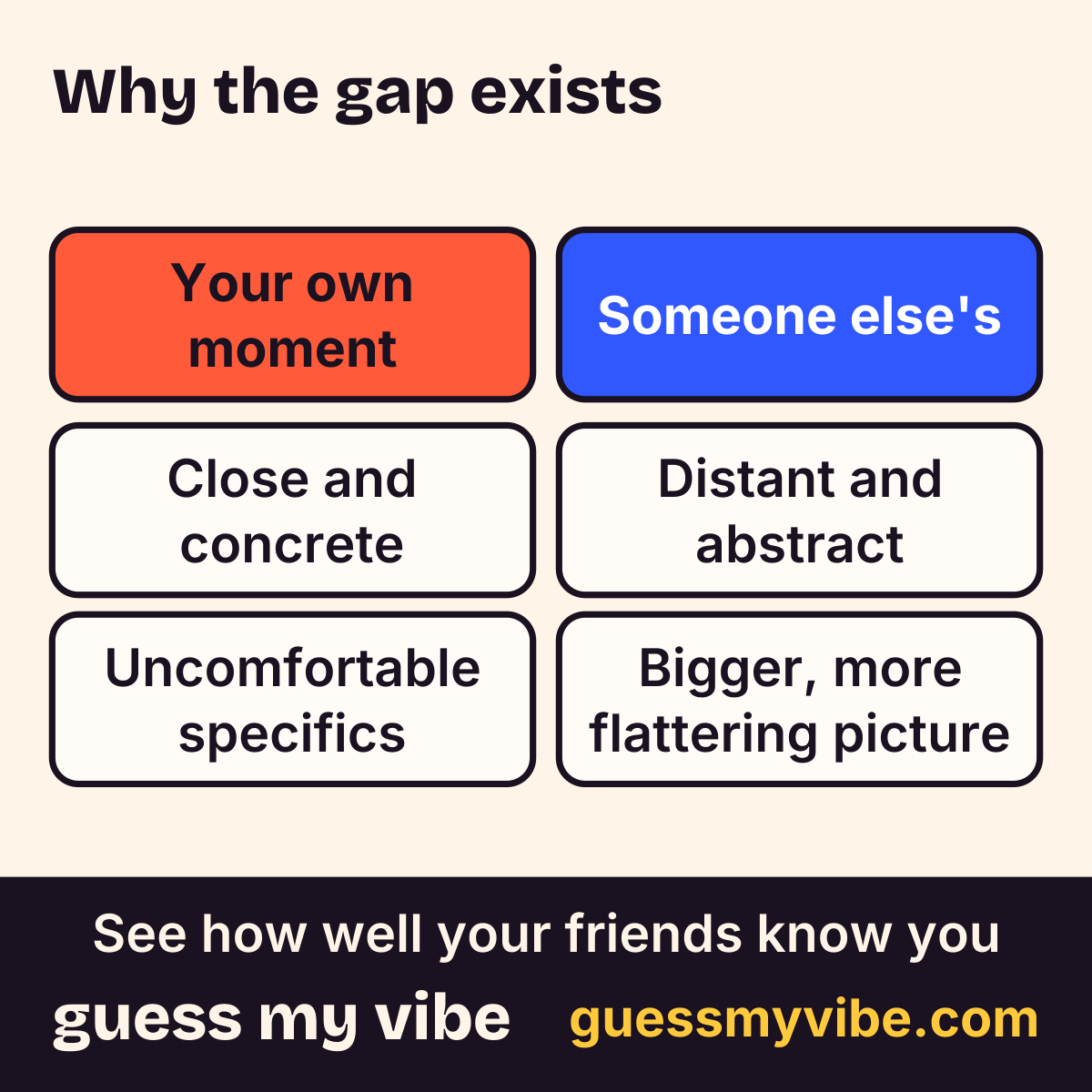
The explanation researchers point to is construal level theory, a well-established idea about how the mind represents things that are close to you versus far from you [3]. The theory's core claim is that psychological distance, whether that's time, physical space, social distance, or even just "did this happen to me or to someone else," changes how abstractly or concretely something gets represented. Something close and personal gets represented concretely, which pulls focus toward specific, uncomfortable details. Something distant and someone-else's gets represented abstractly, which pulls focus toward the bigger picture instead, in this case, the broader meaning of showing vulnerability rather than the embarrassing specifics of it. Your own vulnerable moment is maximally close, so you see the stammer, the shaking hands, the thing you wish you hadn't said. A friend's vulnerable moment is comfortably distant, so you see the courage in showing up honestly, with none of those close-up details in the way.
Cite this figure
Figure: "Why the gap exists." Guess My Vibe (guessmyvibe.com). https://guessmyvibe.com/learn/beautiful-mess-effect#figure-close-vs-distant
Does it hold up? A 2022 follow-up, and what changes it
A finding worth building an article around should hold up more than once, and this one has. The same researchers ran four additional studies specifically testing what might shrink the gap, rather than just confirming it exists again from scratch [2]. They found self-compassion, being kind to yourself under difficulty instead of harshly critical, buffers against the effect: people higher in self-compassion showed a smaller self-other gap in how they evaluated their own vulnerability, and the pattern held up across different vulnerable situations, not just one. That's a more useful finding than a flat replication, since it points at something an actual person could work on, how kindly you treat your own hard moments, rather than just confirming the gap exists and leaving it there.
Curious how your friends would answer?
Free. Answer 10 quick questions about you, then send your link. Friends play in their browser, no app needed.
Start freeOne place the effect doesn't fully apply: status
The beautiful mess effect isn't unconditional, which is part of what makes it a real finding rather than a feel-good platitude. The research above focused on peers, roughly equal-status people evaluating each other's vulnerability. Vulnerability shown by someone clearly above you in status, a boss admitting a weakness to an employee, carries different risk than the same admission between equals, since it can cost that person perceived competence in a way a peer-to-peer confession doesn't. The honest version of this research isn't "showing vulnerability always goes over better than you think" in every relationship. It's specifically about how you judge your own vulnerability compared to a peer's, which is exactly the comparison the studies above actually tested.
What this means for an actual friendship
If you're sitting on something you want to tell a friend, that you're struggling, that you need something from them, that you feel more strongly about someone than you've let on, the research says your own internal preview of how it'll land is reliably too harsh. You're running the concrete, close-up version in your head: the shaky voice, the too-long pause, the exact wording you'll probably fumble. The friend on the other end is going to see the abstract, distant version instead, the one the beautiful mess effect research says reads as courage rather than weakness. Picture the reverse case and the gap gets obvious fast: when a friend texts you that she's been struggling and finally said something, your first reaction is almost never "that was weak of her." It's closer to respect, that she said it at all. The research above says that's not a special case. It's the default reaction, and it's one you're unlikely to guess accurately about your own moment while you're still standing inside it. This connects to a wider pattern in how people misjudge their own blind spots: self-perception is largely accurate, but it has real gaps, and research on those gaps finds they're biggest for the traits people most want, or most fear, to be true of them [4]. A vulnerable moment puts exactly that kind of trait on display, which is a reasonable guess at why the self-view and the friend's view come apart so sharply there.
Seeing the other side of the gap directly, instead of guessing
The hard part of all this research is that you can't just reason your way out of the gap, since the whole mechanism is about psychological distance, not about having the right facts. What actually helps is seeing a real, specific reaction instead of the imagined one running in your head. Guess My Vibe's honest take card is a small, low-stakes version of exactly that: a friend answers real questions about you honestly, in writing, which hands you their actual read instead of the harsher one you'd otherwise be running on autopilot. It won't settle every hard conversation, but it's a working example of the same finding above: someone else's honest view of you tends to be kinder, and more accurate, than the one you'd guess on your own.
Key takeaways
- People reliably judge their own vulnerable moments more harshly than they judge the same moment happening to someone else, across confessing feelings, asking for help, and revealing a flaw [1].
- The effect held up again in a 2022 follow-up with four new studies, which also found it shrinks in people who score higher in self-compassion [2].
- The proposed mechanism is construal level: the farther something is from your own direct experience, the more abstractly you represent it, which changes what you notice and how you judge it [3].
- This fits a broader pattern in self-perception research: people have real blind spots about themselves, and those blind spots are often biggest around the most emotionally loaded situations [4].
- This isn't therapy, a diagnosis, or a substitute for professional care; it's a plain-English summary of what personality and social psychology research says about showing vulnerability.
Questions people ask
What is the beautiful mess effect?
It's the finding that people judge their own vulnerable moments, like asking for help or admitting a mistake, more harshly than they judge the same moment happening to someone else. Seven studies found this gap consistently across different kinds of vulnerability [1].
Why do we judge our own vulnerability more harshly than other people's?
The leading explanation is psychological distance: your own vulnerability is close and concrete, so you focus on the uncomfortable specifics, while someone else's is distant and abstract, so you focus on the bigger, more flattering picture of what it took to be open [3].
Has the beautiful mess effect been replicated?
Yes. A 2022 follow-up ran four new studies and found the same self-other gap again, while also identifying self-compassion as a factor that shrinks it [2].
Does being vulnerable always make people like you more?
Not unconditionally. The research covers peers judging each other's vulnerability; vulnerability shown across a status gap, like a boss admitting a weakness to an employee, carries different risk and isn't what these studies tested.
Can anything make the beautiful mess effect smaller?
Self-compassion appears to help. People who scored higher in self-compassion showed a smaller gap between how they judged their own vulnerability and how they judged someone else's, across several different situations [2].
See how well your friends know you.
Free. Answer 10 quick questions about you, then send your link. Friends play in their browser, no app needed.
Start freeReferences
- [1] Bruk, A., Scholl, S. G., & Bless, H. (2018). Beautiful mess effect: Self-other differences in evaluation of showing vulnerability. Journal of Personality and Social Psychology, 115(2), 192–205. PubMed: 30024240 (opens in a new tab)
- [2] Bruk, A., Scholl, S. G., & Bless, H. (2022). You and I both: Self-compassion reduces self-other differences in evaluation of showing vulnerability. Personality and Social Psychology Bulletin, 48(7), 1054–1067. PubMed: 34292104 (opens in a new tab)
- [3] Trope, Y., & Liberman, N. (2010). Construal-level theory of psychological distance. Psychological Review, 117(2), 440–463. PubMed: 20438233 (opens in a new tab)
- [4] Vazire, S., & Carlson, E. N. (2011). Others sometimes know us better than we know ourselves. Current Directions in Psychological Science, 20(2), 104–108. doi.org/10.1177/0963721411402478 (opens in a new tab)
How we find and check these sources: how we write. Spotted an error? Report a correction.
Related
Want to try it with your own friends? Take the best friend test and see how your friends see you
Cite this article
- Title
- The Beautiful Mess Effect: Vulnerability Reads as Brave
- Publisher
- Guess My Vibe
- Updated
- URL
- https://guessmyvibe.com/
learn/ beautiful-mess-effect
Copy this citation
Guess My Vibe. (2026, October 3). The Beautiful Mess Effect: Vulnerability Reads as Brave. Guess My Vibe. https://guessmyvibe.com/
To point at one section, add that section's anchor (the # link on its heading) to the URL.