You can feel lonely with friends around because loneliness is about how connected you feel, not how many people are nearby: researchers put it plainly, "Loneliness is not simply being alone" [1]. Feeling understood matters for relationships and well-being, and people's sense of being understood is only modestly related to whether they actually are [2].
If you are asking why am I lonely when you have friends, group chats and plans on the calendar, you are asking a question researchers take seriously, and the short answer is that loneliness is not the same as being alone. It is about how connected and understood you feel, and you can be surrounded by people and still feel on the outside. This article walks through what the research says about why that happens, in plain words and without assuming anything about your life. It can't tell you why you in particular feel this way. But it can give you a few useful ways to think about it.
Why am I lonely even when I have friends?
A review of the loneliness literature defines the experience through perception: loneliness is the perception of social isolation, and the authors state directly that it is not simply being alone [1]. That has a big implication. If loneliness were about numbers, a full calendar would fix it. Because it's about perception, two people with identical social lives can feel completely different, and one person can feel very connected on a quiet week and very lonely at a crowded party.
So the research doesn't treat "I have friends but I feel lonely" as a contradiction. It treats it as a common pattern. The question that follows isn't "why am I ungrateful for the friends I have," which is a harsh and unhelpful one, but "what kind of connection am I missing?" The next sections look at two ways of answering that.
Cite this figure
Figure: "Being alone is not loneliness." Guess My Vibe (guessmyvibe.com). https://guessmyvibe.com/learn/why-am-i-lonely#figure-alone-vs-lonely-here
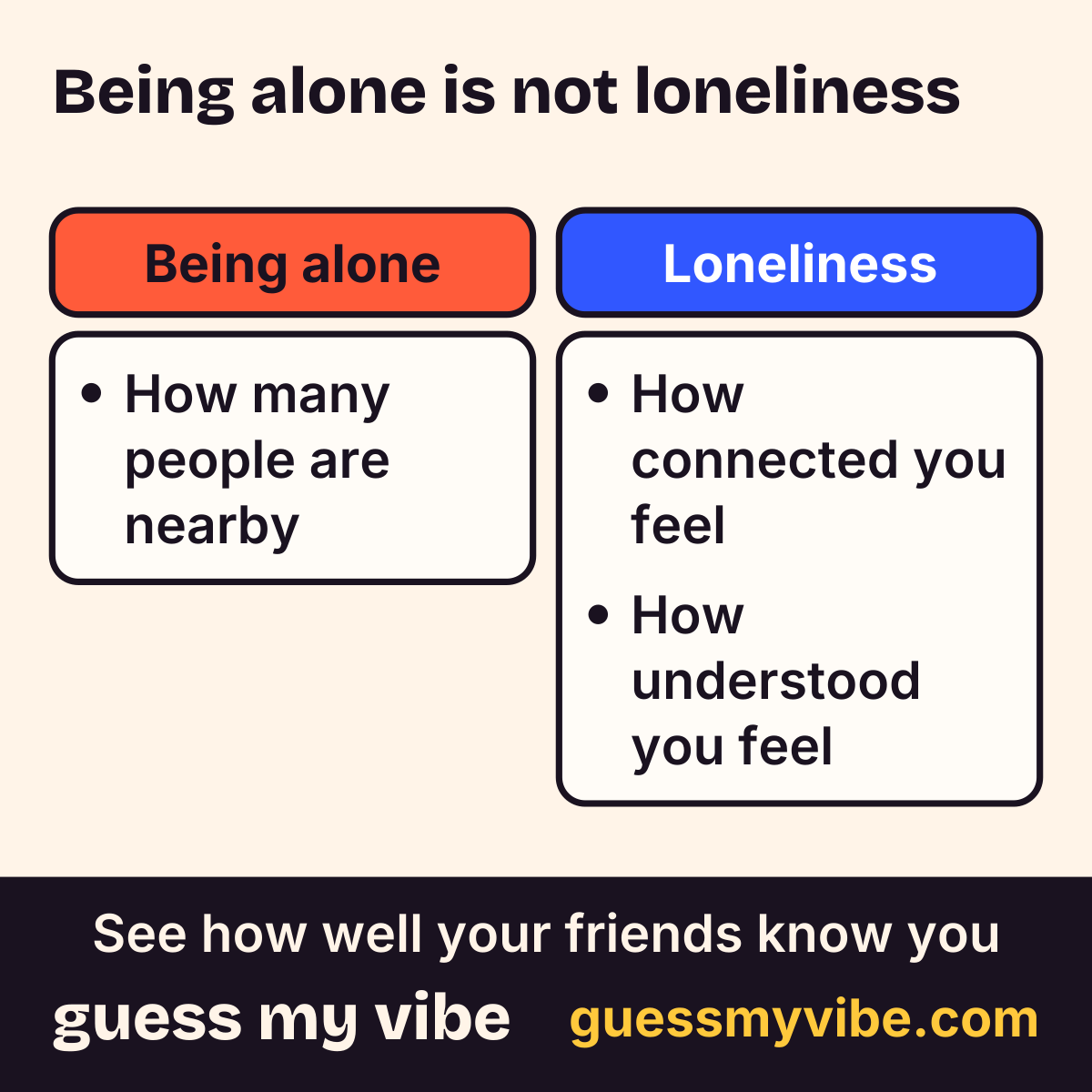
Feeling understood matters, not just being around people
One thing that may be missing is the feeling of being understood. Researchers who reviewed the work on this topic note that people want to be understood by others, and that feeling understood is important for relationship and personal well-being [2]. The same review makes a point that is easy to miss: people's perceptions of being understood are only modestly related to actually being understood. In other words, how understood you feel and how well people actually know you are two related but separate things, and either one can be off.
That gives you two different questions to ask. Is it that the people around you really don't know the real you, because most of your time together stays light? Or do they know more than you feel they do, and something else is making it hard to feel it? The review describes situational, dispositional and relational factors that shape feeling understood or misunderstood, so there isn't one answer for everyone. It may be that you haven't shared much that feels real. It may be that you have, and it didn't land the way you hoped. Both are common, and neither means something is wrong with you or with them.
How loneliness can color what you notice
Here is a finding that is easy to misread, so we'll state it carefully. Across three studies with 1,197 people in total, loneliness was associated with a negative bias in perceiving relationship partners' regard and care. Loneliness was associated with seeing family members, friends and romantic partners as less admiring and caring, and this held even when it was compared against what those partners reported themselves and against ratings from outside informants and observers [3]. The researchers also reported that this bias partially accounted for the link between loneliness and lower relationship quality, and that these perceptions went along with later loneliness.
This is not a claim that lonely people are imagining things or that it's their fault. Loneliness is a painful state, and it makes sense that it would shape how we read other people. The review of loneliness research describes something related: perceived social isolation increases vigilance for threat, heightens feelings of vulnerability, and raises the desire to reconnect [1]. Put those together, and a plausible picture emerges, which is our reading, not a conclusion from either paper: you want closeness, but you are also on guard, so a slow reply or a canceled plan can feel like proof. These are observational studies, so they can't show cause and effect on their own. Still, they suggest that how connected you feel may depend partly on how you read other people's regard and care.
Curious how your friends would answer?
Free. Answer 10 quick questions about you, then send your link. Friends play in their browser, no app needed.
Start freeWhat a large survey found about who feels lonely
Loneliness can feel like a private failing. A large survey can show who reports it. In the BBC Loneliness Experiment, which analyzed reports from 46,054 people aged 16-99 across 237 countries, islands and territories, loneliness decreased with age, which means younger people reported more of it than older people [4]. The same study found loneliness was greater in men than in women and increased with individualism, and it found the most vulnerable were younger men living in individualistic cultures. So reporting loneliness is not a sign of something unusual about you; the survey found it varied by age, gender and culture.
One caution: this was one large survey, so it shows a pattern, not a precise count of how many people feel lonely. It also can't tell you how any one person or friend group feels.
Questions to ask yourself (our suggestions, not findings)
Research can't diagnose your situation, and neither can we. But the ideas above point to some gentle questions you can use to look at your own life with curiosity instead of judgment:
- Who do I feel understood by? Even one person counts. Notice what is different about time with them.
- What do my friends know about the real me? If the honest answer is "not much," that may be the gap, and it can change.
- Am I reading this accurately? When a friend seems distant, what are the other explanations that I haven't considered?
- What kind of connection am I missing? Someone to laugh with, to be serious with, to be quiet with, to ask for help?
- What is one small thing I could share this week? Something a little more real than usual, with someone who has been kind to you before.
If it feels heavy
Feeling lonely sometimes, even often, doesn't mean something is wrong with you. If it has been weighing on you for a while, or it is getting in the way of sleep, school, work or enjoying things, it's worth talking to someone you trust, such as a friend, a family member, or a counselor. Reaching out is also one way of working on the gap itself. This article is general information only: it isn't therapy, a diagnosis, or a substitute for professional care, and it can't assess how you are doing.
A small way to feel a bit more known
Since feeling understood seems to be part of the picture, one gentle option is a low-pressure way to let friends know a little more about you. In Guess My Vibe, friends guess how you would answer real questions, and you see where they were right and where they missed. It isn't a fix for loneliness, and we wouldn't claim it is. What it can do is give you and a friend an easy reason to talk about something real, which is where feeling understood usually starts.
Key takeaways
- Loneliness is a perception of social isolation, not a head count, and a review stresses that it is not simply being alone [1].
- Feeling understood by other people matters for relationships and well-being, yet people's feeling of being understood is only modestly related to being understood [2].
- Loneliness can color perception: in three studies of 1,197 people, loneliness was associated with seeing friends, family and partners as less admiring and caring, even when compared with those people's own reports [3].
- In a review, perceived social isolation (loneliness) increased vigilance for threat, heightened feelings of vulnerability and raised the desire to reconnect [1].
- In a survey of 46,054 people aged 16-99, loneliness decreased with age, so younger people reported more of it than older people [4].
- This isn't therapy, a diagnosis, or a substitute for professional care.
Questions people ask
Why do I feel lonely even when I'm around people?
Loneliness is the perception of social isolation, not a count of people nearby, and researchers state that it is not simply being alone [1]. Feeling understood matters for well-being, and people's sense of being understood is only modestly related to actually being understood [2].
Is it normal to feel lonely when you have friends?
It can happen, because loneliness is about perception, not headcount. In a survey of 46,054 people aged 16-99, loneliness decreased with age, so younger people reported more of it [4]. A review stresses that loneliness is not simply being alone [1].
Can feeling lonely change how I see my friends?
Research suggests it can. In three studies of 1,197 people, loneliness was associated with perceiving friends, family and partners as less admiring and caring, even compared with those people's own reports [3]. It is an association, and it doesn't mean your friends don't care.
How can I feel less lonely with the friends I already have?
Research doesn't give a recipe, so this is our suggestion: since feeling understood matters [2], try sharing something a little more real with someone who has been kind to you. If loneliness feels heavy, talk to someone you trust or a professional.
When should I talk to someone about feeling lonely?
If it has lasted a while or is affecting your sleep, school, work or enjoyment of things, talking to someone you trust or a professional is a reasonable step. This isn't therapy, a diagnosis, or a substitute for professional care.
See how well your friends know you.
Free. Answer 10 quick questions about you, then send your link. Friends play in their browser, no app needed.
Start freeReferences
- [1] Hawkley, L. C., & Cacioppo, J. T. (2010). Loneliness matters: A theoretical and empirical review of consequences and mechanisms. Annals of Behavioral Medicine, 40(2), 218-227. PubMed: 20652462 (opens in a new tab)
- [2] Reis, H. T., Lemay, E. P., Jr., & Finkenauer, C. (2017). Toward understanding understanding: The importance of feeling understood in relationships. Social and Personality Psychology Compass, 11(3), e12308. doi.org/10.1111/spc3.12308 (opens in a new tab)
- [3] Lemay, E. P., Jr., Cutri, J., & Teneva, N. (2024). How loneliness undermines close relationships and persists over time: The role of perceived regard and care. Journal of Personality and Social Psychology, 127(3), 609-637. PubMed: 38407098 (opens in a new tab)
- [4] Barreto, M., Victor, C., Hammond, C., Eccles, A., Richins, M. T., & Qualter, P. (2021). Loneliness around the world: Age, gender, and cultural differences in loneliness. Personality and Individual Differences, 169, 110066. PubMed: 33536694 (opens in a new tab)
How we find and check these sources: how we write. Spotted an error? Report a correction.
Related
- Loneliness: What It Is and Who Feels It Most
- Alone vs Lonely: Why Solitude Isn't the Same Thing
- Loneliness in College: Why the First Year Hits So Hard
- Feeling Left Out by Friends: What's Actually Happening
- Social Connection: Why It Matters for Wellbeing
- Sense of Belonging: The Need to Belong, Explained
- One-Sided Friendship: What the Research Actually Finds
Cite this article
- Title
- Why Am I Lonely Even With Friends? What Research Says
- Publisher
- Guess My Vibe
- Updated
- URL
- https://guessmyvibe.com/
learn/ why-am-i-lonely
Copy this citation
Guess My Vibe. (2026, October 4). Why Am I Lonely Even With Friends? What Research Says. Guess My Vibe. https://guessmyvibe.com/
To point at one section, add that section's anchor (the # link on its heading) to the URL.