A friend who only talks about themselves is usually doing something that feels good to the brain, not necessarily something selfish: in experiments, sharing information about the self was associated with activity in the brain's reward system, and people even gave up money to do it [1]. The same research field also shows that people who ask more questions, especially follow-up questions, are better liked, and that people don't expect this [2].
Want to take it for real? Make a friendship quiz where both of you take a turn
A friend who only talks about themselves can leave you feeling like an audience. You nod, ask a question, wait for a turn that never comes, and head home a bit emptier than you arrived. The research on conversation does not say that friend is selfish or does not care. It says talking about yourself is rewarding, that asking questions is a reliable way to be liked, and that most of us misjudge both. That gives you some options other than quietly fuming or ending the friendship.
Two notes before the findings. No study here measured a friend who only talks about themselves as a type, so everything below describes general patterns in conversation. And we are not going to label anyone: whatever your friend's reasons are, a label wouldn't help you figure out the next conversation.
Why people talk about themselves so much
A set of five studies started from a striking fact: humans devote 30 to 40% of speech output solely to telling others about their own subjective experiences. They tested the idea that this is because it feels good. Self-disclosure was strongly associated with increased activation in brain regions of the mesolimbic dopamine system, including the nucleus accumbens and ventral tegmental area. People were also willing to forgo money for the chance to disclose about themselves. Two follow-up studies suggested that the effects came from two independent sources of value: self-referential thought, and simply sharing information with others [1].
In plain words, talking about yourself is rewarding for people in general, you included. That is a useful frame for a friend who talks a lot. Most of the time they are not trying to push you out of the conversation. They are enjoying something that comes naturally and feels good, and they may simply not notice that you haven't had a turn.
What asking questions does
Here is where the research gets practical. Across three studies of live dyadic conversations, including online get-to-know-you chats and face-to-face speed dating, people who asked more questions, particularly follow-up questions, were better liked by their conversation partners. When people were told to ask more questions, they were seen as more responsive, a term for listening, understanding, validation and care, and responsiveness explained the effect on liking. Speed daters who asked more follow-up questions were more likely to get a second date. And despite all of that, people did not anticipate that question-asking would increase liking [2].
This matters in both directions. If you are the friend who listens, you have been doing something that goes with being well liked, and it can help to know that. If your friend rarely asks you anything, one gentle possibility is that they do not realize questions matter. That is our reading, not something the study tested, and it does not excuse a friendship that is truly lopsided. But it does mean the habit may be a blind spot rather than a message about how they feel about you.
Curious how your friends would answer?
Free. Answer 10 quick questions about you, then send your link. Friends play in their browser, no app needed.
Start freeDisclosure and liking go in circles
A meta-analysis of disclosure and liking pulled together three separate effects. People who disclose intimately tend to be liked more than people who disclose less. People disclose more to those they initially like. And people come to like others as a result of having disclosed to them. The authors argue these effects work together as one dynamic system, and they found the link varied with the type of study, the type of disclosure and the discloser's gender [3].
The third effect is the interesting one here. A friend who talks to you at length may well come to like you more because of it. That is not an excuse, but it can reframe the situation. A long monologue can be a form of affection, however clumsy. It is also why the balance matters: a friendship where only one side discloses leaves the other person without the same bonding benefit.
The quiet friend's side: you may be underestimating how welcome your stories are
A series of experiments with strangers found a pattern that applies to the quiet friend. People systematically underestimated how caring and interested their conversation partners were in their own intimate revelations. Conversations with strangers felt less awkward, and created more connectedness and happiness, than participants expected. Participants especially overestimated how awkward deep conversations would be, and yet they felt more connected to deep conversation partners than to shallow ones. The expectations were better calibrated for people whose care was already clearly known, such as close friends, family or partners [4].
The research is about strangers, so it can't tell us how your own friend will react. But it does suggest a pattern worth testing: if you have gone quiet around a talkative friend, your guess about how much they would want to hear about your week may be too pessimistic. The experiments found people were more accurate with close friends, which also hints that a friend may be more receptive than you fear. The only way to find out is to try.
Getting your turn, kindly
None of the tips below were tested on a one-sided friendship. They are our own suggestions, built from the findings above, and they start from the assumption that your friend may not know.
- Bring your own story early. Start with something small, like I had the strangest day, and say it before the other person's story gets going, so you are not trying to break in halfway.
- Say what you want out loud. A friendly line such as I would love to tell you about my week too, when you have a minute, is clearer than hoping they will ask.
- Pick the right moment. Right after someone shares something heavy is a bad time to redirect. A quiet lunch or a walk, with no big story waiting, is better.
- Model what you want. Ask a follow-up question or two, then offer a story of your own. The question-asking study found follow-up questions go with being liked, which may make your friend more willing to listen.
- Notice the pattern over weeks, not one night. One long monologue is a bad evening. A year of them is information about the friendship that is worth acting on.
- If you have tried and nothing changes, it is fine to take the friendship at a lower dose, such as shorter hangouts or group settings. That is a choice about energy, not a verdict on your friend.
Cite this figure
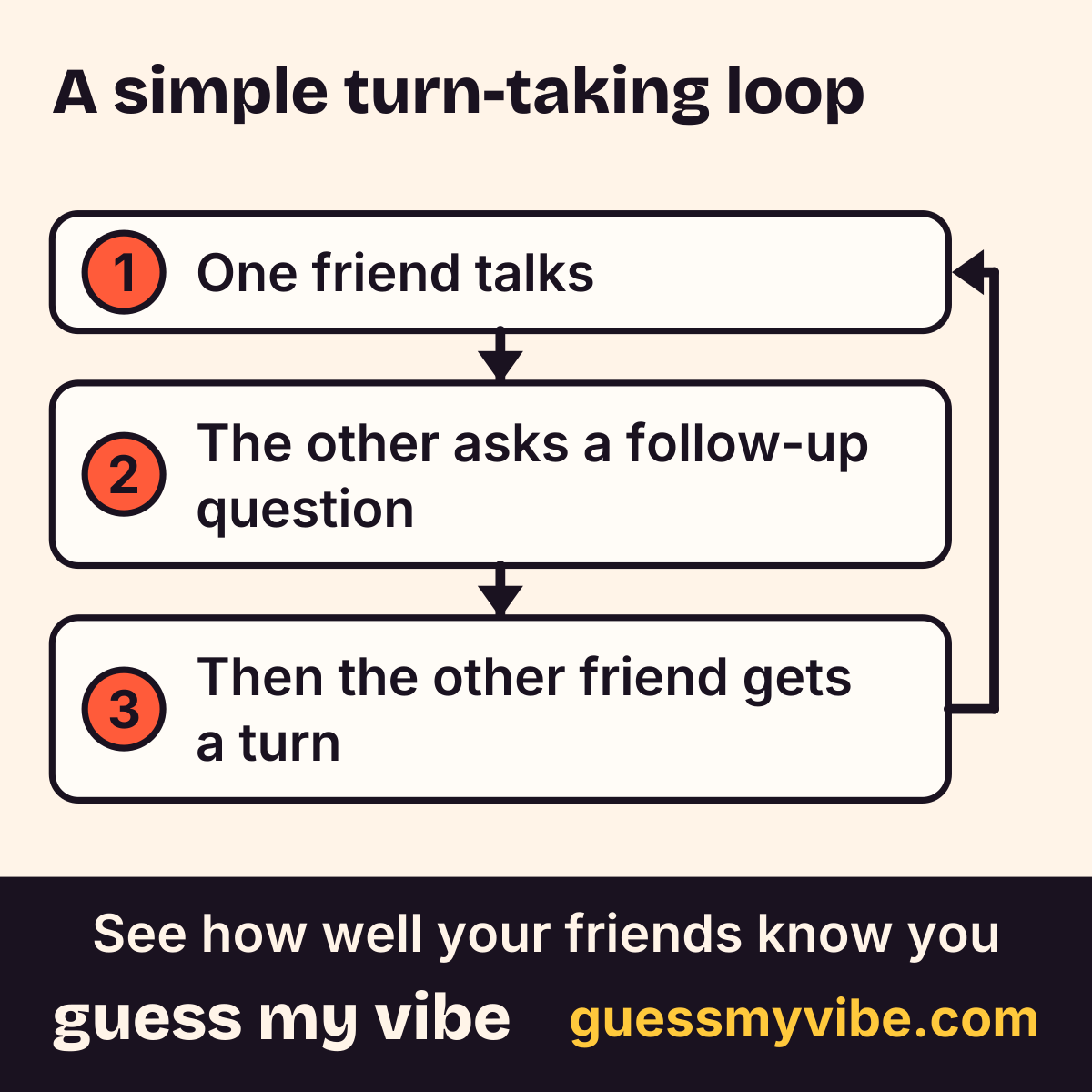
Figure: "A simple turn-taking loop." Guess My Vibe (guessmyvibe.com). https://guessmyvibe.com/learn/friend-who-only-talks-about-themselves#figure-turn-taking-loop
If you are the talker
If part of this sounded like you, there is nothing wrong with enjoying your own stories. The research says it feels good for everyone. The easy fix is the one the question-asking study points to: ask the next question. Follow-up questions in particular were tied to being liked, and people did not expect that [2]. A single how did that go for you can change how the whole evening feels to the other person.
How Guess My Vibe fits in
A guessing game puts both friends in the answering seat and the guessing seat. You each have to say something about yourself and pay attention to the other, which makes turn-taking part of the game instead of something to negotiate.
Key takeaways
- People devote 30 to 40% of their speech to telling others about their own experiences, and self-disclosure was associated with activity in the brain's reward circuitry; people were even willing to give up money to do it [1].
- In three studies of live conversations, people who asked more questions, especially follow-up questions, were better liked, and people did not anticipate that asking questions would increase liking [2].
- Disclosing to someone and liking them reinforce each other: people who disclose intimately tend to be liked more, people disclose more to those they like, and people come to like others as a result of disclosing to them [3].
- Strangers who had deeper conversations underestimated how much their partner would care about their disclosures and overestimated the awkwardness, and expectations were better calibrated with close friends, family or partners [4]. A quiet friend may be underestimating how welcome their own stories are, though that is our reading.
- This isn't therapy, a diagnosis, or a substitute for professional care.
Questions people ask
Why does my friend only talk about themselves?
Often because it feels good and they have not noticed the balance. Self-disclosure was associated with activity in the brain's reward system, and people gave up money to do it [1]. That is a common pattern, not proof of anything about your friend's character.
Is a friend who talks about themselves all the time a narcissist?
We can't say, and this research doesn't try. Talking a lot about yourself is common, and the studies we cite describe general conversation patterns, not personality labels. A label also wouldn't change what to try next, which is gentle, direct feedback.
Do questions really make people like you more?
In three studies of live conversations, people who asked more questions, especially follow-up questions, were better liked, and people didn't anticipate this [2]. The studies covered get-to-know-you chats and speed dating, so friendships are an extension, not a direct test.
How do I get a friend to ask about me?
Tell them what you would like, and start with a small story of your own. People generally underestimate how interested others are in their stories, especially with strangers, and are better calibrated with close friends [4], so a friend may be more willing than you expect. That is a suggestion, not a tested method.
Should I end a friendship with someone who always talks about themselves?
That is your call, and one night of monologue isn't enough to decide. If you have tried asking for balance a few times and nothing changes, it is reasonable to see the friend less or in groups. The research can't tell you which friendships are worth keeping.
See how well your friends know you.
Free. Answer 10 quick questions about you, then send your link. Friends play in their browser, no app needed.
Start freeReferences
- [1] Tamir, D. I., & Mitchell, J. P. (2012). Disclosing information about the self is intrinsically rewarding. Proceedings of the National Academy of Sciences, 109(21), 8038-8043. PubMed: 22566617 (opens in a new tab)
- [2] Huang, K., Yeomans, M., Brooks, A. W., Minson, J., & Gino, F. (2017). It doesn't hurt to ask: Question-asking increases liking. Journal of Personality and Social Psychology, 113(3), 430–452. PubMed: 28447835 (opens in a new tab)
- [3] Collins, N. L., & Miller, L. C. (1994). Self-disclosure and liking: A meta-analytic review. Psychological Bulletin, 116(3), 457-475. PubMed: 7809308 (opens in a new tab)
- [4] Kardas, M., Kumar, A., & Epley, N. (2022). Overly shallow? Miscalibrated expectations create a barrier to deeper conversation. Journal of Personality and Social Psychology, 122(3), 367–398. PubMed: 34591541 (opens in a new tab)
How we find and check these sources: how we write. Spotted an error? Report a correction.
Related
Cite this article
- Title
- Friend Who Only Talks About Themselves: What Research Says
- Publisher
- Guess My Vibe
- Updated
- URL
- https://guessmyvibe.com/
learn/ friend-who-only-talks-about-themselves
Copy this citation
Guess My Vibe. (2026, October 7). Friend Who Only Talks About Themselves: What Research Says. Guess My Vibe. https://guessmyvibe.com/
To point at one section, add that section's anchor (the # link on its heading) to the URL.