The strength of weak ties is the idea, from sociologist Mark Granovetter in 1973, that loose ties such as acquaintances have a cohesive power of their own, because the overlap between two people's friend networks rises with the strength of their tie, so weak ties are the ones that link groups; the paper explores what that means for how information and opportunities spread [1]. Later research adds a second benefit: students felt happier and more like they belonged on days when they interacted with more classmates than usual [2].
The strength of weak ties is one of the most cited ideas in social science, and it is also one of the more reassuring ones. The core claim is that acquaintances, the people you know a little, matter because loose ties link different groups and so help information and influence travel between them. Newer research suggests another benefit that has nothing to do with networks: brief, casual contact with people on the edges of your life is linked with feeling better. This article explains the idea in plain terms, what experiments have found, and what it means for how you spend your social energy.
What the strength of weak ties actually says
Granovetter's 1973 paper argues that the degree of overlap between two people's friendship networks rises with the strength of their tie to one another, which suggests strong ties tend to sit inside tight groups. His emphasis was on the opposite end. Most network models, he noted, deal implicitly with strong ties, which limits them to small, well-defined groups, while an emphasis on weak ties lends itself to discussing the relations between groups [1].
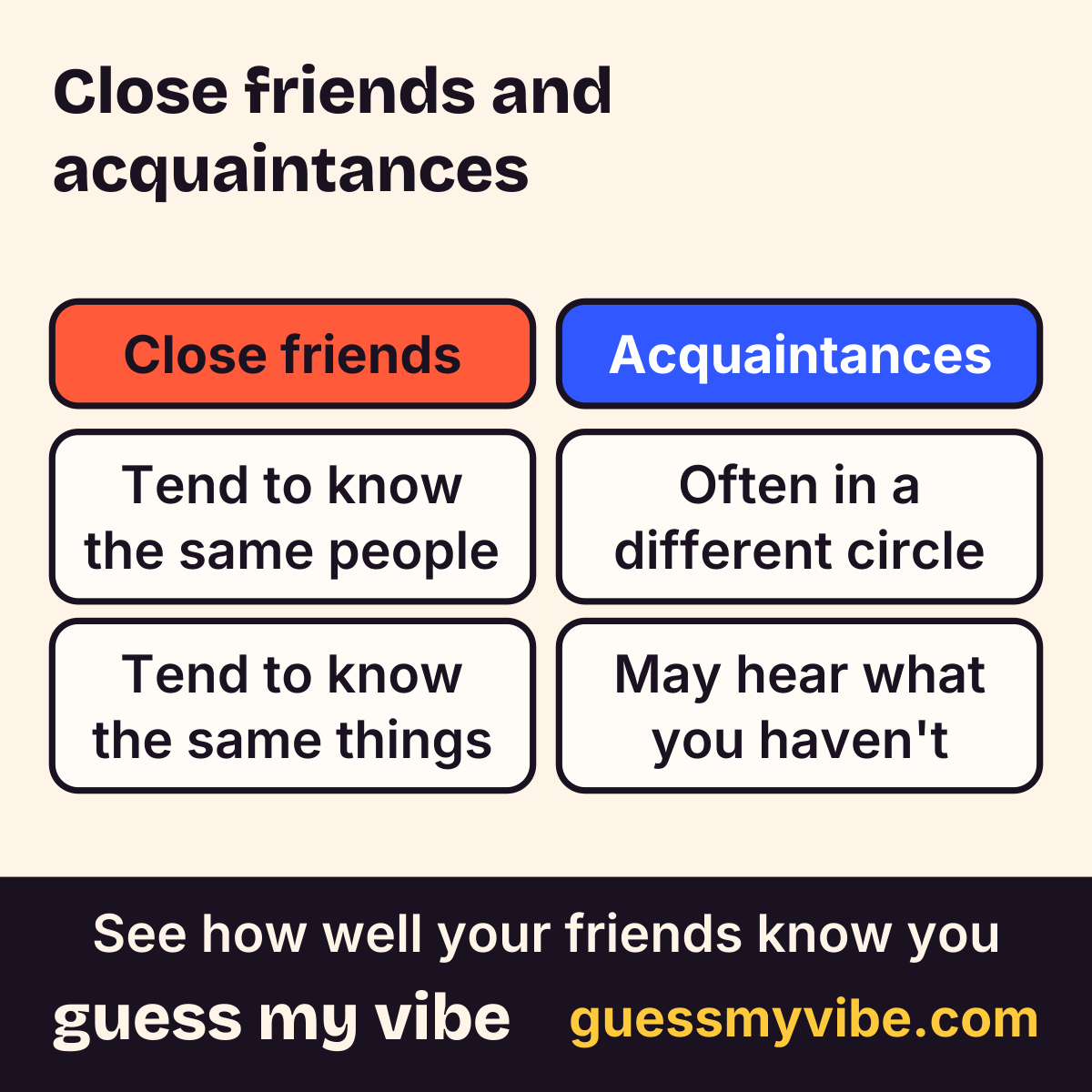
From that, the paper explores the impact on the spread of influence and information, on mobility opportunity, and on community organization, and it stresses what it calls the cohesive power of weak ties [1]. Here is our plain-language reading of that argument, not a finding of the paper. Your close friends tend to know the same people and the same things you do. An acquaintance often lives in a different circle, so they may be more likely to hear something you haven't.
As its abstract describes it, this is a paper that lays out an argument, not a single experiment with a result. Treat it as an influential framework that others have tested, which is where the next section comes in. It also overlaps with, but is separate from, the idea of mutual friends and triadic closure, which is about how new ties form through existing ones.
Cite this figure
Figure: "Close friends and acquaintances." Guess My Vibe (guessmyvibe.com). https://guessmyvibe.com/learn/strength-of-weak-ties#figure-close-friends-vs-acquaintances
A causal test: weak ties and jobs
A more recent study set out to test it causally using several large randomized experiments on LinkedIn's People You May Know feature, which recommends new connections. The experiments randomly varied how many weak ties appeared in the networks of over 20 million people over five years, a period in which 2 billion new ties and 600,000 new jobs were created. The authors report experimental causal evidence supporting the strength of weak ties and suggest three revisions to the theory [3].
- The effect is nonlinear. There was an inverted U-shaped relationship: weaker ties increased job transmission, but only up to a point, after which there were diminishing returns to tie weakness [3].
- It depends how you measure weak. Moderately weak ties, measured by mutual connections, and the weakest ties, measured by how little two people interacted, created the most job mobility [3].
- It varies by industry. Weak ties increased job mobility in more digital industries, whereas strong ties increased it in less digital industries [3].
Two cautions. This tested job transmission on a professional network, not friendship or happiness, so it does not show that acquaintances are good for your social life. And it supports the idea with a twist: it is not that the weaker the tie, the better, but that a mix matters.
Weak ties and how you feel day to day
The benefits of weak ties may not be only about information. A set of studies asked whether well-being is related to interactions with acquaintances and not just with close friends and family. In the first study, students experienced greater happiness and greater feelings of belonging on days when they interacted with more classmates than usual. The authors then widened the scope to all daily interactions, strong and weak, in two further studies and again found that weak ties were related to social and emotional well-being [2].
The honest reading is modest. This shows that on days with more casual contact, people reported feeling better. It does not show that chatting with the barista improves your life, because happier people might simply chat more, and a good day might produce both. The authors' takeaway is that even interactions with the more peripheral members of our social networks seem to contribute to well-being [2]. That is a reasonable thing to take from it, and no more than that.
A related line of work suggests one reason people skip these small interactions. Commuters on trains and buses who were told to connect with a stranger reported a more positive experience than those told to stay disconnected, with no loss of productivity. A separate group guessed the opposite, expecting solitude to be more pleasant [4]. Strangers are not exactly weak ties, and a commute is a very specific setting, but the pattern is similar: we may underrate small, low-stakes contact.
Curious how your friends would answer?
Free. Answer 10 quick questions about you, then send your link. Friends play in their browser, no app needed.
Start freeNot every friend needs to be a best friend
A useful side effect of all this is relief. If you feel guilty that your social circle is full of people you know a little, the research gives you a more generous way to see them. Granovetter's argument is that weak ties matter for how information and opportunity spread between groups [1], and everyday contact with them is associated with feeling better [2]. Neither point says close friends matter less. They suggest that your social life works best as a mix, and that the people on the edge of it are not wasted effort.
It also means the question is not only how to make more close friends. Sometimes the simpler move is to turn up regularly where the same acquaintances are, and let a few of them become something more over time. If you want to see how that second step works, our article on the stages of friendship covers what separates an acquaintance from a friend.
In everyday life, weak ties look ordinary: the classmate you sit near, a coworker from another team, the person who runs your club's group chat, a friend of a friend you see at parties. None of them is a close friend, yet each belongs to a circle you aren't in. That is exactly why they are useful for hearing about things your close friends don't know, and why a short chat with them is not a waste of an afternoon. It is also why a friend group that only ever talks to itself can feel closed in over time.
How to make use of your weak ties
- Say hello more. The classmate study found more interactions than usual went with feeling happier and more belonging that day [2]. A short hello costs little.
- Mention what you're looking for. Because a weak tie can reach a different circle [1], telling acquaintances you are looking for a job, a roommate or a hobby group can reach people your close friends can't.
- Keep a mix. The LinkedIn experiments found that tie weakness helped only up to a point [3], so you don't need to collect thousands of contacts.
- Don't assume it will be awkward. In the commuter experiments, separate participants guessed a stranger chat would be worse than solitude, while those who connected reported a more positive trip [4], so your guess about how it will go may be gloomier than the reality.
- Let a few acquaintances become friends. You don't have to, and most won't, but the loose tie is where new friendships tend to come from.
Where the research stops
A few limits are worth keeping in mind. The causal test is about jobs on one platform and found the effect differs by industry [3], so it cannot be assumed to hold in every setting. The well-being studies report associations rather than causes, and the first sample was students [2]. And the original paper is a framework from 1973, before social media and remote work changed how people stay in touch [1]. None of it supports a claim that you should have fewer close friends, or that acquaintances can do what close friends do.
Guess My Vibe is one low-pressure way to turn a weak tie into something warmer. Sending the link to someone you only know a little, and seeing what they guess about you, is a lighter ask than a long hangout, and it gives you a real conversation to start from.
Key takeaways
- A weak tie is a loose connection such as an acquaintance, and Granovetter argued that the overlap between two people's friend networks grows with how strong the tie between them is [1].
- In a large set of randomized experiments on LinkedIn, weak ties helped job mobility, but only up to a point, and the effect varied by industry [3].
- In a student study, more interactions with classmates than usual went with greater happiness and a stronger sense of belonging that day [2].
- In commuter experiments, people expected talking to a stranger to be worse than sitting alone, but those who connected reported a more positive trip [4].
- This isn't therapy, a diagnosis, or a substitute for professional care, and the research does not say weak ties can replace close friends.
Questions people ask
What is the strength of weak ties?
It is Mark Granovetter's 1973 argument that weak ties, such as acquaintances, matter because they connect you to parts of a network that close friends don't reach, which the paper explores for how information and opportunities spread [1].
What is a weak tie?
A loose connection, like an acquaintance or classmate you know a little. Granovetter argued the overlap between two people's friend networks varies with the strength of their tie, so close friends tend to share the same circle and weak ties often don't [1].
Is the strength of weak ties true?
Mostly, with caveats. Large randomized LinkedIn experiments supported it for job mobility but found the effect was nonlinear and differed by industry [3].
Do weak ties make you happier?
They are associated with it. Students were happier and felt more belonging on days they interacted with more classmates than usual, and weak ties were related to social and emotional well-being in two further studies [2]. The studies are correlational.
See how well your friends know you.
Free. Answer 10 quick questions about you, then send your link. Friends play in their browser, no app needed.
Start freeReferences
- [1] Granovetter, M. S. (1973). The Strength of Weak Ties. American Journal of Sociology, 78(6), 1360–1380. doi.org/10.1086/225469 (opens in a new tab)
- [2] Sandstrom, G. M., & Dunn, E. W. (2014). Social Interactions and Well-Being: The Surprising Power of Weak Ties. Personality and Social Psychology Bulletin, 40(7), 910–922. PubMed: 24769739 (opens in a new tab)
- [3] Rajkumar, K., Saint-Jacques, G., Bojinov, I., Brynjolfsson, E., & Aral, S. (2022). A causal test of the strength of weak ties. Science, 377(6612), 1304-1310. doi.org/10.1126/science.abl4476 (opens in a new tab)
- [4] Epley, N., & Schroeder, J. (2014). Mistakenly seeking solitude. Journal of Experimental Psychology: General, 143(5), 1980–1999. PubMed: 25019381 (opens in a new tab)
How we find and check these sources: how we write. Spotted an error? Report a correction.
Related
Want to try it with your own friends? Make a friendship quiz for your friend group
Cite this article
- Title
- The Strength of Weak Ties: Why Acquaintances Matter
- Publisher
- Guess My Vibe
- Updated
- URL
- https://guessmyvibe.com/
learn/ strength-of-weak-ties
Copy this citation
Guess My Vibe. (2026, October 4). The Strength of Weak Ties: Why Acquaintances Matter. Guess My Vibe. https://guessmyvibe.com/
To point at one section, add that section's anchor (the # link on its heading) to the URL.