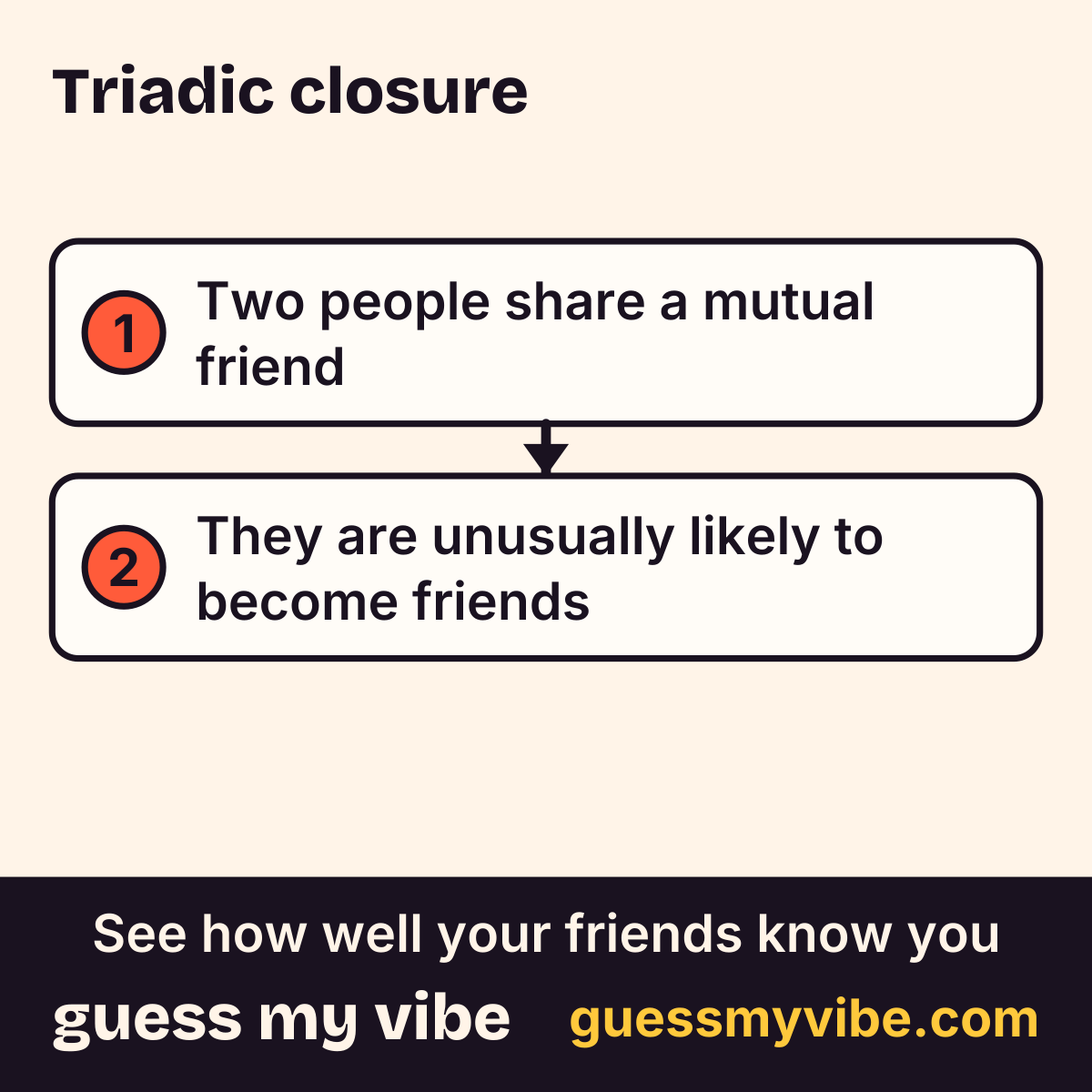
Mutual friends matter because new friendships overwhelmingly form through existing ones, a pattern researchers call triadic closure: if A and B are both friends with C, A and B are unusually likely to become friends too [1]. Mutual friends also explain a strange, well-documented effect called the friendship paradox: your friends, on average, really do have more friends than you do [2]. And a surprising number of friendships people call "mutual" turn out not to be, when researchers check both sides [3].
Mutual friends do more work in a social life than people usually give them credit for. They're not just a shortcut for "we already have something in common": they're the main mechanism by which most new friendships actually form, they explain a genuinely strange statistical effect where your friends seem to have more friends than you, and research checking both sides of real friendships finds a lot of ties people assume are mutual actually aren't. This article walks through what's behind all three.
Why friendships form through mutual friends (triadic closure)
Researchers have a name for the pattern where two people with a mutual friend go on to become friends themselves: triadic closure. A study that tracked a real, evolving network of 43,553 university students, faculty, and staff over a full academic year, using time-stamped email contact as a proxy for interaction, found that closure of exactly this kind (a shared connection turning into a direct one) was one of the main forces driving how the network grew, alongside shared activities and similarity between people [1]. In plain terms: if you and someone else both already trust the same person, that shared trust does a lot of the early work a brand-new friendship would otherwise have to build from nothing.
This idea isn't new. In one of the most cited sociology papers ever written, Mark Granovetter argued that the degree of overlap between two people's friendship networks rises directly with the strength of the tie between them [4]. Close friends tend to already share friends (dense, closed little triangles); people who are only loosely connected are far more likely to be each other's only bridge to a different, otherwise-disconnected part of the social world. That's where his famous idea of "the strength of weak ties" comes from: a close friend can introduce you to people you probably already know through someone else, but a weak tie, an acquaintance, a friend of a friend, can hand you an introduction, a job lead, or new information your close circle has no way to reach, simply because they sit in a different part of the network than you do.
Cite this figure
Figure: "Triadic closure." Guess My Vibe (guessmyvibe.com). https://guessmyvibe.com/learn/mutual-friends#figure-triadic-closure
The friendship paradox: why your friends seem more popular
Here's a genuinely odd finding that falls directly out of how mutual friends connect a network. Sociologist Scott Feld showed mathematically, then confirmed using real friendship-network data from a 1961 high school study, that on average, your friends have more friends than you do [2]. This isn't a comment on your personal popularity. It's a sampling effect: people with a lot of friends show up, by definition, in a lot of other people's friend lists, so when you average across everyone's friends, the well-connected people get counted disproportionately often. Feld connected it to a related, equally strange pattern called the "class size paradox," where students tend to experience their average class as bigger than it actually is, for the same statistical reason: bigger classes contain more students, so more students end up reporting having been in one.
The practical point isn't to feel bad about the math. It's that mutual friends (the people who connect you to other parts of a network) are exactly the mechanism that produces this effect. The more mutual friends tie a network together, the more this paradox shows up, because it's mutual connections that let popular people's friend counts ripple out and inflate everyone else's average.
Curious how your friends would answer?
Free. Answer 10 quick questions about you, then send your link. Friends play in their browser, no app needed.
Start freeFewer friendships are actually mutual than people assume
There's a third wrinkle worth knowing, and it's about the word "mutual" itself. A study of 84 students asked each person to name their friends, then checked both sides of every named friendship. People expected friendship to be close to universally mutual, naming someone as a friend in 94% of the connections where a tie existed. The actual ties were reciprocal only about 53% of the time: plenty of people named someone as a friend who didn't name them back [3]. Checking against five other published social-network datasets, the researchers found reciprocity ranging from 34% to 53% of ties, consistently far below the near-universal mutuality people assume. A "mutual friend" in the sense of a shared connection is extremely common and genuinely useful, as the triadic closure research shows. Whether a specific friendship is mutual, in the sense that both people would independently call it a close friendship, is far less certain than it feels from the inside.
Mutual friends also connect whole groups, not just two people
Triadic closure explains how one new friendship forms, but the same force also works at the level of whole friend groups. When someone with a foot in two different circles introduces people across them, those circles start to overlap, and the new overlap creates fresh opportunities for closure on its own, more shared connections, more chances for a friend of a friend to become a direct friend. That's part of why a friend group's size can grow faster than it feels like it should once two previously separate groups get even one bridge between them. It also means losing a single well-connected mutual friend can do more damage to a wider social world than losing someone who mostly just hung out inside one existing circle.
What this means for how you actually make friends
Put together, these findings point the same direction: a new friendship is far more likely to start through someone you already know than from nothing, weak ties and loose connections are doing more useful work than they get credit for, and it's worth checking your assumptions about who actually considers you a close friend rather than taking mutuality for granted. None of this needs a big gesture. It mostly means mutual friends and casual acquaintances are underrated as the place new, real friendships come from.
Guess My Vibe leans on exactly this mechanism instead of ignoring it: sending your link to a mutual friend is usually an easier ask than reaching out cold, since triadic closure means you're both already closer to that shared connection than to each other, which gives the invite a reason to land instead of getting ignored.
Key takeaways
- Most new friendships don't form between two random strangers. They form through triadic closure: two people who already share a friend become friends with each other [1].
- The strength of weak ties explains why a friend of a friend matters even when you're not especially close to the friend in the middle, weak ties are what bridge you to people and information your close friends can't reach [4].
- The friendship paradox is a real, mathematical effect: because popular people show up in more friend lists, the average friend count of your friends is almost always higher than your own [2].
- People expect friendship to be mutual almost all the time, but when researchers checked both sides of real friendship ties, only about half turned out to be reciprocal [3].
- This isn't therapy, a diagnosis, or a substitute for professional care.
Questions people ask
What does "mutual friends" actually mean?
Usually it means two people share a connection to the same third person. Research shows that shared connection is one of the main forces that actually turns strangers into friends, a pattern called triadic closure [1].
Why do new friendships so often start through a mutual friend?
Because sharing a connection with someone does a lot of the trust-building work a brand-new friendship would otherwise need to start from scratch. A real evolving social network study found this kind of closure was one of the strongest forces shaping how the network grew [1].
Is it true that your friends have more friends than you do?
On average, yes, and it's not personal. This friendship paradox is a mathematical sampling effect: popular people show up in more friend lists, which pulls up the average friend count you see among your own friends [2].
Are friendships usually mutual?
Less often than people assume. One study found people expected friendship to be mutual 94% of the time, but when both sides were actually checked, only about 53% of ties were reciprocal [3].
Why does Granovetter say weak ties matter more than close friends for some things?
Because close friends tend to already know each other, so they mostly circulate information you already have access to. A weak tie, someone you're not very close to, is more likely to be your only bridge to a different part of the social network, which is why it can introduce something genuinely new [4].
See how well your friends know you.
Free. Answer 10 quick questions about you, then send your link. Friends play in their browser, no app needed.
Start freeReferences
- [1] Kossinets, G., & Watts, D. J. (2006). Empirical Analysis of an Evolving Social Network. Science, 311(5757), 88–90. PubMed: 16400149 (opens in a new tab)
- [2] Feld, S. L. (1991). Why Your Friends Have More Friends Than You Do. American Journal of Sociology, 96(6), 1464–1477. doi.org/10.1086/229693 (opens in a new tab)
- [3] Almaatouq, A., Radaelli, L., Pentland, A., & Shmueli, E. (2016). Are you your friends' friend? Poor perception of friendship ties limits the ability to promote behavioral change. PLOS ONE, 11(3), e0151588. PubMed: 27002530 (opens in a new tab)
- [4] Granovetter, M. S. (1973). The Strength of Weak Ties. American Journal of Sociology, 78(6), 1360–1380. doi.org/10.1086/225469 (opens in a new tab)
How we find and check these sources: how we write. Spotted an error? Report a correction.
Related
Want to try it with your own friends? Make a friendship quiz for your friend group
Cite this article
- Title
- Mutual Friends: Why So Many Friendships Start Through One
- Publisher
- Guess My Vibe
- Updated
- URL
- https://guessmyvibe.com/
learn/ mutual-friends
Copy this citation
Guess My Vibe. (2026, October 3). Mutual Friends: Why So Many Friendships Start Through One. Guess My Vibe. https://guessmyvibe.com/
To point at one section, add that section's anchor (the # link on its heading) to the URL.