In personality research, neuroticism means a relatively stable tendency to respond with negative emotions to threat, frustration, or loss [1]. It is one of the Big Five traits, a sliding scale that everyone is on somewhere, not a label for a type of person and not a diagnosis. People high on it tend to feel stress more often and more strongly. People low on it, often called emotionally stable, tend to stay calmer under the same pressure.
What does neuroticism mean?
Neuroticism is the Big Five trait that describes how strongly and how often a person responds to stress with negative emotion. A standard research definition calls it a relatively stable tendency to respond with negative emotions to threat, frustration, or loss. The same review points out how wide the range is: some people have frequent and intense emotional reactions to minor setbacks, and others show little emotional reaction even in the face of significant difficulties [1]. Everyone is somewhere on that range. In the game we call the same trait Stress, because that is what it feels like from the inside.
Two things the word does not mean. It does not mean "neurotic" in the movie sense of someone who is always panicking, and it does not mean a clinical condition. It is a continuous scale, like height. A high score is not a diagnosis, and a low score is not a prize. Most people sit somewhere in the middle, and where they sit can shift with age and circumstances, as the later sections show.
Why the name sounds worse than the trait
The word comes from older psychology, and in everyday English it has picked up a judgmental edge. That is a problem for a trait that, on a questionnaire, is just one end of a scale. The other end is usually called emotional stability, meaning staying steadier under the same pressure. Our separate article on emotional stability covers that calmer end and how it shows up around friends. Describing someone as high on neuroticism is the research way of saying that stress tends to land hard and stick around, not that anything is wrong with them.
A plain-language rewrite is often more accurate: "I react strongly to stress" is a description, where "I'm neurotic" is a verdict. The research uses the first idea and, unhelpfully, the second word.
What it looks like day to day
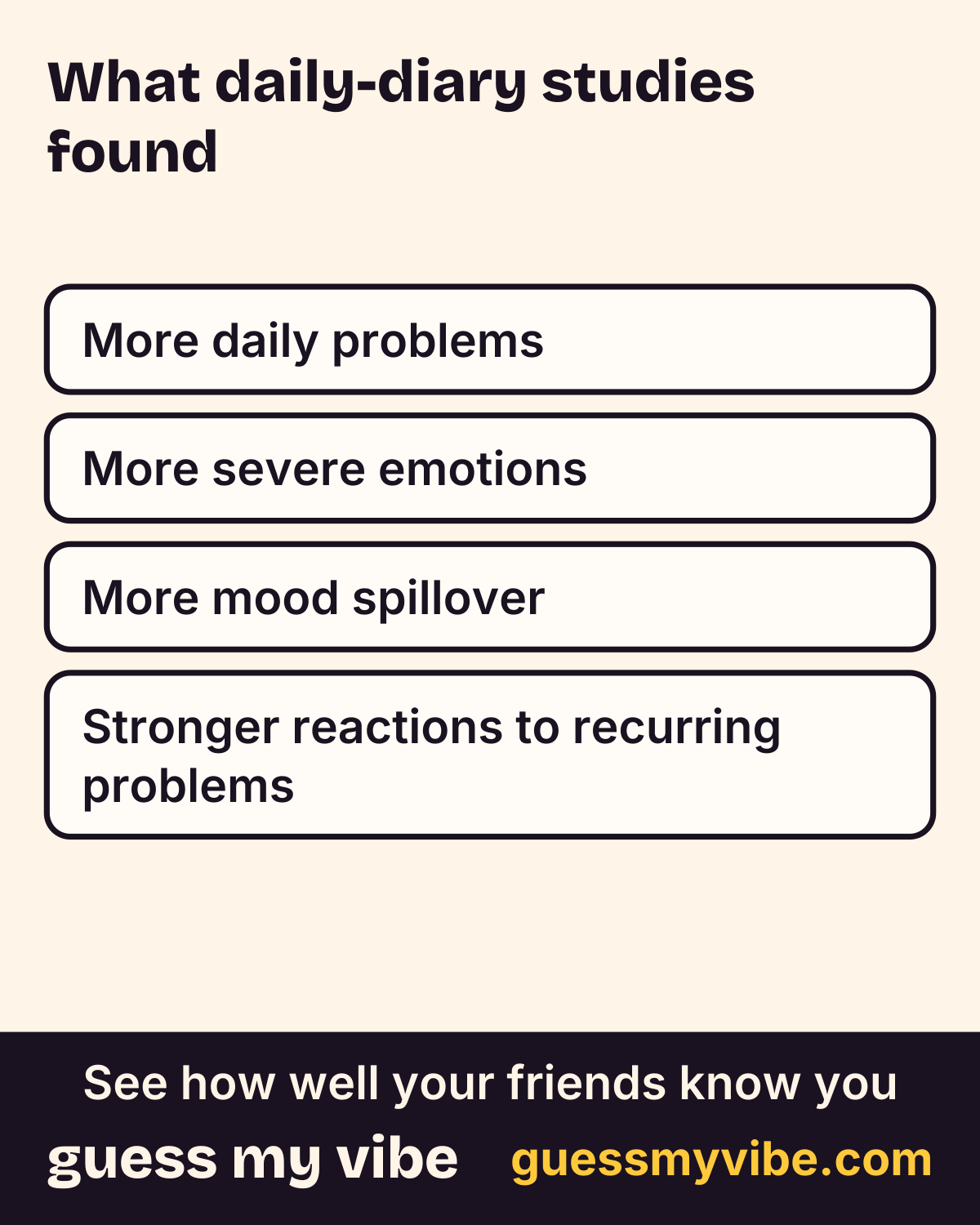
The clearest picture comes from daily-diary studies, where community residents reported problems and mood several times a day or at the end of each day. Across several of them, people who scored higher on neuroticism reported more daily problems, tended to react with more severe emotions, experienced more mood spillover from earlier in the day, and had stronger reactions to recurring problems. The authors called that pattern the "neurotic cascade" and noted that the susceptibility to stress seemed to extend to all types of problems [2].
A separate daily-diary study of 1,012 adults aged 25 to 74 over eight days found the same kind of thing from another angle: the association between a day's stress and that day's negative mood was stronger for people high in neuroticism than for people low on the trait [3]. Neither study shows why. They describe how the trait looks in ordinary life: more mood carryover, stronger reactions, and the same bad day weighing more.
Cite this figure
Figure: "What daily-diary studies found." Guess My Vibe (guessmyvibe.com). https://guessmyvibe.com/learn/neuroticism-meaning#figure-what-diary-studies-found
Curious how your friends would answer?
Free. Answer 10 quick questions about you, then send your link. Friends play in their browser, no app needed.
Start freeWhat neuroticism is not
It is not a diagnosis, and this page can't tell you anything about your own mental health. It is useful to know why researchers care about the trait, though. One major review describes neuroticism as a robust correlate and predictor of many different mental and physical disorders and of the use of health services, and argues that it is of profound public health significance and a top priority for research [1]. Read that carefully: it is a statistical relationship across large groups of people. It does not mean a high score means someone has a disorder, and it does not mean a low score protects anyone. If stress, worry, or low mood is making daily life hard, a licensed professional is the right person to talk to, not a personality article.
It also doesn't describe weakness. People high on the trait are not worse people, and being low on it is not the same as being kind, wise, or successful. It is one of five separate scales, and each of the other four says something different about a person.
Does neuroticism change with age?
On average, yes, in the direction most people hope. A meta-analysis of 92 longitudinal samples found that people increase in emotional stability, along with conscientiousness and social dominance, especially in young adulthood, roughly ages 20 to 40 [4]. A very large cross-sectional web sample of 1,267,218 people aged 10 to 65 reached a similar broad conclusion for adults: trends were overwhelmingly in the direction of greater maturity and adjustment, while late childhood and adolescence were key periods of different trends [7].
Those are averages. Individual people vary, and the second study compares different people at different ages rather than following the same people over time. The honest takeaway is that the trait is relatively stable but not frozen, and that many people calm down a little through their twenties and thirties.
Where does it come from?
A twin study of 123 sets of identical twins and 127 sets of fraternal twins estimated the broad genetic influence on neuroticism at 41 percent. It found that shared family environment accounted for a negligible proportion of the variance in most scales, and that non-shared environment, the things that differ even between siblings, made up most of the environmental influence [8]. In plain words: genes matter, but they are not destiny, and for most of the traits measured, growing up in the same house added little to how alike twins turned out. A twin study is one design, in one sample, so treat the number as an estimate and not a precise rule.
Do men and women differ?
In self-reports from 26 cultures (23,031 people), women reported higher neuroticism on average, and the authors stressed that gender differences were small relative to individual variation within each gender [9]. That means a randomly chosen woman and man will overlap a great deal. The paper measured self-reports, not behavior, so it can't say whether the gap reflects differences in feeling, in what people are willing to report, or something else.
Can your friends see it?
Partly, and this is the trait where you hold the advantage. In a study of 165 people rated by themselves, four friends, and strangers, then checked against behavioral tests, the self was the best judge of neuroticism-related traits [5]. A meta-analysis of 44,178 people rated across 263 samples found that closeness improved accuracy especially for traits low in visibility, with Emotional Stability as its example [6]. So a close friend can read some of your stress, and a stranger will read less, but you still know the most.
See whether your friends read your stress
Stress is the trait where your own view counts most, so it makes a good test of how well a friend reads you. In Guess My Vibe, a friend guesses your answers to everyday stress questions, such as whether a slow reply sends you spiraling, and the game scores how close they land. It is a fun snapshot, not a measurement of your neuroticism, and a miss here may simply mean you keep that part private.
Key takeaways
- Neuroticism is a scale, not a verdict. Researchers describe it as a relatively stable tendency to respond with negative emotions to threat, frustration, or loss, and people vary markedly on it [1].
- In daily-diary studies, people higher on neuroticism reported more daily problems, reacted with more severe emotion, and carried more mood over from earlier in the day [2].
- Stress hits harder on the same scale: in 1,012 adults followed for eight days, the link between a day's stress and that day's negative mood was stronger for people high in neuroticism [3].
- It is not fixed. Across 92 longitudinal samples, people on average became more emotionally stable, especially between ages 20 and 40 [4].
- You are usually the best judge of it: in one study, the self was the best judge of neuroticism-related traits, while closeness helps others read it [5] [6].
- This isn't therapy, a diagnosis, or a substitute for professional care.
Questions people ask
What does neuroticism mean in simple terms?
How strongly and how often someone responds to stress, threat, or frustration with negative emotion. Researchers describe it as a relatively stable tendency, and people vary markedly on it [1].
Is neuroticism a mental illness?
No. It is a personality trait, a scale everyone is on. It is statistically linked to many disorders across large groups of people [1], but a trait score is not a diagnosis. For any concern about your own health, talk to a licensed professional.
What is the opposite of neuroticism?
Emotional stability: staying steadier under the same pressure. It is the other end of the same scale, not a separate trait.
Is high neuroticism bad?
It is a description, not a grade. High scorers in daily-diary studies reported more daily problems and stronger emotional reactions to them [2], which can be hard. The trait says nothing about kindness, intelligence, or worth.
Can neuroticism change?
On average it tends to shift toward more emotional stability across adulthood, especially between about ages 20 and 40 [4]. Individual paths vary.
See how well your friends know you.
Free. Answer 10 quick questions about you, then send your link. Friends play in their browser, no app needed.
Start freeReferences
- [1] Lahey, B. B. (2009). Public health significance of neuroticism. American Psychologist, 64(4), 241–256. PubMed: 19449983 (opens in a new tab)
- [2] Suls, J., & Martin, R. (2005). The daily life of the garden-variety neurotic: Reactivity, stressor exposure, mood spillover, and maladaptive coping. Journal of Personality, 73(6), 1485–1509. PubMed: 16274443 (opens in a new tab)
- [3] Mroczek, D. K., & Almeida, D. M. (2004). The effect of daily stress, personality, and age on daily negative affect. Journal of Personality, 72(2), 355–378. PubMed: 15016068 (opens in a new tab)
- [4] Roberts, B. W., Walton, K. E., & Viechtbauer, W. (2006). Patterns of mean-level change in personality traits across the life course: A meta-analysis of longitudinal studies. Psychological Bulletin, 132(1), 1–25. PubMed: 16435954 (opens in a new tab)
- [5] Vazire, S. (2010). Who knows what about a person? The self-other knowledge asymmetry (SOKA) model. Journal of Personality and Social Psychology, 98(2), 281–300. PubMed: 20085401 (opens in a new tab)
- [6] Connelly, B. S., & Ones, D. S. (2010). An other perspective on personality: Meta-analytic integration of observers' accuracy and predictive validity. Psychological Bulletin, 136(6), 1092–1122. PubMed: 21038940 (opens in a new tab)
- [7] Soto, C. J., John, O. P., Gosling, S. D., & Potter, J. (2011). Age differences in personality traits from 10 to 65: Big Five domains and facets in a large cross-sectional sample. Journal of Personality and Social Psychology, 100(2), 330–348. PubMed: 21171787 (opens in a new tab)
- [8] Jang, K. L., Livesley, W. J., & Vernon, P. A. (1996). Heritability of the big five personality dimensions and their facets: a twin study. Journal of Personality, 64(3), 577-591. PubMed: 8776880 (opens in a new tab)
- [9] Costa, P. T., Jr., Terracciano, A., & McCrae, R. R. (2001). Gender differences in personality traits across cultures: Robust and surprising findings. Journal of Personality and Social Psychology, 81(2), 322-331. PubMed: 11519935 (opens in a new tab)
How we find and check these sources: how we write. Spotted an error? Report a correction.
Related
- Emotional Stability: What It Means and Why It Helps Friends
- Neuroticism in Relationships: What the Research Shows
- Overthinking Texts: Why You Reread Every Message
- Is Personality Genetic? About 40%, Says the Research
- Personality Blind Spots: What You Can't See About Yourself
- Self-Perception vs. How Others See You
Cite this article
- Title
- Neuroticism Meaning: What the Trait Actually Is
- Publisher
- Guess My Vibe
- Updated
- URL
- https://guessmyvibe.com/
learn/ neuroticism-meaning
Copy this citation
Guess My Vibe. (2026, October 6). Neuroticism Meaning: What the Trait Actually Is. Guess My Vibe. https://guessmyvibe.com/
To point at one section, add that section's anchor (the # link on its heading) to the URL.