The short answer: no, not really. The largest studies on birth order, each tracking thousands of real families, find essentially no effect on personality. In those studies, being the oldest, the youngest, or stuck in the middle was not linked to differences in extraversion, agreeableness, conscientiousness, or the other broad traits tested [1]. The data doesn't back birth order theory, and one reason it may feel true anyway is the way families tell stories about their kids.
What birth order theory actually claims
Search "birth order" and you'll land in a tidy, decades-old sorting system: firstborns are supposedly bossy and responsible, middle children are overlooked peacemakers, youngest children are charming and a little spoiled, and only children are serious little adults who never learned to share. Birth order theory goes back over a century, to ideas the psychiatrist Alfred Adler popularized in the early 1900s, and it has never really left pop culture. The honest answer, once large modern studies actually went looking for these effects, is that they mostly aren't there. Where you land in the sibling lineup has close to zero effect on your actual personality.
What large studies actually found
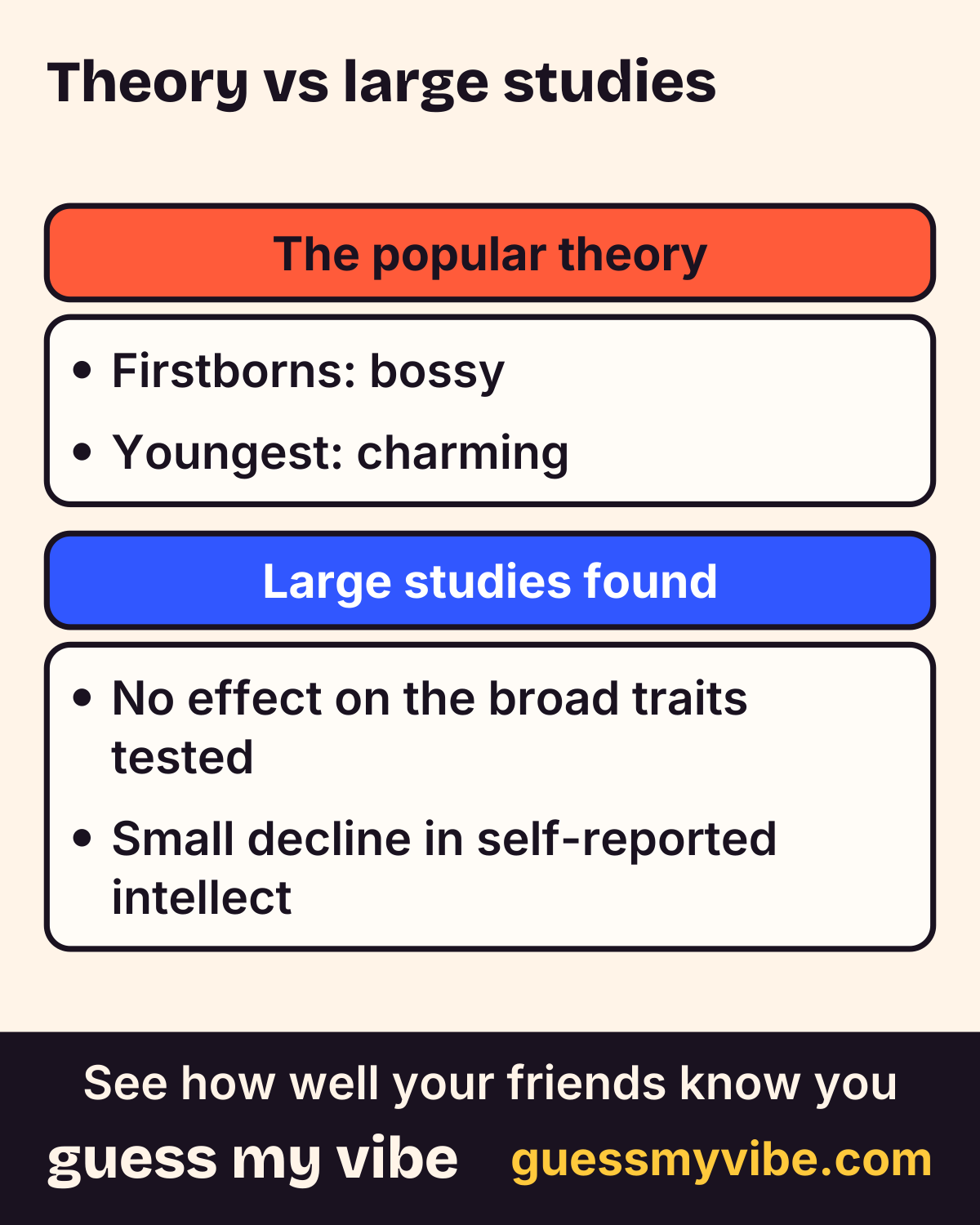
For most of the 20th century, birth order research was a mess of small samples and contradictory results, which is exactly the kind of gap pop psychology loves to fill with confident claims. That changed once researchers ran studies big enough to catch even a tiny effect. One team pulled data from three national panels, in the United States, Great Britain, and Germany, totaling more than 20,000 people, and tested birth order two different ways: comparing siblings directly within the same family, and comparing people from different families to each other [1]. Both approaches agreed. Birth order had no effect on extraversion, emotional stability, agreeableness, conscientiousness, or imagination. The one real finding was about intellect, not personality: a decline of about a tenth of a standard deviation in self-reported intellect with increasing birth-order position, which held up even after the researchers controlled for actual measured IQ. That's a statistically significant effect, but a small one.
A separate team looked at how birth order is associated with both personality and intelligence in a representative sample of U.S. high school students [2]. The full paper is paywalled and no abstract was available to us, so we can't report its sample size or effect sizes, and we aren't leaning on it for any number. We mention it because its title and scope show that researchers have also tested this question outside the three national panels above.
A third study pushed past the standard Big Five traits entirely, testing whether birth order might show up in narrower, more specific characteristics instead: life satisfaction, how much someone trusts others, risk-taking, patience, impulsivity, and political leanings [3]. Using a technique called specification-curve analysis, which runs the same question through many reasonable variations of the analysis instead of picking just one, the researchers again confirmed the small intellect effect and again found nothing meaningful for any of the personality-adjacent traits. The two studies we could read in full used large samples and several analysis strategies, and they point the same way: in those data, broad personality traits didn't sort themselves by birth position.
Cite this figure
Figure: "Theory vs large studies." Guess My Vibe (guessmyvibe.com). https://guessmyvibe.com/learn/birth-order#figure-theory-vs-studies
Why does birth order affect intellect, but not personality?
The small, real intellect effect is worth pausing on, since it's the one piece of birth order theory the data doesn't fully dismiss. One explanation researchers have proposed is a confluence model: a firstborn spends a stretch of early childhood as the only child in the house, getting undiluted adult attention and conversation, before a sibling arrives and that attention gets split. A later-born child, by contrast, always shares parental attention with at least one older sibling from day one. That's a plausible mechanism for a small, early difference in verbal and intellectual environment. It says nothing about warmth, outgoingness, or emotional steadiness, because there's no equivalent reason those traits would track the same kind of early-childhood resource split. Intellect and personality aren't the same thing, and birth order theory's one real finding and its many non-findings turn out to make sense together once you see why.
Curious how your friends would answer?
Free. Answer 10 quick questions about you, then send your link. Friends play in their browser, no app needed.
Start freeWhy birth order theory feels so true anyway
If the data is this clear, why does nearly everyone have a story about how being the oldest or the baby of the family shaped who they are? A few ordinary things are doing the work. Families tell stories, and stories flatten people into roles: once "the responsible one" and "the free spirit" get assigned at Thanksgiving, every new piece of behavior gets filed under the label that already exists, while anything that doesn't fit quietly gets forgotten. That's a well-documented habit of memory in general, not something unique to siblings, but families have an unusually long, unusually repeated story to apply it to.
There's also a timing problem in a lot of older birth order research: comparing a 16-year-old firstborn to an 8-year-old laterborn and calling the difference "birth order" is really just comparing a teenager to a child, since age does affect behavior. Careful studies control for that; casual observation at the dinner table doesn't. And genuinely different parenting does happen across a family's timeline (nervous first-time parents loosen up by kid three), which is a real pattern worth noticing. It's just not a personality effect that shows up in the adult sitting in front of you decades later, once a large sample averages out all the individual family stories.
If not birth order, what actually makes siblings so different?
This is the genuinely interesting part the birth order myth distracts from. Siblings who grow up in the same house, with the same parents, often turn out to have quite different personalities, and the honest explanation comes down to something behavioral geneticists call the nonshared environment, not birth order. A classic line of research on this found that most of the environmental influence on personality, psychopathology risk, and cognitive ability comes from the things that happen differently to each child in a family, not the things the family shares [4]. Two kids raised by the same parents, in the same house, still get different friend groups, different teachers, different injuries, different lucky breaks, and even a measurably different version of the same parents, who are themselves older and changed by the time the second kid shows up. Adopted siblings, who share a family environment but not genes, end up with personality correlations close to zero on most traits, which is the clearest evidence that what a family shares matters far less than what happens separately to each person in it. Birth order is one tidy label for all of that complexity; it just isn't the right one.
What this actually means for you and your family
None of this is a dig at anyone who feels like their birth order shaped them. Feeling responsible as the oldest, or feeling like you had to be louder to get noticed as a middle child, can be a real, honest memory of your own family's dynamics, even though it isn't a trait large population studies can detect. The research just says you shouldn't expect birth order alone to tell you much about a stranger's personality, or your own future kid's. If you actually want to know how your personality compares with a sibling's, guessing is a lot more interesting than assuming a label fits. That's the same idea behind Guess My Vibe: a sibling answers the same real personality questions you do, so you see exactly where your guesses about each other land and where they miss, instead of defaulting to "well, I'm the oldest, so..."
Key takeaways
- Across three large national samples (about 20,000 people total), tested both between different families and within the same family, birth order had no measurable effect on extraversion, emotional stability, agreeableness, conscientiousness, or imagination [1].
- Another study examined how birth order is associated with personality and with intelligence in a representative sample of U.S. high school students [2]. We could only verify its title and scope, so we don't quote its numbers.
- The one small birth order effect those researchers found is on self-reported intellect, not personality, and it was about a tenth of a standard deviation, a small difference [1].
- A follow-up study tested birth order against narrower traits too (life satisfaction, trust, risk-taking, patience, impulsivity) and found no meaningful effects on those either, so the lack of effect was not limited to broad traits [3].
- This isn't therapy, a diagnosis, or a substitute for professional care.
Questions people ask
Does birth order really affect personality?
Essentially no, according to the largest studies we could verify. Research spanning more than 20,000 people across three countries found no effect of birth order on extraversion, emotional stability, agreeableness, conscientiousness, or imagination, whether siblings were compared within the same family or across different families [1].
Is there any real evidence for birth order theory?
The one effect those studies found is a small decline in self-reported intellect with increasing birth-order position, about a tenth of a standard deviation, and it was not an effect on the broad personality traits [1].
Why do firstborns seem more responsible if birth order doesn't matter?
Probably a mix of family storytelling and small, real differences in how parents acted over time, not a lasting personality effect. Researchers have studied birth order's links with personality and intelligence in a representative sample of U.S. high school students [2], but the strongest evidence we could verify is the three-panel study, which found no effects on broad personality traits [1].
What about only children or middle child syndrome?
A follow-up study of narrower traits, like trust, risk-taking, and life satisfaction, found no meaningful birth-order effects there either [3]. That study looked at birth-order position in general, so it doesn't test any specific label like "middle child syndrome" on its own.
If birth order doesn't explain sibling differences, what does?
Mostly the nonshared environment: the different friends, teachers, experiences, and even differently-aged versions of the same parents that each sibling ends up with, even growing up in one house. The review argues it is the major source of environmental influence on personality in a family [4].
See how well your friends know you.
Free. Answer 10 quick questions about you, then send your link. Friends play in their browser, no app needed.
Start freeReferences
- [1] Rohrer, J. M., Egloff, B., & Schmukle, S. C. (2015). Examining the effects of birth order on personality. Proceedings of the National Academy of Sciences, 112(46), 14224–14229. PubMed: 26483461 (opens in a new tab)
- [2] Damian, R. I., & Roberts, B. W. (2015). The associations of birth order with personality and intelligence in a representative sample of U.S. high school students. Journal of Research in Personality, 58, 96–105. doi.org/10.1016/j.jrp.2015.05.005 (opens in a new tab)
- [3] Rohrer, J. M., Egloff, B., & Schmukle, S. C. (2017). Probing Birth-Order Effects on Narrow Traits Using Specification-Curve Analysis. Psychological Science, 28(12), 1821–1832. PubMed: 29040007 (opens in a new tab)
- [4] Plomin, R., & Daniels, D. (2011). Why are children in the same family so different from one another?. International Journal of Epidemiology, 40(3), 563–582. PubMed: 21807642 (opens in a new tab)
How we find and check these sources: how we write. Spotted an error? Report a correction.
Related
- Sibling Relationships: Closeness, Conflict and Personality
- How Well Do You Know Me Questions to Ask Friends
- BFF Test: A Real One to Take With Your Best Friend
- Why Are Siblings So Different? What Twin Studies Show
- Traits of First-Born Children: Myth vs Research
- Middle Child Syndrome Isn't Real (Here's What Is)
- Only Child Syndrome: The Myth and the Data
- Sibling Rivalry in Adulthood: What Research Says
More in Family, siblings and birth order
- Why Are Siblings So Different? What Twin Studies Show
- Is Personality Genetic? About 40%, Says the Research
- Do Twins Have the Same Personality? What Studies Show
- Traits of First-Born Children: Myth vs Research
- Middle Child Syndrome Isn't Real (Here's What Is)
- Only Child Syndrome: The Myth and the Data
- Sibling Rivalry in Adulthood: What Research Says
- Sibling Relationships: Closeness, Conflict and Personality
Cite this article
- Title
- Birth Order and Personality: What the Evidence Shows
- Publisher
- Guess My Vibe
- Updated
- URL
- https://guessmyvibe.com/
learn/ birth-order
Copy this citation
Guess My Vibe. (2026, October 3). Birth Order and Personality: What the Evidence Shows. Guess My Vibe. https://guessmyvibe.com/
To point at one section, add that section's anchor (the # link on its heading) to the URL.