Middle child syndrome isn't a recognized medical or psychological condition. It's a pop-psychology label for the idea that middle children feel overlooked, and the large studies don't support a reliable middle-child personality. A study of more than 700,000 adults found middle-borns scored slightly higher, not lower, on honesty-humility and agreeableness, though the differences were small once family size was accounted for [1].
Is middle child syndrome real? Not as a syndrome. It isn't a recognized medical or psychological condition, and no large study we found describes a distinct middle-child personality. The phrase is a pop-psychology shorthand for a story: that children born between an older and a younger sibling get less attention, feel invisible, and grow up to be peacemakers, rebels or people-pleasers. The research on birth order doesn't back that story as a rule. If anything, the biggest sample we could find points the opposite way on warmth and cooperation [1].
This article covers where the "syndrome" idea comes from, what the large studies actually show for middle children, why the label still feels true to so many people, and what is useful about it. For the full birth-order debate, including oldest and youngest children, see our guide to birth order. For the oldest-child version of this question, see our guide to traits of firstborns.
What "middle child syndrome" claims
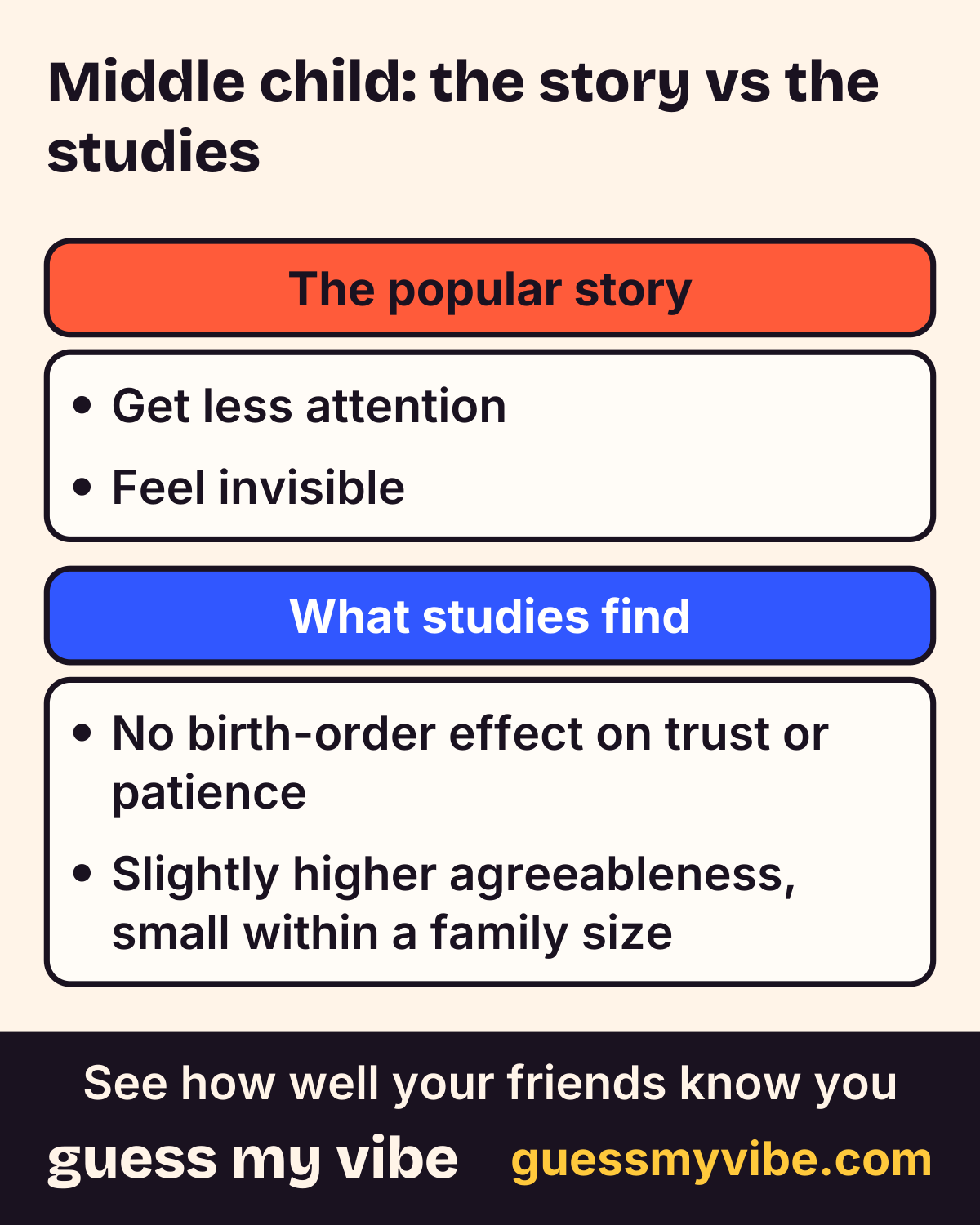
The popular version goes like this. The oldest child gets the first-time-parent attention and the responsibility. The youngest gets the doting and the leniency. The middle child gets neither, so they either work harder for notice, rebel, keep the peace, or look for belonging with friends instead of family. You can find a version of this in jokes, parenting blogs and personality quizzes.
It's important to be clear about the word "syndrome." In health care, a syndrome is a recognized pattern of symptoms that goes with a condition. Middle child syndrome is not a recognized condition, and the people who use the phrase usually mean it casually. We use the term only because it's what people search for. Nothing in this article is meant to suggest a middle child has, or doesn't have, anything that needs treatment. If you're struggling with how you feel about your family, a mental health professional is the right person to talk to.
What the large studies find
A caveat first. Most of the rigorous birth-order studies test birth-order position broadly, not the middle slot alone, and their abstracts don't single out middle children. Still, that evidence bears directly on the syndrome claim, because a middle-child personality would have to show up as a birth-order effect.
Researchers using three national panels (US n = 5,240; Great Britain n = 4,489; Germany n = 10,457) compared siblings with different birth-order positions within the same family, and also people across different families. They consistently found no birth-order effects on extraversion, emotional stability, agreeableness, conscientiousness or imagination, and concluded that birth order does not have a lasting effect on broad personality traits outside of the intellectual domain [2]. A follow-up in a large representative sample tested narrower traits with a method that checks many defensible analysis choices. It found no meaningful birth-order effects on life satisfaction, locus of control, interpersonal trust, reciprocity, risk taking, patience, impulsivity or political orientation [3]. A study of U.S. high school students also examined associations of birth order with personality and intelligence in a representative sample [4]. We don't quote its numbers because we could not open its abstract.
Those studies found no birth-order effects on trust, patience or life satisfaction, so they give no support to the idea that middle children are systematically less trusting, less patient or less satisfied with life. The one effect the national panels did find was on intellect, a decline of about a tenth of a standard deviation in self-reported intellect with increasing birth-order position, which has nothing to do with the middle child's feelings of being overlooked [2].
Cite this figure
Figure: "Middle child: the story vs the studies." Guess My Vibe (guessmyvibe.com). https://guessmyvibe.com/learn/middle-child-syndrome#figure-story-vs-studies
Curious how your friends would answer?
Free. Answer 10 quick questions about you, then send your link. Friends play in their browser, no app needed.
Start freeThe one study that looks at middle-borns directly
Ashton and Lee (2025) split people into birth-order categories (first, middle, last and only) and looked at the HEXACO personality traits in a sample of more than 700,000 online adults, mainly from English-speaking countries. Honesty-humility and agreeableness had the highest means for middle-borns, followed by last-borns, then firstborns, then only children, with differences between middles and onlys of d of at least 0.20. A second, smaller sample of more than 70,000 replicated the pattern [1].
If you take the stereotype of the peacekeeping middle child literally, that looks like a point in its favor, since agreeableness measures cooperativeness and warmth. But the paper adds cautions that matter. The second sample measured family size too, and honesty-humility and agreeableness were higher in larger families. Once family size was held constant, birth-order differences were considerably smaller, with oldests up to d = 0.10 lower than middles and youngests [1]. That is a tenth of a standard deviation, small enough to be invisible in any single family. There's also an obvious caveat: a middle child must have at least two siblings, so "middle" is confounded with having a larger family, which is why the family-size analysis matters. And the data are self-reports from an online sample, so they may not represent everyone.
The fair summary, then, is that the best data for middle children don't show the resentful, invisible, attention-seeking pattern the syndrome describes. They show, if anything, slightly higher agreeableness and honesty-humility that mostly shrinks when you account for how many siblings someone has. That's neither a diagnosis nor a destiny.
Why the label still feels true
Many middle children say the stereotype fits them, and that's worth taking seriously. The explanations that follow are our own reasoning, not findings from the studies above. First, families often really do pay different amounts of attention to different children at different times. A firstborn has a stretch alone with the parents, and a youngest is the last one at home. A middle child never has either of those, and it can be easy to remember the moments of being passed over. Second, memory is selective: once a story fits, a person notices the examples that confirm it. Third, "I felt overlooked" is a feeling about a specific family, and it can be true for one family and not another.
None of that requires a group-wide middle-child personality. The large studies are averages over many families, and an average can hide a lot of individual stories. A real feeling about your own childhood and a lack of a population-level pattern can both be true. If a middle child feels they were overlooked, that experience deserves to be taken seriously without needing a syndrome to explain it.
What to do with this
If you're a middle child, the practical message is that your birth position isn't a verdict on you. You aren't doomed to be a people-pleaser or a rebel, and you aren't guaranteed to be a mediator. The research doesn't say what you are like. If you want to know that, a more useful approach is to look at how you act across situations and how the people close to you describe you.
That's what Guess My Vibe is built for. You answer a set of personality questions, your friends and siblings answer the way they think you would, and you see where their read matches yours and where it differs. For a middle child, it can be a nice way to find out whether the people around you see you the way the stereotype says, or the way you actually are.
Key takeaways
- "Middle child syndrome" is a popular phrase, not a medical or psychological diagnosis, and nothing in the research we read describes it as one.
- Three national panels found no birth-order effect on extraversion, emotional stability, agreeableness, conscientiousness or imagination [2], and no meaningful effect on trust, patience, impulsivity or risk taking [3].
- In a very large online sample, middle-borns had the highest average honesty-humility and agreeableness of any birth-order group, with differences of d of at least 0.20 from only children, which is the opposite of the resentful stereotype [1].
- Within a given family size, birth-order differences were considerably smaller, and the data are self-reports from an online sample, so they don't make a case for a middle-child personality [1].
- Feeling overlooked in a family can be real for some middle children even though it isn't a group-wide personality pattern. This isn't therapy, a diagnosis, or a substitute for professional care.
Questions people ask
Is middle child syndrome a real diagnosis?
No. It's a popular phrase, not a recognized medical or psychological diagnosis. The large birth-order studies we read test personality traits across birth-order positions and don't describe a syndrome [2].
What is the personality of a middle child?
There's no reliable single answer. Three national panels found no birth-order effect on the Big Five [2]. A very large online sample found middle-borns had the highest average honesty-humility and agreeableness, but differences were small once family size was accounted for [1].
Are middle children more likely to feel left out?
Some do, and that experience is real for them. But the studies we read don't show a group-wide pattern in traits like trust, life satisfaction or patience across birth order [3]. Feeling overlooked varies from family to family.
Are middle children better at getting along with others?
One large study found middle-borns had the highest average agreeableness, but the differences shrank considerably once family size was held constant [1]. It is a small, self-reported difference, not a rule about any individual.
See how well your friends know you.
Free. Answer 10 quick questions about you, then send your link. Friends play in their browser, no app needed.
Start freeReferences
- [1] Ashton, M. C., & Lee, K. (2025). Personality differences between birth order categories and across sibship sizes. Proceedings of the National Academy of Sciences, 122(1), e2416709121. PubMed: 39715437 (opens in a new tab)
- [2] Rohrer, J. M., Egloff, B., & Schmukle, S. C. (2015). Examining the effects of birth order on personality. Proceedings of the National Academy of Sciences, 112(46), 14224–14229. PubMed: 26483461 (opens in a new tab)
- [3] Rohrer, J. M., Egloff, B., & Schmukle, S. C. (2017). Probing Birth-Order Effects on Narrow Traits Using Specification-Curve Analysis. Psychological Science, 28(12), 1821–1832. PubMed: 29040007 (opens in a new tab)
- [4] Damian, R. I., & Roberts, B. W. (2015). The associations of birth order with personality and intelligence in a representative sample of U.S. high school students. Journal of Research in Personality, 58, 96–105. doi.org/10.1016/j.jrp.2015.05.005 (opens in a new tab)
How we find and check these sources: how we write. Spotted an error? Report a correction.
Related
Cite this article
- Title
- Middle Child Syndrome Isn't Real (Here's What Is)
- Publisher
- Guess My Vibe
- Updated
- URL
- https://guessmyvibe.com/
learn/ middle-child-syndrome
Copy this citation
Guess My Vibe. (2026, October 4). Middle Child Syndrome Isn't Real (Here's What Is). Guess My Vibe. https://guessmyvibe.com/
To point at one section, add that section's anchor (the # link on its heading) to the URL.