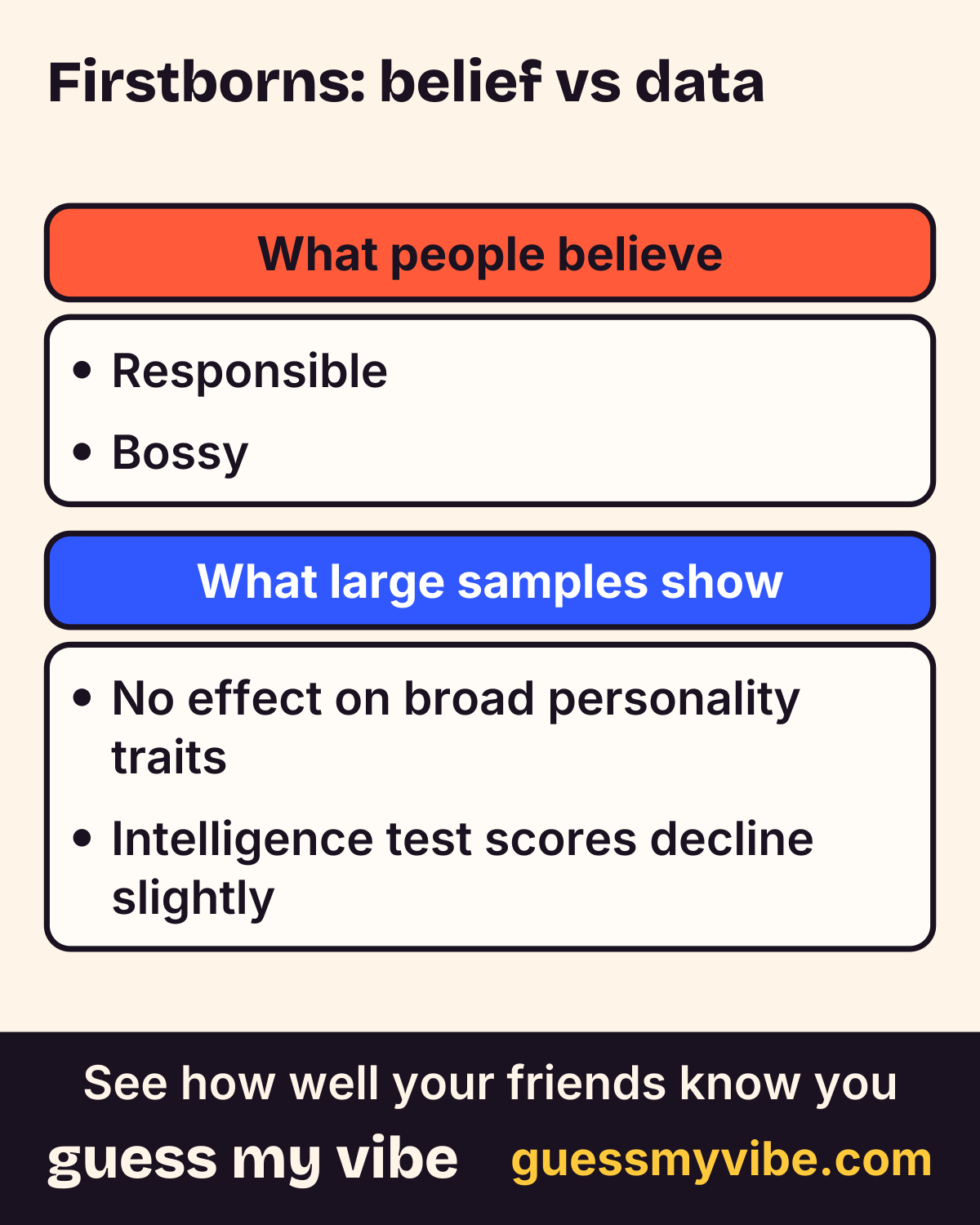
The popular traits of a first born are responsible, driven and bossy. In three large national samples (about 20,000 people), being the firstborn had no effect on conscientiousness, extraversion, agreeableness, emotional stability or imagination [1]. The one thing that did show up was a small edge on intelligence-test performance, not a personality trait. A bigger online sample later found small differences, so the honest picture is tiny effects at most.
What are the traits of a first born? Ask almost anyone and you'll hear the same list: responsible, organized, ambitious, a natural leader, maybe a little bossy or perfectionistic. The research tells a quieter story. Studies of thousands of families found no effect of being the oldest on conscientiousness, extraversion, agreeableness, emotional stability or imagination [1]. If firstborns do have an edge, it shows up in intelligence-type measures, not in the personality traits people usually talk about.
This article goes claim by claim through what people believe about oldest children and checks each against the evidence. For the wider debate about birth order across all positions, including why the idea feels true, see our guide to birth order. For what the research says about siblings getting along, see our guide to sibling relationships.
What people believe about firstborns
The folk picture of the oldest child has a few recurring parts. Firstborns are said to be responsible and conscientious, because they are asked to help with younger siblings. They are said to be high achievers and leaders, because they get undivided attention early on. And they are said to be bossy, controlling or anxious to please, because they are used to being in charge. These are beliefs from popular culture and family storytelling, and a lot of people feel they fit. Whether they fit large groups of people is a separate question, and it's one researchers have tested directly.
What the large samples show
The strongest tests use big samples and two different designs. One study used national panels from the United States (n = 5,240), Great Britain (n = 4,489) and Germany (n = 10,457). It compared siblings with different birth-order positions within the same family, and it compared people from different families. The authors report that they consistently found no birth-order effects on extraversion, emotional stability, agreeableness, conscientiousness or imagination, and concluded that birth order does not have a lasting effect on broad personality traits outside of the intellectual domain [1]. In plain words, there was no sign that oldest children were more conscientious or more outgoing than their siblings, nor than other people's children.
A second study asked whether the myth might hide in narrower traits rather than the broad five. Using a large representative sample and a method that runs the same question through many defensible analysis choices, the authors confirmed the earlier intellect effect but found no meaningful effects on life satisfaction, locus of control, interpersonal trust, reciprocity, risk taking, patience, impulsivity or political orientation [2]. So the "firstborns are more cautious" or "firstborns are more patient" versions of the claim didn't show up either, at least as people described themselves.
Cite this figure
Figure: "Firstborns: belief vs data." Guess My Vibe (guessmyvibe.com). https://guessmyvibe.com/learn/traits-of-first-born#figure-belief-vs-large-samples
The one real edge: intellect, not personality
There is one consistent finding, and it deserves to be stated fairly. Research on birth order and intelligence has documented that scores on psychometric intelligence tests decline slightly from firstborns to later-borns [1]. In the national panels, the authors confirmed that pattern and also observed a decline of about a tenth of a standard deviation in self-reported intellect with increasing birth-order position, which persisted after controlling for objectively measured intelligence [1]. That is a small shift. A tenth of a standard deviation is far too little to tell you whether any given oldest child is smarter than their younger sister. Think of it as a tiny tilt in a very large group, not a trait you'd spot in a family.
A study of U.S. high school students (Damian and Roberts, 2015) examined how birth order relates to both personality and intelligence in a representative sample. [4] We don't quote its numbers here because we could not open its abstract, so we can only point readers to it.
Curious how your friends would answer?
Free. Answer 10 quick questions about you, then send your link. Friends play in their browser, no app needed.
Start freeThe evidence isn't completely one-sided
A newer, much bigger study complicates the "no effect" story. Ashton and Lee (2025) analyzed self-reports on the HEXACO personality inventory from more than 700,000 online adults, mainly from English-speaking countries, and replicated the pattern in a second sample of more than 70,000. Honesty-humility and agreeableness had the highest averages for middle-borns, then last-borns, then firstborns, then only children, with differences between middles and onlys of d of at least 0.20 [3]. For firstborns specifically, that means a slightly lower average on those two traits than middle-borns, not the more demanding, more dominant picture of the stereotype.
The second sample also measured family size, which lets researchers separate birth order from how many siblings someone has. Honesty-humility and agreeableness were higher with larger sibship sizes, and within a given family size the birth-order differences were considerably smaller: oldests remained up to d = 0.10 lower than middles and youngests on those two traits, and about d = 0.10 higher on openness [3]. A d of 0.10 is a tenth of a standard deviation, tiny by any standard. So the best reading of the evidence is mixed in detail but consistent in size: the most careful large studies find either nothing or very small differences for firstborns. We can only guess at why the studies differ. They use different personality measures and different kinds of samples (national panels versus an online sample). Either way, these are self-reports and correlations, not proof that birth order causes any gap.
Why the stereotype still feels true
Even with small effects, many oldest children recognize themselves in the list. A few ordinary things could explain that, although these are our own explanations, not findings from the studies above. First, oldest children really do have a different role at home for a while. An eight-year-old asked to watch a toddler is behaving responsibly in that moment, whether or not that behavior sticks for life. Second, families like labels. Once someone is "the responsible one," people notice the evidence for it and forget the exceptions.
Third, there is the age problem. At any one time an oldest sibling is older than the others, and older people are generally more capable than younger ones simply because they are older. Careful studies compare people at the same age or measure adults, but casual observation at the dinner table doesn't. Fourth, the people who write about birth order tend to write in stories, and stories flatten people into roles. None of these require birth order to shape anyone's personality.
What this means if you're the oldest
If you're a firstborn and you do feel like the responsible one, that's a real feeling about your own family, and the research doesn't say your memories are wrong. It says the label isn't a reliable guide to how any firstborn is likely to act as an adult, and it's not a reason to expect anything particular from someone you meet. Your personality is better read from how you actually behave across situations than from where you landed in the lineup.
A more interesting test is to ask the people around you. Do your siblings and friends describe you the way the stereotype would? In Guess My Vibe, friends and siblings answer personality questions the way they think you would, and you see where they match you and where they miss. If you're the oldest, it's a fun way to find out whether the "responsible one" label shows up in how the people closest to you actually see you.
Key takeaways
- Three national panels (US, Great Britain, Germany) found no birth-order effect on extraversion, emotional stability, agreeableness, conscientiousness or imagination, whether comparing siblings within a family or people across families [1].
- The consistent exception is intelligence: test performance declines slightly from firstborns to later-borns, and self-reported intellect declines by about a tenth of a standard deviation with increasing birth-order position [1].
- Narrower traits such as trust, patience, impulsivity and risk taking showed no meaningful birth-order effects either [2].
- A very large online sample (more than 700,000 adults) did find differences: firstborns averaged somewhat lower on honesty-humility and agreeableness than middle-borns, but within a given family size the gaps were small, up to d = 0.10 [3].
- This isn't therapy, a diagnosis, or a substitute for professional care.
Questions people ask
What are the personality traits of a first born?
Popular belief says responsible, ambitious and bossy. In three large national panels, birth order had no effect on extraversion, emotional stability, agreeableness, conscientiousness or imagination [1]. A larger online sample found small differences, with firstborns somewhat lower than middle-borns on honesty-humility and agreeableness [3].
Are first born children smarter?
There is a small average edge. Scores on intelligence tests decline slightly from firstborns to later-borns, and self-reported intellect declines about a tenth of a standard deviation with increasing birth-order position [1]. That is far too small to tell you about any one person.
Are firstborns more responsible or conscientious?
Not in the large studies. The national panel study found no birth-order effect on conscientiousness, whether it compared siblings within families or people across families [1].
Are firstborns more likely to be bossy or perfectionistic?
Bossiness and perfectionism aren't among the traits named in the abstracts we read. Those studies did find no birth-order effect on broad traits like extraversion and agreeableness [1], and none on narrower traits such as patience, trust and risk taking [2].
Why do so many people think birth order matters?
Probably a mix of real differences in role within the family, family storytelling and the fact that older siblings are older. These are plausible explanations rather than tested findings. The large studies find that personality traits don't line up much with birth order [1].
See how well your friends know you.
Free. Answer 10 quick questions about you, then send your link. Friends play in their browser, no app needed.
Start freeReferences
- [1] Rohrer, J. M., Egloff, B., & Schmukle, S. C. (2015). Examining the effects of birth order on personality. Proceedings of the National Academy of Sciences, 112(46), 14224–14229. PubMed: 26483461 (opens in a new tab)
- [2] Rohrer, J. M., Egloff, B., & Schmukle, S. C. (2017). Probing Birth-Order Effects on Narrow Traits Using Specification-Curve Analysis. Psychological Science, 28(12), 1821–1832. PubMed: 29040007 (opens in a new tab)
- [3] Ashton, M. C., & Lee, K. (2025). Personality differences between birth order categories and across sibship sizes. Proceedings of the National Academy of Sciences, 122(1), e2416709121. PubMed: 39715437 (opens in a new tab)
- [4] Damian, R. I., & Roberts, B. W. (2015). The associations of birth order with personality and intelligence in a representative sample of U.S. high school students. Journal of Research in Personality, 58, 96–105. doi.org/10.1016/j.jrp.2015.05.005 (opens in a new tab)
How we find and check these sources: how we write. Spotted an error? Report a correction.
Related
Cite this article
- Title
- Traits of First-Born Children: Myth vs Research
- Publisher
- Guess My Vibe
- Updated
- URL
- https://guessmyvibe.com/
learn/ traits-of-first-born
Copy this citation
Guess My Vibe. (2026, October 4). Traits of First-Born Children: Myth vs Research. Guess My Vibe. https://guessmyvibe.com/
To point at one section, add that section's anchor (the # link on its heading) to the URL.