Sibling rivalry doesn't automatically end at 18, but for many siblings the friction does ease. A study following 201 families from age 7 to 30 found sibling conflict declined across adolescence and leveled off in young adulthood, while closeness rose through the mid-20s [1]. Rivalry is its own dimension, separate from warmth and conflict [2]. Other studies of adult siblings link perceived parental favoritism to less closeness between siblings [3] and link giving a parent care to more sibling tension [4].
Sibling rivalry gets talked about as a childhood thing, two kids fighting over the front seat. But plenty of adults still feel a competitive edge with a brother or sister, and it's reasonable to wonder whether that's normal or a sign something's off. Here's what studies of grown siblings say. In one long study, conflict between siblings leveled off by young adulthood, and other studies link perceived favoritism and caregiving to sibling closeness and tension. This article sticks to adult siblings and to what the research can and can't tell us.
What adult sibling rivalry actually is
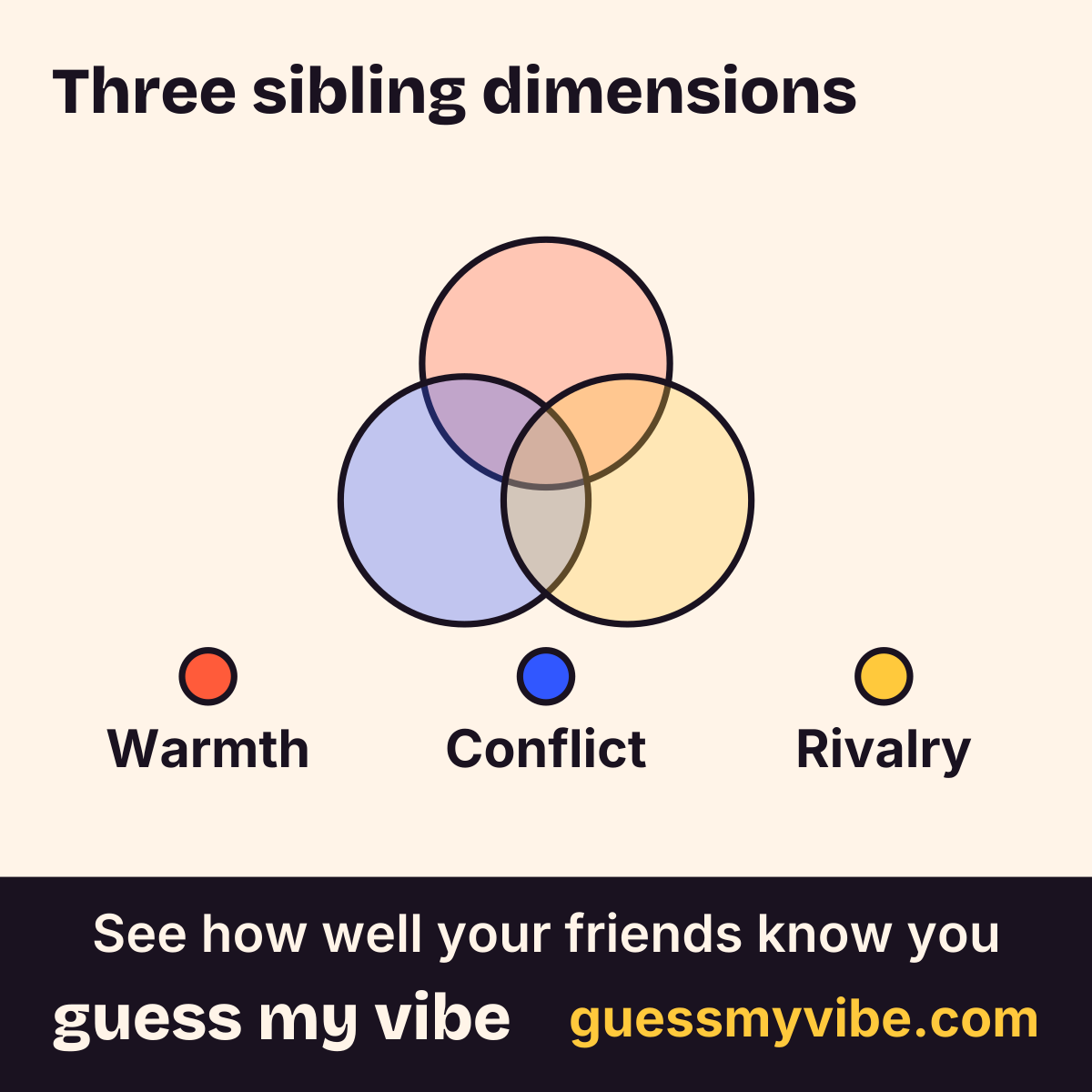
The most useful starting point is how researchers measure it. A questionnaire built for adult siblings, tested in two samples totaling 383 people, found that sibling relationships in early adulthood are characterized by three independent dimensions: warmth, conflict and rivalry. Differences between people on these dimensions were somewhat associated with family structure and were linked to how much contact siblings had and to the siblings' mental health [2].
"Independent" is the key word. It means rivalry isn't just a louder version of conflict, and it isn't the opposite of warmth. Think of conflict as the arguments, and rivalry as the comparing: who got more attention, who's doing better, who's the favorite. Two siblings can be very close and still feel that scoreboard running. If you want the full tour of those three dimensions, our guide to sibling relationships covers them. Here we're asking what happens next, once everyone's grown.
Cite this figure
Figure: "Three sibling dimensions." Guess My Vibe (guessmyvibe.com). https://guessmyvibe.com/learn/sibling-rivalry#figure-three-dimensions
Does sibling rivalry fade with age?
Part of the answer comes from one of the few studies to follow siblings from childhood into their late twenties. It used data from mothers, fathers and two siblings in each of 201 families, and charted sibling intimacy and conflict from age 7 to age 30. Intimacy declined from middle childhood through early adolescence, then increased through the mid-20s and leveled off. Conflict was stable in middle childhood, declined across adolescence and leveled off in young adulthood [1].
So on average in that sample, the stormiest stretch had passed by young adulthood, and closeness had been climbing. That's reassuring, but three limits matter. First, the families were predominately White, working- and middle-class, so the pattern may not describe everyone [1]. Second, the pattern varied by the siblings' sexes, by the sex mix of the two siblings, and by birth order, so "typical" hides real differences [1]. Third, the abstract reports on intimacy and conflict, not rivalry itself. That means this study shows friction easing for many siblings, but it can't tell us that the competitive comparing fades in the same way. Rivalry may well linger quietly after the arguments stop.
The same study found some things that go along with better sibling relationships. A more expressive, feminine-typed personality was linked to more sibling intimacy and less conflict, although that link disappeared in young adulthood. Mothers' warmth was linked to more sibling intimacy, and mothers' conflict was linked to more sibling conflict [1]. These are links, not proof that one causes the other, but they fit a picture where the way a family handles closeness and conflict shows up between its children too.
Curious how your friends would answer?
Free. Answer 10 quick questions about you, then send your link. Friends play in their browser, no app needed.
Start freePerceived favoritism and sibling closeness
One thing researchers have studied is the sense that a parent treats siblings differently. A study of 151 sibling twosomes (302 young adults, average age about 24) had both siblings report on how their mothers and fathers treated them, plus their own depressive symptoms and sibling relationship quality. Young adults who said they got less support than their sibling reported more depressive symptoms, and greater amounts of unequal treatment went with less sibling intimacy. Several of these links differed by which parent was involved, by the siblings' gender mix and by how big the gap in treatment was [3].
A few cautions help here. A study like this can't show whether unequal treatment causes distance or whether distant siblings simply perceive more unfairness. And these are the siblings' own reports of how they were treated, not a measure of what parents actually did. What the finding does show is that favoritism isn't a childhood issue that expires. It was still linked to how siblings felt about each other in their twenties.
Caring for parents can reopen old tension
Another situation that has been studied comes later. In a study of 450 adult children in 214 families where the mother had needed care within the previous two years, researchers looked at what shaped tension between siblings after a mother's major health events. Providing care and perceiving favoritism about future caregiving were each associated with more sibling tension. The link between caregiving and tension was bigger when perceptions of favoritism were also present [4].
The authors point out that siblings are usually the people caregivers are most likely to turn to for support, yet these relationships are also often a major source of interpersonal stress [4]. That's a fair description of why this period can feel so loaded: the person you'd most want to share the work with is also the person you've been compared to your whole life. It's worth noting that part of this study is about perceptions of favoritism. It doesn't say who is right about who does more.
It's also worth noticing how these studies were built, because rivalry takes two people. The favoritism study asked both siblings in each family to report on their treatment, and the caregiving study surveyed several adult children within the same families [3] [4]. That design matters because two siblings can describe the same family differently. One may feel like the overlooked child while the other feels like the one under pressure. Neither study decides whose version is closer to the truth, and a single sibling's account of a rivalry is only half of the picture.
What this means if you still feel the rivalry
None of these studies tests a way to fix rivalry, so what follows is our own reading, not a research finding. First, feeling competitive with a sibling as an adult is not unusual, since rivalry is one of the three dimensions researchers find in adult sibling relationships, independent of warmth, so it can sit alongside affection [2]. Second, the research points at situations more than at people, though these studies did not measure rivalry directly. If the tension spikes when a parent's health changes, or when you compare how you were each treated, that's useful to notice. The friction may belong to the situation as much as to either of you.
Third, perceptions matter, and they can be tested. Much of the evidence above is about what siblings believe: who's favored, who's doing more. It's easy to assume you know what a sibling thinks without ever checking. A calm conversation that starts with "here's how it looked from my side" gives a sibling the chance to say how it looked from theirs. This isn't therapy, a diagnosis, or a substitute for professional care, and if a family situation is weighing on you, a qualified professional is the right person to talk to.
A low-stakes way to compare notes
Rivalry often runs on assumptions about what the other person thinks. A light way to check them is to play Guess My Vibe with your sibling: each of you answers the questions, then guesses the other's answers. It won't settle any old scoreboard, but it's a fun, low-pressure way to find out whether you know each other as well as you both assume.
Key takeaways
- Adult sibling relationships have three independent dimensions, warmth, conflict and rivalry, so siblings can be close and competitive at the same time [2].
- In a study of 201 families followed from age 7 to 30, sibling conflict was stable in middle childhood, declined across adolescence and leveled off in young adulthood, while intimacy dipped in early adolescence, rose through the mid-20s and then leveled off [1].
- In a study of 151 sets of two young adult siblings, those who reported receiving less support than their sibling reported more depressive symptoms, and more unequal treatment went with less sibling intimacy [3].
- In 214 families where a mother needed care, providing care and perceiving favoritism were each linked to more sibling tension, and caregiving's link to tension was larger when favoritism was also perceived [4].
- This isn't therapy, a diagnosis, or a substitute for professional care.
Questions people ask
Is sibling rivalry normal in adults?
Yes, it's a recognized part of adult sibling relationships. Research on early adulthood found siblings' relationships have three independent dimensions, warmth, conflict and rivalry, so closeness and rivalry can exist together [2].
Does sibling rivalry go away when you grow up?
Not automatically. In one study following 201 families from age 7 to 30, sibling conflict declined across adolescence and leveled off in young adulthood [1]. That study tracked conflict and intimacy rather than rivalry, so it doesn't show whether rivalry itself fades.
Does feeling treated unequally by parents affect adult siblings?
Researchers have studied perceived parental favoritism. Among young adult siblings, reporting less support than a sibling went with more depressive symptoms, and more unequal treatment went with less sibling intimacy [3]. These are links in one sample, not proof of cause.
Why do siblings fight about caring for aging parents?
In a study of 214 families where a mother needed care, providing care and perceiving favoritism about future caregiving were each linked to more sibling tension, and more so when both were present [4].
Is sibling rivalry the same as sibling conflict?
No. In research on adult siblings, conflict and rivalry load on separate dimensions, along with warmth [2]. Conflict is about friction between you. Rivalry is more about comparison.
See how well your friends know you.
Free. Answer 10 quick questions about you, then send your link. Friends play in their browser, no app needed.
Start freeReferences
- [1] McHale, S. M., Sun, X., Updegraff, K. A., & Whiteman, S. D. (2024). Patterns and correlates of changes in sibling intimacy and conflict from middle childhood through young adulthood. Developmental Psychology, 62(3), 665–677. PubMed: 38647474 (opens in a new tab)
- [2] Stocker, C. M., Lanthier, R. P., & Furman, W. (1997). Sibling relationships in early adulthood. Journal of Family Psychology, 11(2), 210–221. doi.org/10.1037/0893-3200.11.2.210 (opens in a new tab)
- [3] Jensen, A. C., Whiteman, S. D., Fingerman, K. L., & Birditt, K. S. (2013). "Life still isn't fair": Parental differential treatment of young adult siblings. Journal of Marriage and Family, 75(2), 438–452. doi.org/10.1111/jomf.12002 (opens in a new tab)
- [4] Suitor, J. J., Gilligan, M., Johnson, K., & Pillemer, K. (2013). Caregiving, perceptions of maternal favoritism, and tension among siblings. The Gerontologist, 54(4), 580–588. PubMed: 23811753 (opens in a new tab)
How we find and check these sources: how we write. Spotted an error? Report a correction.
Related
Cite this article
- Title
- Sibling Rivalry in Adulthood: What Research Says
- Publisher
- Guess My Vibe
- Updated
- URL
- https://guessmyvibe.com/
learn/ sibling-rivalry
Copy this citation
Guess My Vibe. (2026, October 4). Sibling Rivalry in Adulthood: What Research Says. Guess My Vibe. https://guessmyvibe.com/
To point at one section, add that section's anchor (the # link on its heading) to the URL.