Only child syndrome isn't a diagnosis, and the research doesn't back the stereotype that only children are spoiled, selfish or lonely. A meta-analysis of 117 studies found only children surpassed people from families of three or more children on adjustment and character [1], and a series of studies in China found only children reported lower loneliness than peers with siblings [2].
Is only child syndrome real? Not as a syndrome. It isn't a recognized diagnosis, and the research doesn't support the stereotype behind it: that only children are spoiled, selfish, socially awkward or lonely. A 1986 meta-analysis of 117 studies found only children surpassed people from larger families on adjustment and character, and surpassed all but firstborns and two-child families on achievement and intelligence [1]. Newer work points the same way on loneliness [2], with one small, self-reported difference worth knowing about [4].
This article covers where the stereotype came from, what the best evidence we could open shows, where the evidence is thin or mixed, and how to think about your own experience as an only child (or as someone who loves one). For how birth order works more broadly, see our guide to birth order, and for how siblings get along, see our guide to sibling relationships.
What "only child syndrome" claims
The stereotype is old and fairly consistent. Only children are supposedly spoiled because they never have to share, bossy or selfish because they never negotiate with siblings, lonely or socially awkward because they lack built-in playmates, and perfectionistic because all of their parents' expectations land on one child. Some versions even call this "only child syndrome." As with other birth-order labels, that word is a pop-psychology shorthand. A syndrome in a health sense is a recognized pattern of symptoms, and this isn't one. We use the phrase because it's what people search for, not because it describes a condition.
What the big meta-analysis found
One major review is a 1986 meta-analysis by Falbo and Polit. It pooled 117 studies into six separate analyses: achievement, adjustment, character, intelligence, mental illness and sociability. According to the abstract, only children surpassed all others except firstborns and people from two-child families on achievement and intelligence, and they surpassed people from families with three or more children on adjustment and character [1]. The authors also proposed a model of the one-child family built on parental attention, parental anxiety and family economic resources, and emphasized the strength of the parent-child relationship in small families [1].
Two cautions apply. First, the abstract we could open states results for only four of the six analyses. It does not say what the sociability and mental illness analyses found, so we can't tell you what the review concluded on those without reading the full text, and we haven't. Second, "character" and "adjustment" are the review's own categories, and the abstract doesn't spell out which measures sit inside them. So we can say the review didn't find only children coming out worse than children from larger families on those two, but we can't say it directly tested "selfishness". The review is also from 1986, which means family sizes, schooling and childcare have changed since.
Are only children lonelier?
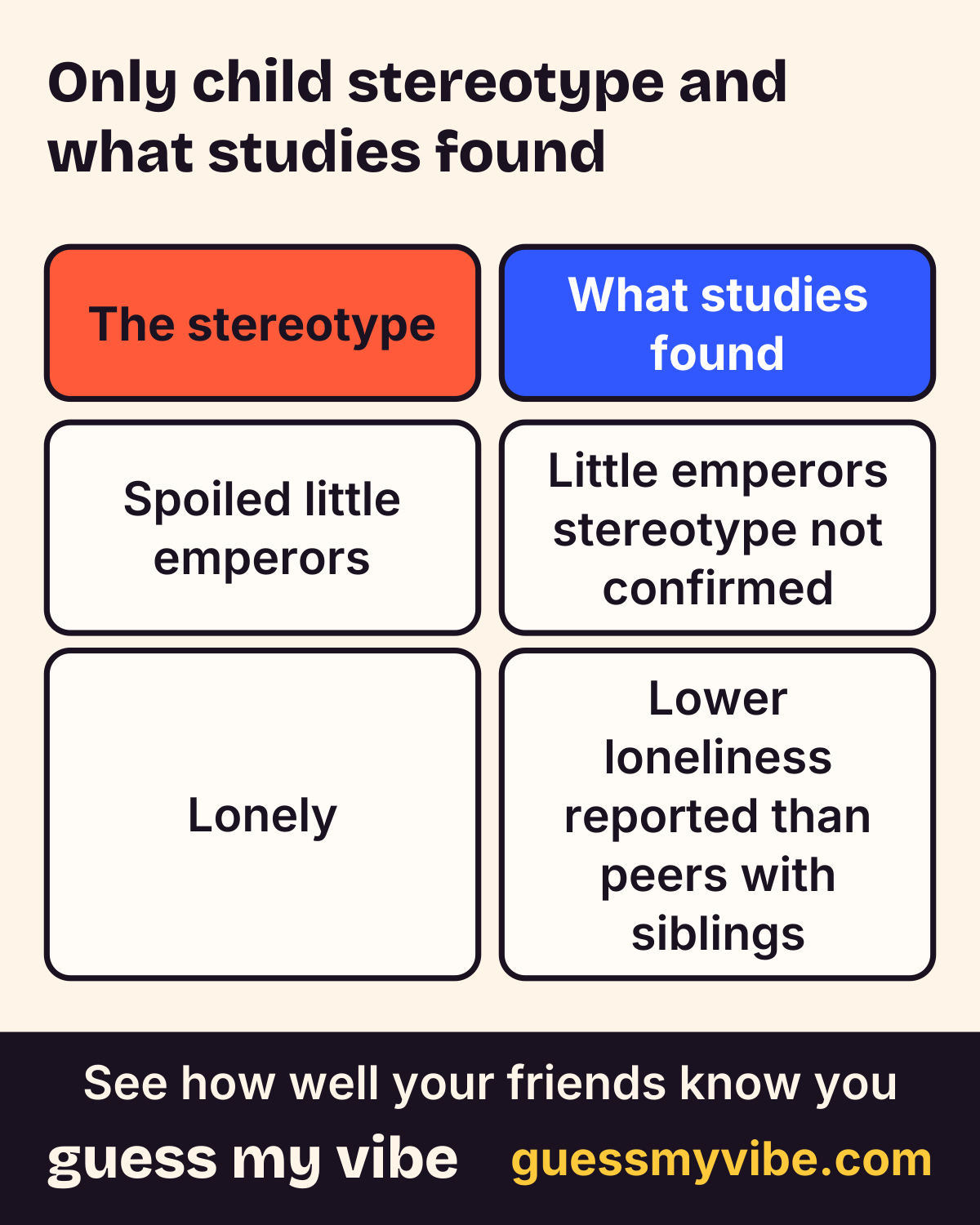
A 2021 paper tested this directly in China, where popular media has raised concern that only children grow up lonely. In the first study, 588 young adults from six cities were asked about the stereotype, and belief that only children are lonely was common, especially among those who had siblings. In the next studies, with 699 emerging adults and then 345 and 210 late adolescents, only children reported lower levels of loneliness than peers with siblings [2]. The authors summarize that belief in the loneliness of only children was widespread, but the evidence indicates that reports of loneliness were greater for those who grew up with siblings [2].
Notice the limits. These are self-reports from Chinese samples, so they may not carry over to US only children, whose families, schools and social lives differ. And loneliness is only one piece of the stereotype. But the result fits a broader point: having siblings doesn't automatically protect someone from feeling lonely, and not having them doesn't guarantee it.
Curious how your friends would answer?
Free. Answer 10 quick questions about you, then send your link. Friends play in their browser, no app needed.
Start freeAre only children spoiled "little emperors"?
In China, the stereotype of the spoiled only child has a name, "little emperors." A lab-in-the-field experiment tested it with adults born before and after the one-child policy began in 1979, across three provinces, using the fact that the policy was introduced at different times and with different strictness. The researchers measured risk, uncertainty and time preferences, plus competitiveness, cooperation and bargaining. They found a statistically significant effect only on risk and uncertainty aversion, with people born after the policy being less averse, and none on any of the other preferences. They write that their findings do not confirm the general wisdom and stereotype of only children in China being "little emperors" [3].
One more limit: this design compares people born before and after a policy, not only children against their siblings directly. It tells us that the policy generation didn't show the expected selfish, uncooperative pattern, which is relevant, but it isn't a head-to-head comparison of only children and others.
Cite this figure
Figure: "Only child stereotype and what studies found." Guess My Vibe (guessmyvibe.com). https://guessmyvibe.com/learn/only-child-syndrome#figure-stereotype-vs-studies
Where small differences do show up
To be fair to the stereotype, one very large study did find some differences. Ashton and Lee (2025) analyzed self-reported HEXACO personality traits from more than 700,000 online adults, mainly from English-speaking countries. Honesty-humility and agreeableness had their highest averages for middle-borns, followed by last-borns, firstborns, and then only children, with differences between middles and onlys of d of at least 0.20. Openness was about d = 0.10 higher for only children than for everyone else together [4].
How should that sit alongside the rest? In a second sample, which also recorded family size, honesty-humility and agreeableness were higher with larger sibship sizes: differences between sibship sizes of one and six or more were d = 0.30 and d = 0.36, respectively. Controls for upbringing religiousness and current religiousness reduced those differences by about 25% [4]. Because an only child always comes from the smallest possible family, it's hard to fully separate "only child" from family size in those averages (that part is our reasoning, not the authors'). Even the full gap, a few tenths of a standard deviation, is small in a group and much smaller than the variation between any two individual people. And it describes self-reported averages in an online sample, with no sign it's a diagnosable pattern. We would not read it as proof of a spoiled-child personality.
Why the stereotype sticks
These are our own explanations, not tested findings. The meta-analysis's model of the one-child family centers on parental attention and family economic resources [1], and people may read extra attention as spoiling. Only children may also spend more time around adults, which could make them seem mature or serious, and someone who is comfortable alone can be mistaken for being lonely. And because a family with one child is a minority in many places, an only child is more often the "odd one out" at a table of people with siblings, so stereotypes are more likely to be applied to them.
What this means if you're an only child
Growing up without siblings is one experience among many, and the research doesn't say how it turns out. If you're an only child, you aren't likely to be more selfish or lonelier on average than people with siblings, according to the evidence above, though your own childhood is the best source of information about you. If you know an only child, it's more helpful to ask them than to assume.
That's the idea behind Guess My Vibe. Friends answer personality questions the way they think you would, and you see where they match you and where they miss. Only children often have especially close friends who feel like siblings, and this is a fun way to find out how well those friends actually know you.
Key takeaways
- A meta-analysis of 117 studies found only children surpassed everyone except firstborns and people from two-child families on achievement and intelligence, and surpassed people from larger families (three or more children) on adjustment and character [1].
- In three studies of Chinese young adults and teens, only children reported lower loneliness than peers with siblings, even though the belief that only children are lonely was common [2].
- An experiment with adults in three Chinese provinces found that people born after the one-child policy differed from those born just before it only in being less averse to risk, not in competitiveness, cooperation or bargaining, so the "little emperors" stereotype wasn't confirmed [3].
- A huge online sample found small average differences: only children scored lowest on honesty-humility and agreeableness among birth-order groups, but these scores rose with family size and the data are self-reports [4].
- This isn't therapy, a diagnosis, or a substitute for professional care.
Questions people ask
Is only child syndrome a real thing?
No. It isn't a recognized diagnosis. A meta-analysis of 117 studies found only children surpassed people from families of three or more children on adjustment and character, and surpassed all but firstborns and two-child families on achievement and intelligence [1].
Are only children selfish or spoiled?
The evidence we could open doesn't support it. An experiment in China found no effect of being born after the one-child policy on competitiveness, cooperation or bargaining, and the authors say the findings don't confirm the "little emperors" stereotype [3]. One large online sample found only children had the lowest average honesty-humility, but scores rose with family size and the difference is small and self-reported [4].
Are only children lonelier than people with siblings?
In studies of Chinese young adults and teens, only children reported lower loneliness than peers with siblings, though belief that they're lonely was common [2]. Those samples may not generalize everywhere.
Do only children have worse social skills?
The abstract of the main meta-analysis lists sociability among its six analyses but doesn't state that result, so we can't say what it found [1]. We found no evidence in the studies we could open that only children come out worse on adjustment or loneliness.
What personality do only children have?
There's no single only-child personality. A very large online sample found only children averaged about d = 0.10 higher on openness than non-onlys, and lower on honesty-humility and agreeableness than other birth-order groups, with those two rising as family size grows [4].
See how well your friends know you.
Free. Answer 10 quick questions about you, then send your link. Friends play in their browser, no app needed.
Start freeReferences
- [1] Falbo, T., & Polit, D. F. (1986). Quantitative review of the only child literature: Research evidence and theory development. Psychological Bulletin, 100(2), 176-189. doi.org/10.1037/0033-2909.100.2.176 (opens in a new tab)
- [2] Lin, S., Falbo, T., Qu, W., Wang, Y., & Feng, X. (2021). Chinese only children and loneliness: Stereotypes and realities. American Journal of Orthopsychiatry, 91(4), 531-544. PubMed: 34166053 (opens in a new tab)
- [3] Carlsson, F., Lampi, E., Martinsson, P., Tu, Q., & Yang, X. (2022). Are only-children different? Evidence from a lab-in-the-field experiment of the Chinese one-child policy. PLoS ONE, 17(11), e0277210. PubMed: 36346790 (opens in a new tab)
- [4] Ashton, M. C., & Lee, K. (2025). Personality differences between birth order categories and across sibship sizes. Proceedings of the National Academy of Sciences, 122(1), e2416709121. PubMed: 39715437 (opens in a new tab)
How we find and check these sources: how we write. Spotted an error? Report a correction.
Related
Cite this article
- Title
- Only Child Syndrome: The Myth and the Data
- Publisher
- Guess My Vibe
- Updated
- URL
- https://guessmyvibe.com/
learn/ only-child-syndrome
Copy this citation
Guess My Vibe. (2026, October 4). Only Child Syndrome: The Myth and the Data. Guess My Vibe. https://guessmyvibe.com/
To point at one section, add that section's anchor (the # link on its heading) to the URL.