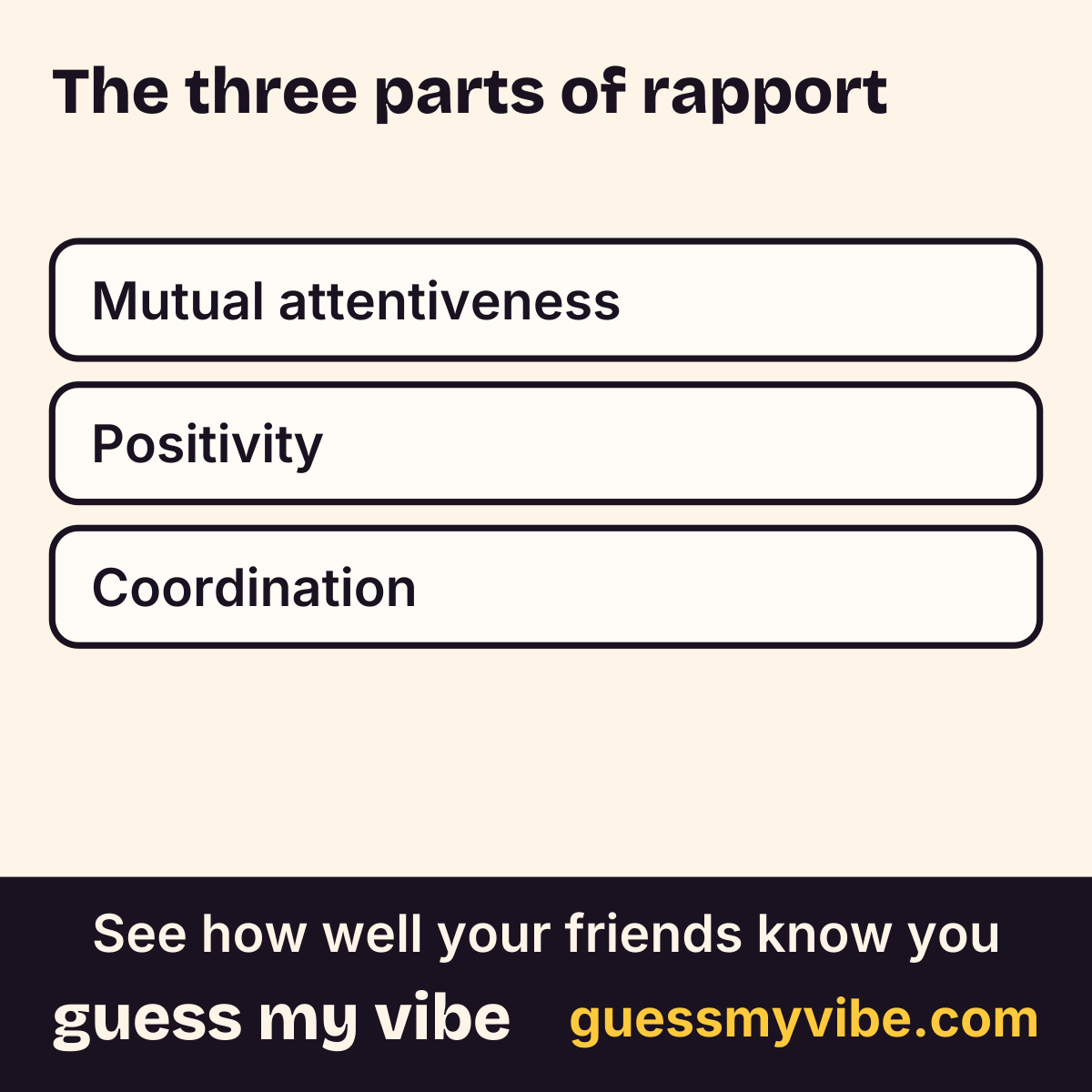
Building rapport means creating three things together: mutual attentiveness, positivity, and coordination, the feeling that the two of you are in sync. That is the three-part model psychologists Tickle-Degnen and Rosenthal proposed in 1990. They also suggested that early on, attentiveness and positivity matter most, and coordination matters more as a relationship develops.
What building rapport actually means
Most advice on building rapport is a list of tricks: mirror their posture, use their name, find something in common. The research behind the word is more useful than the tricks, because it says what rapport is made of. In 1990, Linda Tickle-Degnen and Robert Rosenthal described it as a dynamic structure of three interrelating components: mutual attentiveness, positivity and coordination [1]. Building rapport, then, is building those three things at once. If one is missing, the whole thing feels off, which is why a very friendly person who isn't really listening doesn't leave you feeling close to them.
The three ingredients, in plain words
Mutual attentiveness is both people being focused on each other and on the interaction. The word mutual matters: you feel it when the other person is tuned in to you and you are tuned in to them. Positivity is the warm, friendly, caring tone of the exchange, the sense that you're glad to be talking. Coordination is the feeling of balance and harmony, of the two of you being in sync, so the conversation has flow instead of stops and starts [1].
A caveat on the source: the paper is mainly a conceptual one. It offers a way of thinking about rapport, plus one meta-analytic study of how nonverbal behavior relates to the positivity component, and then sets out hypotheses for future work [1]. So this is a well-known framework, not a proven formula with measured effect sizes for each part.
Cite this figure
Figure: "The three parts of rapport." Guess My Vibe (guessmyvibe.com). https://guessmyvibe.com/learn/building-rapport#figure-three-ingredients
Rapport changes as a relationship develops
The most useful idea in the paper is that the three ingredients don't carry equal weight all the time. The authors propose that in early interactions, positivity and attentiveness count for more than coordination, while in later interactions coordination and attentiveness count for more [1]. Put simply: with someone new, being warm and clearly paying attention does most of the work. With someone you know, the feeling of easy sync starts to matter more.
That fits a common experience. Meeting someone for the first time, you don't expect effortless sync, and you wouldn't hold its absence against them. You do notice if they seem distracted or cold. Years in, you can sit in silence with a friend and feel connected, which is coordination at work, but a friend who stops paying attention would still hurt. Treat this as the authors' proposal, not a measured law.
Why there isn't a reliable list of rapport tricks
If rapport had a handful of specific behaviors, such as leaning in, nodding at set intervals or smiling on cue, researchers could just list them. The paper explains why it isn't that simple. The authors describe rapport as a gestalt, meaning people experience it as a whole rather than as the sum of separate parts, and for that reason it is not easy to pin the three components to particular nonverbal behaviors [1]. They discuss two ways to measure nonverbal behavior, a molecular approach that counts small, specific behaviors and a molar approach that captures broader impressions, and recommend using them differently depending on the stage of the relationship [1].
The practical lesson is a healthy suspicion of any article, video or training that promises a fixed set of moves. The framework itself says the whole is felt, not assembled from parts. A person who nods on schedule while their mind is elsewhere has copied a behavior without producing the attentiveness behind it. That last point is our reading of the framework, not a tested finding.
Curious how your friends would answer?
Free. Answer 10 quick questions about you, then send your link. Friends play in their browser, no app needed.
Start freeDoes mirroring someone build rapport?
Mirroring is the most famous rapport trick, so it deserves a careful look. In experiments by Chartrand and Bargh, people unintentionally matched the posture and mannerisms of strangers they worked with. When a confederate deliberately mimicked a participant, the interaction went more smoothly and the participant liked the confederate more. More empathic people mimicked more [4]. That is the study behind the popular advice.
A second set of experiments looked at the other direction. People who were given a goal to affiliate showed more nonconscious mimicry of their partner, and people who had failed to connect in an earlier interaction then mimicked more. The authors suggest mimicry may be part of the repertoire people use, without noticing, when they want rapport [2]. In other words, mirroring seems to be something that happens when you want to connect, not only something you can do to create connection.
Here is where to be cautious. Both papers report lab experiments, and neither abstract mentions how big the effect is in everyday life. We didn't verify how well the mimicry findings have held up in later studies, so don't treat them as proof that copying someone's posture will win them over. There's also a plain practical problem: coordination that feels forced reads as the opposite of attentive. The safer takeaway is that being really tuned in tends to produce some natural mirroring on its own.
What you can actually do to build rapport
Taking the three-part model as the guide, here is how the research connects to things you can actually do, with the strength of the evidence noted.
- For attentiveness, ask follow-up questions. In three studies of live conversations, people who asked more questions, especially follow-ups, were better liked, and being seen as responsive explained the effect [3].
- For attentiveness and warmth together, listen without judging. In five experiments, speakers talking with an attentive, empathic, nonjudgmental listener felt less socially anxious [5].
- For positivity, show that you're glad to be there. This one comes straight from the framework itself, which treats positivity as one of the three parts [1].
- For coordination, let it develop. The framework suggests it matters more later in a relationship, so you don't have to force a perfect rhythm in the first conversation [1].
- Skip the scripted mirroring. The evidence is that mimicry shows up when people want to connect, which is different from showing that performing it works [2].
Here is a simple illustration, not a study. Say you sit next to a new classmate. Early on, the model suggests your job is mostly warmth and attention: you look up when they speak, you react to what they actually said, and you ask about the thing they just mentioned. Weeks later, with the same person, the conversation has its own rhythm, and you finish each other's tangents. The ingredients are the same three, but the balance has moved. The studies cited here don't test this scenario, so it is only a way to picture the framework.
When rapport doesn't click
Sometimes rapport doesn't build, and it isn't anyone's fault. The three-part model gives a gentler way to read that. Maybe one person was distracted, maybe the tone stayed formal, maybe the conversation never found a rhythm, and each of those can change on the next try. It also helps to know how unreliable your own read can be. In studies of strangers getting acquainted, dorm neighbors and workshop attendees, people systematically underestimated how much their conversation partners liked them and enjoyed their company [6]. The point here is just that a first chat that felt flat to you may have felt better to the other person.
Rapport is easier to see from the outside
Your friends have a read on how attentive, warm and in sync you are, one you can't fully see yourself. Guess My Vibe lets a friend guess how you'd answer questions about everyday social moments, then shows you how close they got. It is a light way to find out how your friends see the way you connect.
Key takeaways
- A classic 1990 paper describes rapport as three interrelating components: mutual attentiveness, positivity and coordination [1].
- The same paper proposes the mix changes over time: in early interactions positivity and attentiveness count most, and in later ones coordination and attentiveness do [1].
- In lab experiments, people with a goal to connect showed more unconscious mimicry of a partner, which is evidence that mirroring is something we do, not a script to run [2].
- Asking follow-up questions, a visible form of attentiveness, was linked to being better liked in three studies of live conversations [3].
- This isn't therapy, a diagnosis, or a substitute for professional care; it's a plain-English summary of what social psychology says about rapport.
Questions people ask
What is rapport?
Psychologists Tickle-Degnen and Rosenthal described rapport as three interrelating components: mutual attentiveness, positivity and coordination [1].
How do you build rapport quickly?
The framework suggests that in early interactions, positivity and attentiveness count for more than coordination [1]. Asking follow-up questions is one concrete way to show attentiveness [3].
Does mirroring someone's body language build rapport?
Lab experiments found that being mimicked by a confederate made an interaction smoother and increased liking [4], and that people who want to connect mimic more [2]. Those were lab experiments, so it isn't proof that copying someone on purpose will work.
Does rapport change over time?
The framework proposes it does: positivity and attentiveness weigh more in early interactions, and coordination and attentiveness weigh more in later ones [1]. That is the authors' proposal rather than a measured law.
What if I think a first conversation went badly?
Your read may be too harsh. People systematically underestimated how much their conversation partners liked them after getting acquainted [6].
See how well your friends know you.
Free. Answer 10 quick questions about you, then send your link. Friends play in their browser, no app needed.
Start freeReferences
- [1] Tickle-Degnen, L., & Rosenthal, R. (1990). The nature of rapport and its nonverbal correlates. Psychological Inquiry, 1(4), 285-293. doi.org/10.1207/s15327965pli0104_1 (opens in a new tab)
- [2] Lakin, J. L., & Chartrand, T. L. (2003). Using nonconscious behavioral mimicry to create affiliation and rapport. Psychological Science, 14(4), 334-339. PubMed: 12807406 (opens in a new tab)
- [3] Huang, K., Yeomans, M., Brooks, A. W., Minson, J., & Gino, F. (2017). It doesn't hurt to ask: Question-asking increases liking. Journal of Personality and Social Psychology, 113(3), 430–452. PubMed: 28447835 (opens in a new tab)
- [4] Chartrand, T. L., & Bargh, J. A. (1999). The chameleon effect: The perception-behavior link and social interaction. Journal of Personality and Social Psychology, 76(6), 893-910. PubMed: 10402679 (opens in a new tab)
- [5] Itzchakov, G., DeMarree, K. G., Kluger, A. N., & Turjeman-Levi, Y. (2018). The listener sets the tone: High-quality listening increases attitude clarity and behavior-intention consequences. Personality and Social Psychology Bulletin, 44(5), 762-778. PubMed: 29347879 (opens in a new tab)
- [6] Boothby, E. J., Cooney, G., Sandstrom, G. M., & Clark, M. S. (2018). The Liking Gap in Conversations: Do People Like Us More Than We Think?. Psychological Science, 29(11), 1742–1756. PubMed: 30183512 (opens in a new tab)
How we find and check these sources: how we write. Spotted an error? Report a correction.
Related
- Active Listening: What Research Says It Actually Does
- Instant Connection: Why You Click With Some People Fast
- How to Make a Good First Impression, According to Research
- The Liking Gap: Why People Like You More Than You Think
- How to Have Deep Conversations, Backed by Research
- The Chameleon Effect: Why We Copy People We Like
Cite this article
- Title
- Building Rapport: The 3 Ingredients Researchers Found
- Publisher
- Guess My Vibe
- Updated
- URL
- https://guessmyvibe.com/
learn/ building-rapport
Copy this citation
Guess My Vibe. (2026, October 4). Building Rapport: The 3 Ingredients Researchers Found. Guess My Vibe. https://guessmyvibe.com/
To point at one section, add that section's anchor (the # link on its heading) to the URL.