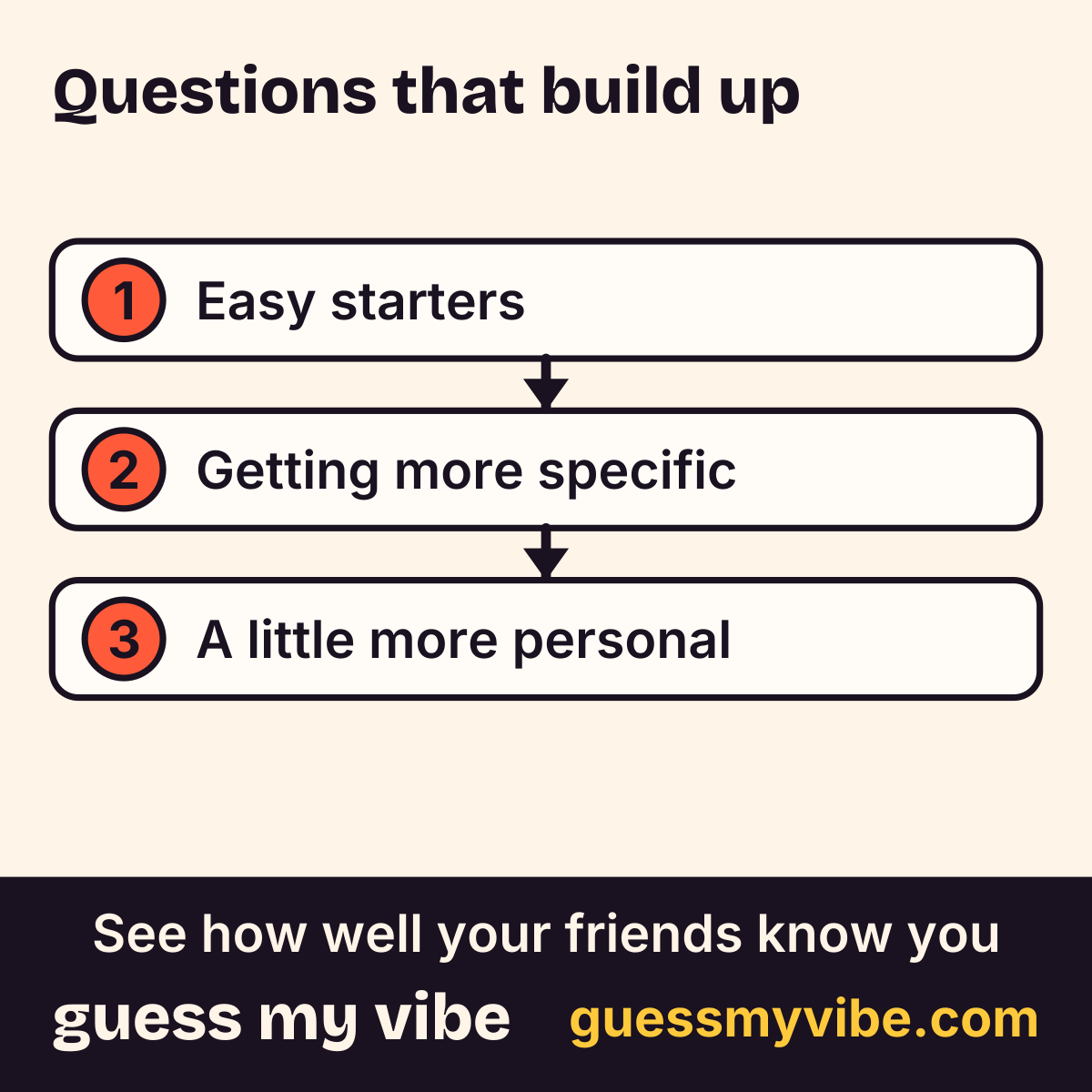
Good get to know you questions move from easy to specific to a little personal, and they work best when you actually follow up on the answer instead of waiting for your turn to talk. Below is a full list organized that way. The follow-up part isn't just etiquette: a study of real conversations found that people who ask more questions, especially follow-up ones, are reliably better liked by the person they're talking to [1].
If you need get to know you questions for a first hang, a new roommate, a group project, or a dating-app match, the list below is organized the way an actual good conversation moves: easy first, more specific in the middle, a little personal toward the end, never all at once. After the list comes the part worth knowing before you use it: real research on why asking questions, and following up on the answers, makes people like you more than almost anything else you can do in a conversation.
Get to know you questions, from easy to deep
Work through a group in order, or pull from whichever section fits the moment. None of these need a quiz app or a notebook. A car ride, a lunch table, or the five minutes before a meeting starts all work.
Easy starters
Low-stakes questions that get a real answer, not a one-word one.
- What's taking up most of your time lately?
- What's the last thing you got way too into?
- What's your go-to order when you don't want to think about it?
- What's something you're looking forward to this month?
- What's a show, book, or podcast you'd actually recommend right now?
- Where did you grow up, and is it anything like here?
Getting more specific
These ask for a story or an opinion, not just a fact.
- What's a decision you made that turned out way better than you expected?
- What's something people usually get wrong about you at first?
- What's a skill you have that almost nobody knows about?
- What's a small thing that instantly puts you in a good mood?
- What's the most useless thing you're weirdly good at?
- What's a rule you grew up with that you still follow, or finally dropped?
A little more personal
Save these for once the conversation's already moving. They're where the real liking happens.
- What's something you're genuinely proud of that you don't usually bring up?
- Who's someone who changed how you see things, and how?
- What's a worry you've mostly made peace with?
- What's something you believed for a long time and then just... stopped believing?
- What would a perfect, totally ordinary day look like for you?
- What's something you want more of in your life right now?
Quick-fire, for when the energy's lighter
Fast ones to reset the mood or fill a quiet stretch.
- Window seat, or aisle?
- Texts back in five minutes, or by tomorrow?
- Morning person, or not before 10am?
- Save the best part for last, or get it over with first?
- Planned itinerary, or wing it?
- Call, or text?
Cite this figure
Figure: "Questions that build up." Guess My Vibe (guessmyvibe.com). https://guessmyvibe.com/learn/get-to-know-you-questions#figure-question-ladder
Why asking questions makes people like you more
This isn't just a hunch about good conversationalists. Researchers studying live, two-person conversations, including online get-to-know-you chats and real face-to-face speed dates, found a consistent pattern across three separate studies: people who asked more questions, and especially more follow-up questions, were rated as more likable by the person they were talking to. The effect held up well enough that a natural-language detector trained to spot follow-up questions could tell, from the speed-dating transcripts alone, who was more likely to get a yes for a second date [1]. The follow-up is the part that matters most. A string of your own new questions can feel like an interview; actually picking up on what the other person just said and asking more about it is what reads as real interest.
Here's the part that makes this worth repeating: the same research found that people don't expect question-asking to work this well. Most people don't anticipate that asking questions raises liking at all, which is probably why so many of us default to talking about ourselves instead [1].
Curious how your friends would answer?
Free. Answer 10 quick questions about you, then send your link. Friends play in their browser, no app needed.
Start freeWhy a deeper question feels riskier than it actually is
The quick-fire and easy-starter questions above are safe, but they also cap how close a conversation can get. The hesitation most people feel about asking something more personal has its own research behind it. Across a series of experiments, people who had conversations with someone they'd just met (deeper ones included) consistently guessed wrong on two things beforehand: they overestimated how awkward the conversation would feel, and they underestimated how much their partner would actually care about what they shared. The real conversations, once they happened, felt less awkward and created more connection than either person had guessed going in [2]. People's guesses got more accurate when they already knew the other person's care was a sure thing, like with close friends or family, which is exactly the gap a brand-new conversation doesn't have yet [2]. In plain terms: the "a little more personal" section above is scarier to ask than it is to actually go through.
Does someone you just met actually get anything real about you?
It's fair to wonder whether answers from a near-stranger even mean anything, compared to a close friend's read on the same questions. Research on this says yes, with real limits. In a study where strangers judged someone's personality from a single brief videotaped interaction, their ratings still agreed with each other more than chance would allow, and the traits that were easiest for the person's close friends to judge accurately were also the ones the strangers judged best [3]. Close friends still had the edge overall. But a get to know you conversation isn't starting from zero information; it's starting from real, if thinner, information, and the questions you choose decide how much of it actually gets used.
The escalating-questions idea behind all of this
If the structure of the list above, easy to specific to personal, feels familiar, it's the same idea behind a well-known lab procedure that built real closeness between total strangers in under an hour: a set of questions that escalate in self-disclosure, combined with a short closeness-building task. In the original study, that escalating-question format produced significantly more closeness between strangers than an equally long small-talk conversation did [4]. You don't need the exact 45-minute lab version to borrow the principle. Order matters. Starting personal is awkward; ending personal, after easier questions have already built a little trust, usually isn't.
Does it matter if you ask these over text instead of in person?
A lot of get to know you questions now happen over text, a dating app thread, or a group chat, not face to face, and the research on follow-up questions and liking above was done in both settings, live chat and live speed dating, with the same pattern holding in each [1]. The follow-up habit itself doesn't change by medium: noticing what someone just said and asking more about it works the same whether you're typing or talking. What does change over text is pacing. A slow reply can read as disinterest even when it isn't, and a wall of questions sent at once can feel more like a form than a conversation. Spacing questions out, and actually reacting to an answer before sending the next one, matters more over text, not less, since you're missing the tone of voice and body language that normally soften a long string of questions in person.
Turn today's get to know you questions into a game
Guess My Vibe takes the same idea, a question about you and a friend's guess at your real answer, and scores it automatically instead of leaving it to a group chat argument. It's built for people who already know each other a little, so once these questions have done their job of starting something, our full how well do you know me questions list is where to go next to see how well that new friend actually reads you.
Key takeaways
- Get to know you questions work best in order: easy and low-stakes first, then specific, then a little personal, so nobody feels interrogated early on.
- Across three studies of real conversations, people who asked more questions, and especially more follow-up questions, were consistently better liked by their conversation partner, yet people don't expect this to be true [1].
- People consistently overestimate how awkward a deeper conversation will feel and underestimate how much a near-stranger actually cares about their answer, which makes most people stop at small talk more than they need to [2].
- Even from a single brief interaction, a near-stranger's read on someone's personality isn't just noise. It genuinely overlaps with how that person sees themselves [3].
- This isn't therapy, a diagnosis, or a substitute for professional care.
Questions people ask
What are good get to know you questions for someone new?
Start easy (what's taking up your time lately, a show you'd recommend), move to something more specific (a decision that worked out well, a hidden skill), then save anything personal for once the conversation is already moving. The order matters more than any single question.
Why do follow-up questions matter so much?
Research on real conversations found that people who ask more follow-up questions, not just more questions in general, are consistently better liked by their conversation partner. A follow-up signals you're actually listening, not just waiting for your turn [1].
Is it weird to ask a deeper question early on?
It usually feels weirder going in than it is going through it. Studies on this found people consistently guess more awkwardness and less genuine interest from their partner than the conversation actually delivers [2].
Can you actually get to know someone from a short conversation?
To a real, if limited, degree. Research on strangers judging personality from a single brief interaction found their ratings agreed with each other more than chance, and with the person's own self-view, though close friends agreed with each other and with the person's self-view much better overall [3].
What are the 36 questions to fall in love?
They're from a 1997 psychology study that used a set of self-disclosure questions, escalating from easy to personal, combined with a short task, to build more closeness between strangers in a lab setting than ordinary small talk did [4]. The same escalating structure, not the exact 36 items, is what the list above borrows.
How many get to know you questions should I ask in one sitting?
Enough to move through at least two of the sections above, not just the easy one. Ten to fifteen questions, with real follow-ups along the way, says more about someone than thirty surface-level ones asked back to back.
See how well your friends know you.
Free. Answer 10 quick questions about you, then send your link. Friends play in their browser, no app needed.
Start freeReferences
- [1] Huang, K., Yeomans, M., Brooks, A. W., Minson, J., & Gino, F. (2017). It doesn't hurt to ask: Question-asking increases liking. Journal of Personality and Social Psychology, 113(3), 430–452. PubMed: 28447835 (opens in a new tab)
- [2] Kardas, M., Kumar, A., & Epley, N. (2022). Overly shallow? Miscalibrated expectations create a barrier to deeper conversation. Journal of Personality and Social Psychology, 122(3), 367–398. PubMed: 34591541 (opens in a new tab)
- [3] Funder, D. C., & Colvin, C. R. (1988). Friends and strangers: Acquaintanceship, agreement, and the accuracy of personality judgment. Journal of Personality and Social Psychology, 55(1), 149–158. PubMed: 3418488 (opens in a new tab)
- [4] Aron, A., Melinat, E., Aron, E. N., Vallone, R. D., & Bator, R. J. (1997). The experimental generation of interpersonal closeness: A procedure and some preliminary findings. Personality and Social Psychology Bulletin, 23(4), 363–377. doi.org/10.1177/0146167297234003 (opens in a new tab)
How we find and check these sources: how we write. Spotted an error? Report a correction.
Related
- How Well Do You Know Me Questions to Ask Friends
- This or That Questions for Friends, and What They Say
- BFF Test: A Real One to Take With Your Best Friend
- The Liking Gap: Why People Like You More Than You Think
- Friendship Tag Questions (Beyond Favorite Color)
- Does AI Know You Better Than Your Friends?
- Who Knows You Best: Comparing the Different Judges
- Deep Questions to Ask Friends, Grouped by Trait
- The 36 Questions, and What They Actually Found
- Friendship Trivia Questions vs. the Questions That Matter
- Friend Question Games Backed by Real Closeness Research
Want to try it with your own friends? Make a friendship quiz and see who knows you best
Cite this article
- Title
- Get to Know You Questions That Make People Like You More
- Publisher
- Guess My Vibe
- Updated
- URL
- https://guessmyvibe.com/
learn/ get-to-know-you-questions
Copy this citation
Guess My Vibe. (2026, October 3). Get to Know You Questions That Make People Like You More. Guess My Vibe. https://guessmyvibe.com/
To point at one section, add that section's anchor (the # link on its heading) to the URL.