Most friendship tag questions, favorite color, celebrity crush, go-to song, test memory and trivia: facts a friend either happened to pick up or didn't. Below is a tag-style list that goes further, including a round built to test something closer to what personality research actually measures: whether a friend can call how you'd think or act, not just recall a fact you mentioned once. Research on this finds friends read some of that far better than strangers do, though neither gets it exactly right [1].
The classic friendship tag video format asks one friend a string of quick questions about the other: favorite color, celebrity crush, go-to karaoke song, middle name. It's fun, and it fills a video, but almost every question in that format tests the same thing: memory. Either your friend remembers the fact you mentioned once, or they don't. Below is a tag-style list split into two halves: the classic trivia round, for the format everyone expects, and a guessing round built to test something more interesting, whether your friend can actually call how you'd think or react, not just recall a fact.
A quick note before the lists: film the trivia and "who's more likely to" rounds first, since they're the format most people expect from a tag video. Save the guessing round for once the camera (and the audience) feels a little less important, since that round works best answered honestly, not performed.
Classic trivia round
The tag-video staples. Quick, factual, good for the first thirty seconds of a video.
- What's my middle name?
- What's my favorite color?
- Who's my celebrity crush?
- What's my go-to karaoke song?
- What's my comfort food?
- What's the weirdest thing in my camera roll?
"Who's more likely to" round
Point at each other, no talking, see if you point at the same person.
- Who's more likely to cry at a commercial?
- Who's more likely to show up without a plan and figure it out?
- Who's more likely to text "we need to talk" as a joke?
- Who's more likely to forget their own birthday plans?
- Who's more likely to start a group chat at 1am?
- Who's more likely to apologize first after a fight?
Guessing round: the one that actually tests if they know you
This is the round worth taking seriously. Answer for yourself first, out loud or on paper, then have your friend guess before they see it.
- If a plan fell through last minute, would I be annoyed or relieved?
- Would I rather get brutally honest feedback or a gentler version?
- In a group project, am I the one organizing it or going along with it?
- If I had a totally free Saturday, would I fill it with people or keep it empty?
- Would I rather take the safe, familiar option or the risky, interesting one?
- When something goes wrong, do I vent about it right away or sit with it first?
Why the guessing round is a different kind of question
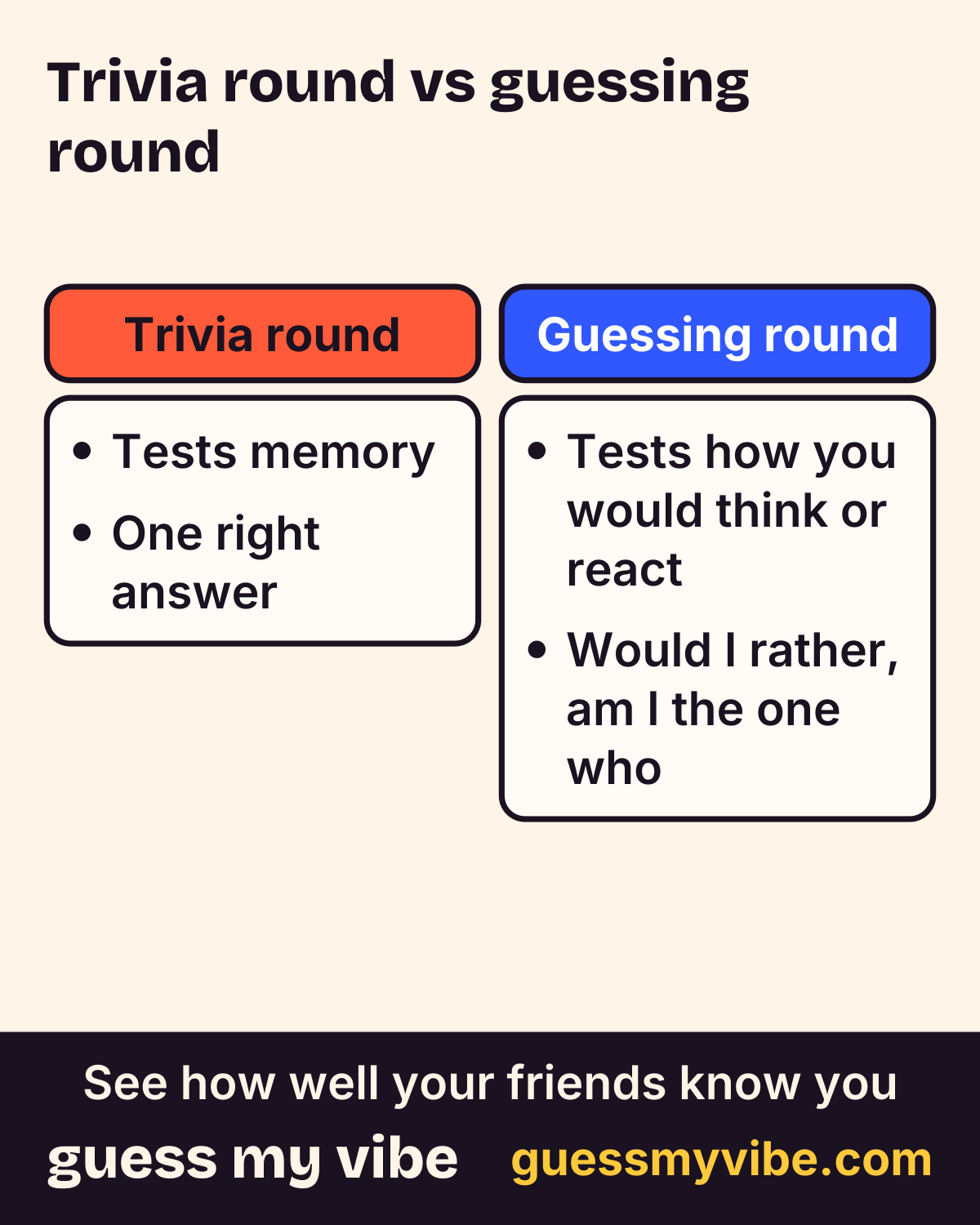
Trivia questions have one right answer that either gets remembered or doesn't. Guessing questions, the "would I rather" and "am I the one who" style above, are closer to what personality researchers actually study when they ask how well one person can judge another's personality. The honest answer from that research: better than guessing, worse than perfect, and it depends a lot on who's doing the guessing, what trait is being guessed, and what they've actually seen you do. A meta-analysis of 263 samples and more than 44,000 people found that how accurate an outside rating is depends on the trait and on how close the rater is: closeness boosted accuracy most for hard-to-observe traits, like emotional stability, and only minimally for highly evaluative ones, like Agreeableness [3]. Some rounds of this guessing game are just plain easier than others, no matter how well your friend knows you.
Cite this figure
Figure: "Trivia round vs guessing round." Guess My Vibe (guessmyvibe.com). https://guessmyvibe.com/learn/friendship-tag-questions#figure-memory-vs-guessing
Curious how your friends would answer?
Free. Answer 10 quick questions about you, then send your link. Friends play in their browser, no app needed.
Start freeFriends vs. strangers: who actually reads you better
A study built almost exactly to answer this question had about 150 undergraduates rated two ways: by two close acquaintances who knew them well, and separately by two total strangers who had only watched one brief videotaped interaction. Close acquaintances agreed with each other, and with the person's own self-ratings, far more than the strangers did. But the strangers weren't just guessing randomly either: their ratings of each other still agreed well beyond chance, and interestingly, the traits that were easiest for close friends to judge accurately were also the easiest ones for total strangers to judge [1]. Translated to tag-question terms: your best friend has a real, earned edge in the guessing round. But even a friendship tag video filmed with someone you've known for three months, not three years, isn't starting from nothing.
You don't need a panel of friends to get a real answer
It's tempting to think a group tag video with five friends guessing at once is more reliable than filming with just one. The research doesn't fully back that up for everyday behavior. A study that tracked 79 people's real daily behavior over four days, recorded rather than self-reported, found that a single close friend's rating of that behavior matched the recorded reality about as well as the person's own self-rating did, and averaging three friends together didn't clearly beat just one good friend's guess [2]. One honest friend who actually knows you, in other words, is already a solid judge. A full group just makes for a better video.
Why your longest friendship probably wins the guessing round
If you've got more than one friend to tag, the research hints at an answer of its own: the one who's known you the longest may read you best, and for a specific reason. A study of how personality judgments differ by length of acquaintance found that as acquaintance length increased, two things happened at once: agreement between self and other ratings went up, and reliance on generic stereotypes about "people in general" went down [4]. A new friend's guess leans on assumptions about what most people would do in a given situation. A years-long friend's guess has mostly replaced that with things that are actually, specifically true about you. That's a fair bet to make before you even hit record: in a head-to-head guessing round, length of acquaintance is a fair thing to bet on.
Does filming it change the answers?
Worth a quick, honest caveat: a tag video isn't a neutral lab setting. Both of you know a camera is rolling and other people will eventually watch it, which nudges answers toward whatever reads better on camera, a funnier guess, a kinder one, a more confident one, rather than necessarily the most accurate one. That's not a flaw unique to filmed questions; it's a version of the same self-presentation pressure that shows up anytime someone knows they're being watched and judged. None of the research above measured on-camera behavior specifically, so there's no clean number for how much a camera shifts the result. The reasonable, low-stakes fix is the same one that works for a lot of things: do a first, honest pass off-camera, then decide together what's worth re-recording for the video.
Score the guessing round for real
A tag video answers these questions once, on camera, with no way to track whether your friend's guesses actually hold up over time. Guess My Vibe turns the same guessing-round idea into a daily habit instead of a one-off clip: you answer a real question about yourself, a friend guesses your answer, and it's scored automatically. Play it with a few different friends and you'll see the same pattern this research points to, your oldest friend calling more of your answers right than someone newer, not because they're trying harder, but because they've simply had more real evidence to work from.
Key takeaways
- Classic friendship tag questions (favorite color, celebrity crush) mostly test memory and trivia, facts a friend either happened to retain or didn't.
- A guessing-style tag round, guessing how a friend would act or choose, tests something research actually studies: self-other personality agreement, not just recall.
- Close friends read a person's personality meaningfully better than strangers do, but even strangers judging from one brief interaction agree with each other more than chance alone would allow [1].
- A single close friend's rating of someone's actual daily behavior lines up about as well with reality as that person's own self-rating does [2].
- This isn't therapy, a diagnosis, or a substitute for professional care.
Questions people ask
What are good friendship tag questions besides favorite color and celebrity crush?
Add a "who's more likely to" round and a guessing round (would I rather have honest feedback or a gentle version, am I the one organizing the group project). Those test whether a friend actually knows how you think, not just facts they've memorized.
Do close friends actually guess personality questions better than strangers?
Yes, meaningfully better. A study comparing close acquaintances to strangers who'd seen only one brief interaction found the acquaintances agreed with the person's own self-ratings far more, though the strangers' guesses still beat random chance [1].
Does it matter how many friends I film a tag video with?
Not as much as you'd think, for everyday behavior questions. Research tracking real daily behavior found one close friend's rating matched reality about as well as the person's own self-rating did, and adding more friends' ratings didn't clearly improve on that [2].
Why does my oldest friend always win the guessing questions?
Research on acquaintance length found that the longer someone's known you, the more their guesses about you rely on things specifically true of you, rather than generic assumptions about people in general, and the more those guesses agree with your own self-view [4].
Can a tag video actually test how well someone knows me?
The classic trivia format mostly tests memory. Adding guessing-style questions (how you'd react, what you'd choose) gets closer to testing real personality knowledge, the same kind of question researchers use to study how well one person can judge another's personality.
See how well your friends know you.
Free. Answer 10 quick questions about you, then send your link. Friends play in their browser, no app needed.
Start freeReferences
- [1] Funder, D. C., & Colvin, C. R. (1988). Friends and strangers: Acquaintanceship, agreement, and the accuracy of personality judgment. Journal of Personality and Social Psychology, 55(1), 149–158. PubMed: 3418488 (opens in a new tab)
- [2] Vazire, S., & Mehl, M. R. (2008). Knowing me, knowing you: The accuracy and unique predictive validity of self-ratings and other-ratings of daily behavior. Journal of Personality and Social Psychology, 95(5), 1202–1216. PubMed: 18954202 (opens in a new tab)
- [3] Connelly, B. S., & Ones, D. S. (2010). An other perspective on personality: Meta-analytic integration of observers' accuracy and predictive validity. Psychological Bulletin, 136(6), 1092–1122. PubMed: 21038940 (opens in a new tab)
- [4] Biesanz, J. C., West, S. G., & Millevoi, A. (2007). What do you learn about someone over time? The relationship between length of acquaintance and consensus and self-other agreement in judgments of personality. Journal of Personality and Social Psychology, 92(1), 119–135. PubMed: 17201547 (opens in a new tab)
How we find and check these sources: how we write. Spotted an error? Report a correction.
Related
- How Well Do You Know Me Questions to Ask Friends
- This or That Questions for Friends, and What They Say
- Get to Know You Questions That Make People Like You More
- BFF Test: A Real One to Take With Your Best Friend
- Friendship Trivia Questions vs. the Questions That Matter
- Friend Question Games Backed by Real Closeness Research
- Deep Questions to Ask Friends, Grouped by Trait
Want to try it with your own friends? Make a friendship quiz and see who knows you best
Cite this article
- Title
- Friendship Tag Questions (Beyond Favorite Color)
- Publisher
- Guess My Vibe
- Updated
- URL
- https://guessmyvibe.com/
learn/ friendship-tag-questions
Copy this citation
Guess My Vibe. (2026, October 3). Friendship Tag Questions (Beyond Favorite Color). Guess My Vibe. https://guessmyvibe.com/
To point at one section, add that section's anchor (the # link on its heading) to the URL.