Friendship trivia questions (middle name, first job, childhood pet) test memory: either a friend remembers a fact you've mentioned, or they don't. Below is a full trivia list for quiz night, plus a second list of behavior questions that test something different and more interesting: whether a friend can call how you'd actually think or act. Research finds that second kind depends less on closeness alone and more on how much real, relevant information a friend has actually gathered about you [1].
Want to take it for real? Take the best friend test instead of trivia
Classic friendship trivia questions, middle name, first concert, childhood pet, test one thing: memory. A friend either filed the fact away at some point or they didn't, and nothing about getting it right proves they understand how you actually think or act. Below is a trivia round for quiz night, followed by a behavior round built to test something research actually studies: not what a friend remembers about you, but how well they can call what you'd do. The honest science section after both lists explains why some friends are simply better at that second kind of question, and it isn't just about how long they've known you.
Friendship trivia questions, the classic round
Quick, factual, good for the first round of quiz night. One point each.
- What was my first job?
- What street did I grow up on?
- What was the name of my first pet?
- What was my childhood nickname, if I had one?
- What's the first concert or show I ever went to?
- What was my favorite subject in school?
- What's the most embarrassing thing I wore in middle school or high school?
- What was my first car, or the first car I ever drove?
A harder trivia round: things that actually require paying attention
Still facts, but ones that need recent attention, not just old memory.
- What am I currently saving up for, if anything?
- What's the show, book, or podcast I've mentioned most in the last month?
- What's a small habit I've picked up or dropped in the last year?
- Who's someone new in my life this year that you've actually met?
- What's something I've complained about more than once recently?
- What's the last thing I asked to borrow, or lent out?
The behavior round: this is the one that actually tests knowing you
Answer for yourself first, privately, then have your friend guess before they see it. No right answer to memorize here, just a real read.
- If I found out plans got canceled last minute, would I be annoyed or quietly relieved?
- Given bad news, do I want the short version first or the full context first?
- In a group project with no clear leader, do I step up or wait and see?
- If a friend asked for brutally honest feedback, would I actually give it, or soften it?
- When something goes wrong, do I talk it through right away or need time alone with it first?
- Would I rather take a guaranteed okay option or risk it for a better one?
Why trivia is the easy mode of knowing someone
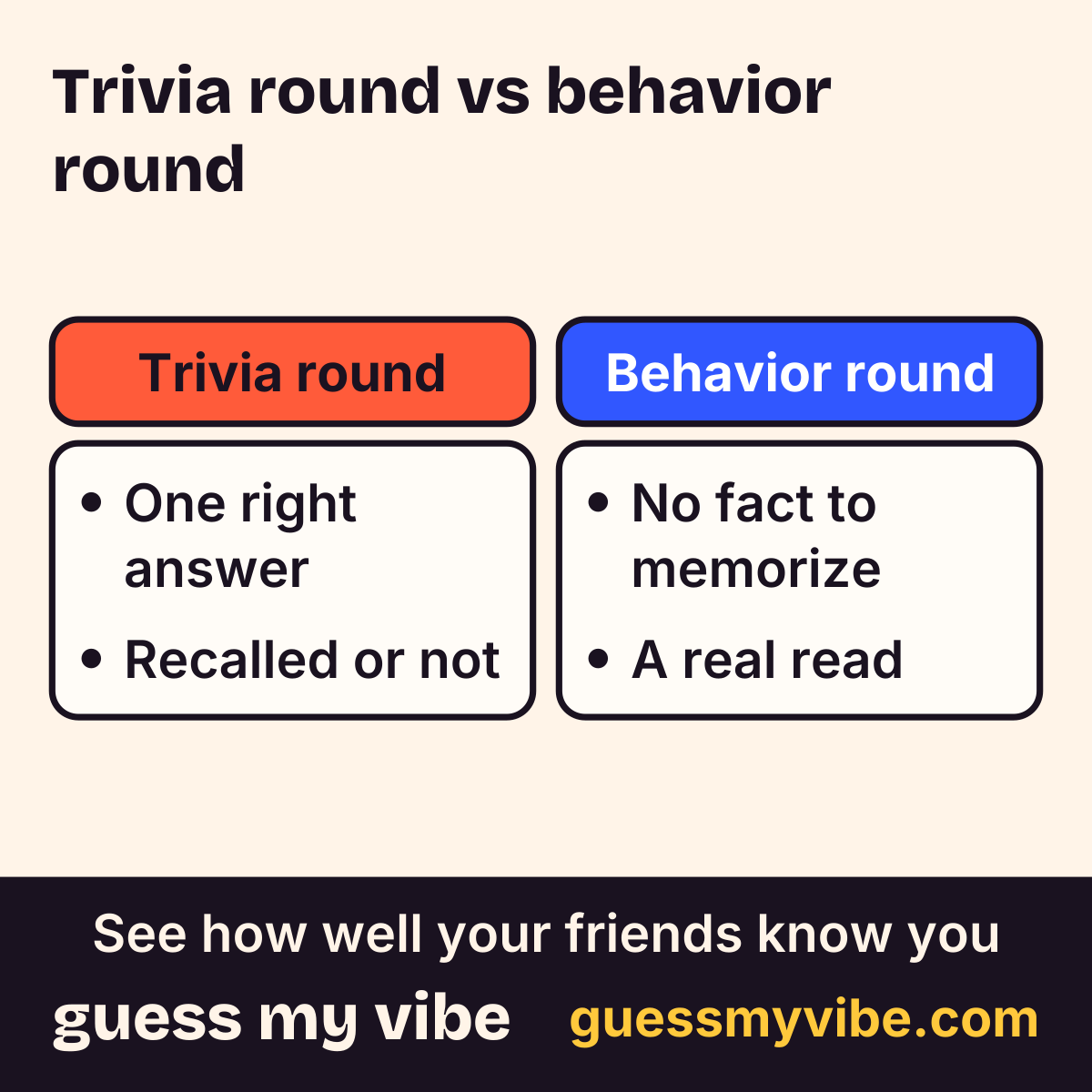
A trivia question has exactly one right answer sitting in someone's memory, waiting to be recalled or not. That's a real, if narrow, measure of attention and shared history, but it's not what personality researchers mean when they ask how well one person knows another. The behavior round above is closer to the real thing: a question with no fact to memorize, just a guess about how you'd actually respond, which is exactly the structure researchers use to study self-other agreement.
Cite this figure
Figure: "Trivia round vs behavior round." Guess My Vibe (guessmyvibe.com). https://guessmyvibe.com/learn/friendship-trivia-questions#figure-trivia-vs-behavior
Curious how your friends would answer?
Free. Answer 10 quick questions about you, then send your link. Friends play in their browser, no app needed.
Start freeWhat actually determines whether a friend gets the behavior round right
It's tempting to assume the answer is simple: the longer you've known someone, the better they know you. A study built to test this more precisely had triads of previously unacquainted college students interact under different conditions, some given more time and information to work with, some given information that was more directly relevant to personality than others, and then had them judge each other. Both factors mattered: more information was linked to more accurate judgments, and more personality-relevant information was linked to more accurate judgments [1]. In plain terms, it's not just time together that makes a friend good at the behavior round. It's whether the time they've spent with you has actually surfaced the kind of information that reveals how you think, not just how much time has passed on a calendar.
That finding has a practical edge for the list above. A friend who's spent years with you watching the same show side by side, never talking about anything deeper, has a lot of hours logged and comparatively little personality-relevant information. A newer friend who's already seen you handle a real crisis, a real disagreement, or a real decision under pressure may outscore them on the behavior round despite knowing you for less time.
Time still matters, just not the way trivia suggests
None of this means time is irrelevant, just that it works differently than trivia implies. A separate study tracking how personality judgments change as people get to know each other found that as acquaintance length increased, two things happened together: people's guesses agreed more with a person's actual self-view, and they relied less on generic assumptions about what people in general are like [2]. A brand-new acquaintance guessing the behavior round above is partly guessing what most people would say. A years-long friend has swapped a lot of that generic guessing out for things specifically true of you. Time is still an advantage. It's just an advantage that works by accumulating relevant information, the exact mechanism the study above measured directly, not by some automatic clock running in the background.
Some behavior questions are just harder than others, for everyone
Even a friend with plenty of relevant information won't call every behavior question equally well, because some traits are genuinely harder to observe than others. A meta-analysis covering 263 samples and more than 44,000 people found that how well an outside rating lines up with a person's own self-view depends on the trait involved and on how close the rater is: closeness helped a great deal for traits that are hard to see from outside, like emotional stability, but only minimally for highly judgmental traits like agreeableness [3]. Translated to the behavior round: some questions (how you'd react under stress, whether you'd soften honest feedback out of warmth) lean on traits that are simply harder to call from outside than others. A low score on one of the harder questions isn't proof your friend doesn't know you. It might just be a genuinely hard question.
A separate study of 165 people rated by friends and by strangers found a related pattern, split by where a trait actually lives rather than by trait name alone: people were the best judges of their own low-observability traits, like how easily their mood gets thrown off by stress, since those mostly happen inside someone's head. Friends had the edge on traits tied to how sharp, capable, or intellectually engaged someone comes across, since those show up more in behavior other people can actually watch [4]. The behavior round above leans mostly toward the visible kind, which is exactly why a good friend has a real shot at it, trivia skills aside.
Score the real version, not just quiz night
A trivia night answers these questions once, by hand, with no way to track whether a friend's behavior-round guesses actually hold up over time or across different kinds of questions. Guess My Vibe turns the same behavior-guessing idea into a running score instead: real personality questions, a friend's guess at your real answer, scored automatically, trait by trait. Play it with the friend who aced your trivia round and see whether they're just as sharp on the behavior side, or whether those turn out to be two different skills entirely.
Key takeaways
- Classic friendship trivia questions test memory: a friend either retained the fact or didn't, and getting it right doesn't require understanding how you think.
- A study that directly manipulated how much information people had about each other, and how relevant it was, found both quantity and relevance were positively related to how accurately they judged each other's personality [1].
- A friend's accuracy about you grows with real information, not just time together: the longer you've known someone, the more their guesses rely on what's actually true of you specifically, not a generic stereotype [2].
- Some traits are simply harder for any friend to call than others: closeness boosts accuracy a lot for hard-to-see traits like emotional stability, but only minimally for highly judgmental ones like agreeableness [3].
- This isn't therapy, a diagnosis, or a substitute for professional care.
Questions people ask
What's the difference between friendship trivia and actually knowing someone?
Trivia tests memory: a fact a friend either retained or didn't. Knowing someone, in the research sense, means being able to guess how they'd actually think or act in a specific situation, which is a different skill that doesn't show up on a trivia quiz at all.
Does knowing someone longer mean they'll win the trivia round?
Usually, for pure facts, since there's simply more history to draw from. For the behavior round, though, research found that the amount and personality-relevance of information a friend has actually gathered is what accuracy tracked, not just raw time together [1].
Why do some friends guess my behavior questions better than others?
Partly because they've accumulated more, and more relevant, information about you specifically, not just spent more hours in the same room [1], and partly because some traits are just easier to observe from the outside than others [3].
Why can't a brand-new friend guess the behavior questions as well?
Research on acquaintance length found that newer relationships rely more on generic assumptions about what people in general are like, and that reliance drops as a friendship actually accumulates specific, personal information over time [2].
What makes a good friendship trivia question?
One with a clear, memorable fact behind it, like a first job or childhood nickname. For something that tests real knowledge of you rather than memory, add a behavior-round question instead, like the ones above, where there's no fact to recall, only a guess to make.
See how well your friends know you.
Free. Answer 10 quick questions about you, then send your link. Friends play in their browser, no app needed.
Start freeReferences
- [1] Letzring, T. D., Wells, S. M., & Funder, D. C. (2006). Information quantity and quality affect the realistic accuracy of personality judgment. Journal of Personality and Social Psychology, 91(1), 111-123. PubMed: 16834483 (opens in a new tab)
- [2] Biesanz, J. C., West, S. G., & Millevoi, A. (2007). What do you learn about someone over time? The relationship between length of acquaintance and consensus and self-other agreement in judgments of personality. Journal of Personality and Social Psychology, 92(1), 119–135. PubMed: 17201547 (opens in a new tab)
- [3] Connelly, B. S., & Ones, D. S. (2010). An other perspective on personality: Meta-analytic integration of observers' accuracy and predictive validity. Psychological Bulletin, 136(6), 1092–1122. PubMed: 21038940 (opens in a new tab)
- [4] Vazire, S. (2010). Who knows what about a person? The self-other knowledge asymmetry (SOKA) model. Journal of Personality and Social Psychology, 98(2), 281–300. PubMed: 20085401 (opens in a new tab)
How we find and check these sources: how we write. Spotted an error? Report a correction.
Related
Want to try it with your own friends? Make a friendship quiz and see who knows you best
Cite this article
- Title
- Friendship Trivia Questions vs. the Questions That Matter
- Publisher
- Guess My Vibe
- Updated
- URL
- https://guessmyvibe.com/
learn/ friendship-trivia-questions
Copy this citation
Guess My Vibe. (2026, October 3). Friendship Trivia Questions vs. the Questions That Matter. Guess My Vibe. https://guessmyvibe.com/
To point at one section, add that section's anchor (the # link on its heading) to the URL.