Small talk feels harder than it actually is because people consistently underestimate how much a stranger wants to talk and overestimate how awkward the conversation will be. Across real studies, commuters who struck up a conversation with a stranger had a more positive trip than people who stayed quiet, and conversations that went a little deeper than usual felt less awkward and more connecting than either person had assumed going in. The fix isn't a better opening line; it's trusting that the conversation will go better than your gut says it will.
Why small talk feels harder than it actually is
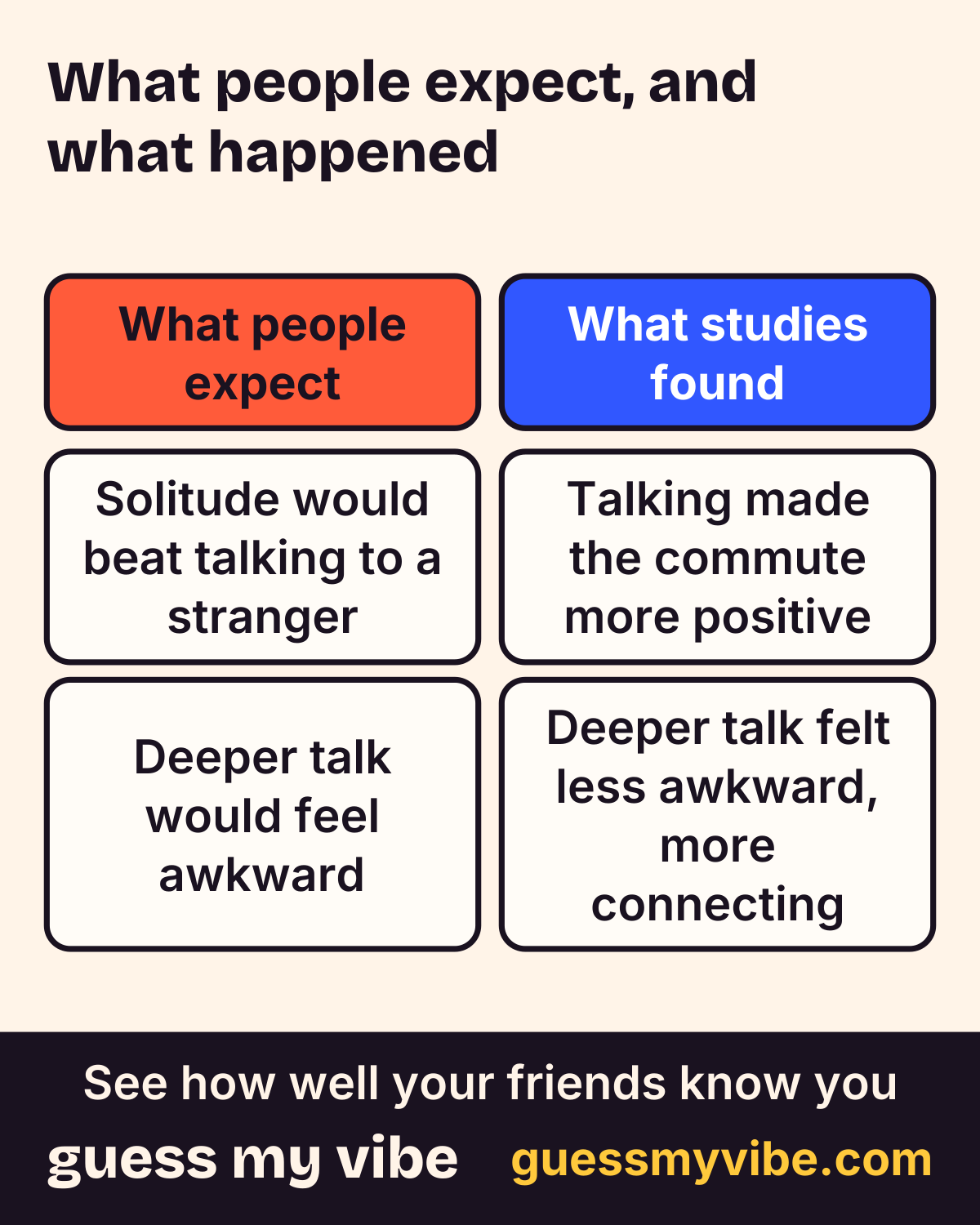
Most advice on how to make small talk starts with a list of opening lines, as if the problem is not knowing what to say. The research points somewhere else entirely: the problem is usually a mistaken assumption, made before the conversation even starts, that it's going to go worse than it actually will. In one set of studies, commuters on trains and buses were randomly assigned to either strike up a conversation with a nearby stranger, stay quiet like they normally would, or just commute as usual. The people told to talk to a stranger reported a more positive commute than the ones who stayed quiet, with no hit to how productive or efficient they felt the ride was [1]. A separate group of people, asked beforehand to guess which option would feel better, got it backwards: they expected solitude to beat connecting with a stranger. What people assumed going in and what they actually experienced pointed in opposite directions.
The misread behind small talk dread
Digging into why people got it so wrong turned up something specific and useful: part of the mistaken assumption traced to underestimating how interested the stranger would actually be in talking back [1]. If you walk up to someone already assuming they'd rather be left alone, every small social cost of starting a conversation (the risk of a flat response, an awkward silence, being brushed off) feels bigger than it really is, and every potential upside feels smaller. A later meta-analysis combining seven separate studies and more than 2,300 participants mapped out exactly which fears show up before a conversation with a stranger: not enjoying it, not being liked, running out of things to say, on both your own side and what you assume the other person is thinking. Taken together, the fears turned out to be overblown when measured against how the conversation actually went afterward [2]. The same research tested two ways to shrink the gap, giving people a few simple conversation tips beforehand, and just having them experience one pleasant conversation with a stranger first, and the authors report testing both as ways to reduce the fear.
Small talk isn't the shallow ceiling it feels like
There's a second, related misjudgment that shows up once a conversation is already underway: people assume going even slightly deeper than typical small talk, asking something a little more personal, admitting something a little more real, will land as awkward or invasive. A large research program running a series of experiments tested this directly by comparing shallow and deep conversations between strangers. People consistently assumed the deeper conversations would feel more awkward than the shallow ones. What actually happened was closer to the opposite: the conversations felt less awkward than people had assumed going in, and participants ended up feeling more connected to partners they'd had a deeper conversation with than to partners they'd only made shallow small talk with [3]. The root cause tracked back to the same basic mistake as the commuter study: participants kept underestimating how much a stranger actually cared about what they were sharing.
Cite this figure
Figure: "What people expect, and what happened." Guess My Vibe (guessmyvibe.com). https://guessmyvibe.com/learn/how-to-make-small-talk#figure-expected-vs-found
Curious how your friends would answer?
Free. Answer 10 quick questions about you, then send your link. Friends play in their browser, no app needed.
Start freeWhy this matters for actually starting a conversation
None of this says small talk is secretly easy or that nerves are irrational to feel. It says the specific content of the nerves, this person doesn't want to talk to me, this will be awkward, I'll run out of things to say, is measurably wrong more often than it's right. That's a more useful thing to know walking up to a stranger than any particular opening line, because it changes what you're actually arguing with yourself about. The hesitation before saying something to a stranger on a train, in a waiting room, or at the edge of a group isn't a signal that the conversation is a bad idea. In the studies above, it was consistently a false alarm.
Does casual small talk actually matter, or is it just filler?
It's reasonable to wonder whether any of this is worth the discomfort if small talk is, by definition, the shallow stuff. Research on daily social interactions found people felt happier and more connected on days with more casual, lower-stakes social contact, not just time spent with close friends and family, but interactions with classmates and other acquaintances, the more peripheral people in a social network [4]. Small talk with someone you'll never get close to isn't a lesser, consolation-prize version of real connection. In this research, it's one of the things linked to a better day, alongside the time you spend with people you're actually close to.
A practical way to use this research
Put together, the research points to a short, specific checklist rather than a script. First, assume the other person is more open to talking than your gut says, since that's the exact assumption the studies above found people get wrong [1]. Second, don't treat a slightly more personal question as a risk; conversations that went a bit deeper than typical small talk came back rated as less awkward and more connecting than people had assumed going in, not more [3]. Third, lower the bar for what counts as worth doing. A two-minute exchange with someone you'll see again, a classmate, a coworker, a regular at the same coffee shop, isn't a weak substitute for real connection; it's linked to a better day in its own right [4]. And if the first attempt feels stiff, that's expected and recoverable: the same research tested giving people conversation tips and giving them one pleasant conversation as ways to reduce these fears [2].
A friend already knows how this goes for you
A friend who has actually watched you talk to a barista, a new classmate, or someone at a party has real evidence about how you handle exactly this moment, evidence you don't fully trust about yourself because of the same kind of misread the research above keeps finding. Guess My Vibe runs on that gap: a friend guesses how you'd actually answer questions about social situations like this one, and you see how close their outside view landed next to your own, which is a smaller, more honest version of the same mismatch between assumption and reality that this whole body of research is about.
Key takeaways
- Commuters randomly told to talk to a stranger on their train or bus had a more positive commute than people who stayed quiet as usual, with no drop in how productive they felt getting there [1].
- A big part of the dread comes from a simple misread: people assume a stranger is less interested in talking than the stranger actually turns out to be [1].
- A meta-analysis of 7 studies and over 2,300 people found specific fears about talking to strangers, that you won't enjoy it, that they won't like you, that you'll run out of things to say, are consistently overblown compared to how the conversation actually goes [2].
- People also lowball how deep they can go: conversations that touched on something a bit more personal than typical small talk felt less awkward and created more connection than either person had assumed beforehand [3].
- This isn't therapy, a diagnosis, or a substitute for professional care; it's a plain-English summary of what personality and social psychology research says about making small talk.
Questions people ask
Why does small talk feel so awkward?
Mostly because of a misread, not because the conversation actually goes badly. Research finds people consistently underestimate how interested a stranger is in talking and overestimate how awkward the exchange will be, compared to how it actually turns out [1] [2].
How do I start small talk with a stranger?
There's no single script the research points to, but the most useful mindset shift is trusting that the other person is more open to talking than you'd guess. Commuters randomly assigned to talk to a stranger had a more positive trip than those who stayed quiet, even though a separate group had assumed the opposite going in [1].
Is it rude or weird to go deeper than small talk?
Research says no, and that the opposite assumption is usually what's wrong. Conversations nudged a bit deeper than typical small talk felt less awkward and created more connection than either person had assumed beforehand [3].
Is small talk with people I'm not close to actually worth it?
Yes. Research on daily interactions found people felt happier and more connected on days with more casual interactions, classmates and other acquaintances, not just time with close friends and family [4].
What's the single biggest fear people have about small talk, and is it true?
A meta-analysis of over 2,300 people found the most common fears, not enjoying it, not being liked, running out of things to say, are all measurably overblown compared to how the conversation actually went [2].
Does it get easier with practice?
The same research tested two ways to reduce the fears, conversation tips and the experience of one pleasant conversation, and reports that conversations go better than people expect [2].
See how well your friends know you.
Free. Answer 10 quick questions about you, then send your link. Friends play in their browser, no app needed.
Start freeReferences
- [1] Epley, N., & Schroeder, J. (2014). Mistakenly seeking solitude. Journal of Experimental Psychology: General, 143(5), 1980–1999. PubMed: 25019381 (opens in a new tab)
- [2] Sandstrom, G. M., & Boothby, E. J. (2021). Why do people avoid talking to strangers? A mini meta-analysis of predicted fears and actual experiences talking to a stranger. Self and Identity, 20(1), 47-71. doi.org/10.1080/15298868.2020.1816568 (opens in a new tab)
- [3] Kardas, M., Kumar, A., & Epley, N. (2022). Overly shallow? Miscalibrated expectations create a barrier to deeper conversation. Journal of Personality and Social Psychology, 122(3), 367–398. PubMed: 34591541 (opens in a new tab)
- [4] Sandstrom, G. M., & Dunn, E. W. (2014). Social Interactions and Well-Being: The Surprising Power of Weak Ties. Personality and Social Psychology Bulletin, 40(7), 910–922. PubMed: 24769739 (opens in a new tab)
How we find and check these sources: how we write. Spotted an error? Report a correction.
Related
- The Liking Gap: Why People Like You More Than You Think
- Communication Styles and Personality: The Real Research
- Social Battery: The Science of Why Socializing Drains You
- This or That Questions for Friends, and What They Say
- Active Listening: What Research Says It Actually Does
- How to Have Deep Conversations, Backed by Research
- How to Keep a Conversation Going: Ask Follow-Ups
Cite this article
- Title
- How to Make Small Talk, According to Research
- Publisher
- Guess My Vibe
- Updated
- URL
- https://guessmyvibe.com/
learn/ how-to-make-small-talk
Copy this citation
Guess My Vibe. (2026, October 3). How to Make Small Talk, According to Research. Guess My Vibe. https://guessmyvibe.com/
To point at one section, add that section's anchor (the # link on its heading) to the URL.