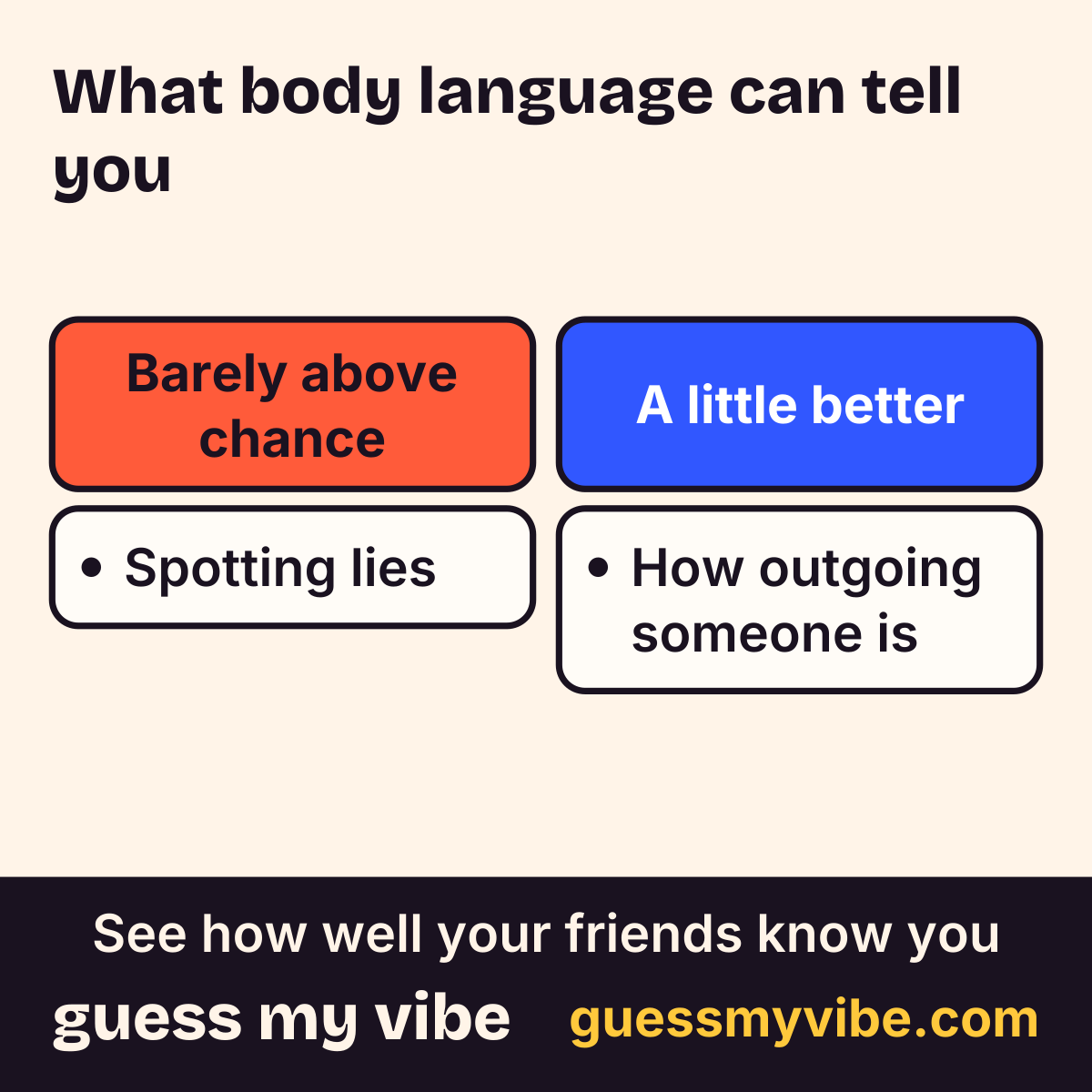
Reading body language can tell you a little, mostly about how outgoing someone is, but it is a poor lie detector. A meta-analysis of 206 documents and 24,483 judges found people correctly sorted lies from truths 54% of the time, only slightly better than a coin flip [1]. Extraversion, by contrast, showed the most outward signs of any trait studied in one study of observable attributes [2].
Reading body language: the honest answer
Reading body language is a mixed bag, and the research is clearer about where it fails than where it works. It fails at the thing most people want it for: telling whether someone is lying. In a large meta-analysis, people judging lies and truths in real time, with no special training, averaged 54% correct [1]. Chance is 50%. It works a little better for something quieter: picking up how outgoing someone is [2]. This article lays out both sides without the pop-psychology claims, because the research doesn't support decoding a stranger from their posture.
If you came here for a cheat sheet of tells, we don't have one, and neither does the science. What we do have is a good sense of which questions body language can answer and which it can't, which is more useful than a list of crossed-arms myths.
Spotting lies from body language: barely above chance
The best evidence comes from a meta-analysis that pooled results from 206 documents and 24,483 judges [1]. In the studies it covered, people tried to tell lies from truths as they happened, with no special aids or training. On average they got 54% right. They correctly flagged 47% of lies as deceptive and correctly called 61% of truths non-deceptive [1]. In plain words, people miss more than half the lies they see, and they tend to believe people by default.
The authors are careful about how to read that. Compared with differences between individual judges, the average ability to tell lies from truths is nontrivial, and relative to other effects social psychologists have meta-analyzed it sits at roughly the 60th percentile in size [1]. So it isn't zero, but it is small. Two other findings from the same review matter for everyday life. People were more accurate judging audible lies than visible ones, and people tended to regard their interaction partners as honest [1]. The first suggests that what someone says and how they sound carry more than how they look. The second is a reminder that most of us start from trust.
Why body language is such a weak lie detector
A natural guess is that people fail because they watch the wrong things, such as avoiding eye contact. A later meta-analysis tested that idea directly and found something different. It looked at 66 behavioral cues across 153 samples. Perceived deception was most strongly tied to impressions of incompetence and ambivalence, and, contrary to what people say they believe, eye contact was only weakly related to whether someone seemed deceptive [3].
The surprise came next. The authors concluded that people rarely rely on the wrong cues. Instead, the limit on lie detection is mainly that behavioral cues to deception are weak [3]. In other words, even a perfect observer would have little to work with. This fits an earlier review that pooled 1,338 estimates of 158 candidate cues. It found liars were somewhat less forthcoming, told less compelling stories, and came across as more tense and more negative, but many behaviors showed no discernible, or only weak, links to deceit [4].
A 2019 review summarizes the state of the field bluntly. The authors write that the nonverbal cues to deceit discovered to date are faint and unreliable, that people are mediocre lie catchers when they pay attention to behavior, and that misbeliefs about nonverbal behavior and deception persist and are hard to debunk [6]. That last point explains why the myths stay popular. A belief that feels like common sense is hard to dislodge even when the data disagree.
Curious how your friends would answer?
Free. Answer 10 quick questions about you, then send your link. Friends play in their browser, no app needed.
Start freeWhat body language can reveal: mostly how outgoing someone is
Lying is a specific, hard case. Reading general personality from behavior does a bit better, and the clearest result is for extraversion. One study videotaped 50 two-person teams of close acquaintances in a standard situation, measured their personality and intelligence, and then had strangers rate either the observable attributes or the personality traits of the people on video [2]. Extraversion was the trait with the most outward manifestations, and the strongest match between the cues strangers used and the cues that were actually valid [2].
Our guess, not the paper's, is that this reflects how outgoing people tend to carry themselves: more animated and more expressive. In that study it was the one trait where what strangers could see lined up best with what was true. The same study found that intelligence was inferred from both visual and acoustic attributes, but only the acoustic cues, how someone sounded, explained the link between tested intelligence and perceived intelligence [2]. Again, the voice matters more than the look.
Natural expression and posture carry some information about other traits too. In a study of full-body photos, observers who saw people in a spontaneous pose and expression were accurate for almost all of ten traits studied, and the authors found that both static cues, like clothing, and dynamic cues, like facial expression and posture, offered valuable information [5]. Note the word accurate: it means the observers' judgments matched self and peer reports of the traits, not that they could read anyone perfectly. Nothing here says you can read a stranger's inner life from how they stand.
Cite this figure
Figure: "What body language can tell you." Guess My Vibe (guessmyvibe.com). https://guessmyvibe.com/learn/reading-body-language#figure-what-body-language-tells
How to use this in real life
The practical lesson is a change of target. Body language is better at suggesting a general style, how outgoing, expressive or animated someone is, than at revealing a specific hidden fact, like whether they are telling the truth right now. If you notice someone fidgeting or avoiding eye contact, the evidence says that is a weak reason to doubt them, since eye contact has only a weak link with seeming deceptive [3] and many behaviors show little link to deceit [4].
- Treat a cue as a question, not an answer. A nervous look can mean nervous, tired, shy or untruthful. Nothing in the studies lets you tell which from posture alone.
- Weigh what people say and how they sound. Audible lies were easier to catch than visible ones [1], and only acoustic cues, not visual ones, accounted for the link between tested and perceived intelligence [2].
- Remember your default is trust. People tend to regard others as honest [1], which helps explain why many lies slip by.
- Ask. When something matters, a direct question beats an interpretation of posture.
None of this makes nonverbal communication meaningless. Some cues carry real information. The research just doesn't support treating a single gesture as a lie detector or a personality test, and a confident-sounding decoder claim is more likely to be a myth than a finding.
A better source than any single gesture
Everything above is about reading strangers or reading in the moment. People who know you well have a different kind of evidence: years of how you act in different moods, with different people, over time. That is the idea behind Guess My Vibe. You answer questions about yourself, your friends guess how you would answer, and you see where they matched you and where they didn't. It doesn't read your body language, and it doesn't detect lies. It just compares your own picture of yourself with the one built from a long run of real behavior, which is a sturdier basis than any one gesture.
Key takeaways
- People judging lies in real time with no training got 54% right on average, correctly spotting 47% of lies and 61% of truths [1].
- The problem is not that people watch the wrong cues: a meta-analysis found people rarely rely on the wrong ones, and the real limit is that behavioral cues to lying are weak [3].
- A review of 1,338 estimates of 158 cues found many behaviors had no discernible, or only weak, links to deceit [4].
- Extraversion is the trait with the most outward signs, and in one study strangers' use of cues matched those cues' validity best for it [2].
- Natural expressions and posture do carry some personality information, in a study where observers judged almost all of ten traits from spontaneous full-body photos [5].
- This isn't therapy, a diagnosis, or a substitute for professional care.
Questions people ask
Can you tell if someone is lying from their body language?
Only slightly better than chance. In a meta-analysis of 24,483 judges, people got 54% of lie-or-truth calls right on average [1], and a 2019 review calls the nonverbal cues to deceit faint and unreliable [6].
Does avoiding eye contact mean someone is lying?
Not reliably. A meta-analysis found eye contact was only weakly related to whether people judged someone deceptive [3], and a review of 158 cues found many behaviors had no discernible or only weak links to deceit [4].
What can body language actually tell you?
Mostly general style, especially how outgoing someone is. Extraversion had the most outward manifestations in one study [2], and natural expression and posture carried some information about other traits too [5].
Is it easier to catch a lie by listening or watching?
Listening, according to a meta-analysis: people were more accurate judging audible lies than visible ones [1].
See how well your friends know you.
Free. Answer 10 quick questions about you, then send your link. Friends play in their browser, no app needed.
Start freeReferences
- [1] Bond, C. F., Jr., & DePaulo, B. M. (2006). Accuracy of deception judgments. Personality and Social Psychology Review, 10(3), 214–234. PubMed: 16859438 (opens in a new tab)
- [2] Borkenau, P., & Liebler, A. (1995). Observable attributes as manifestations and cues of personality and intelligence. Journal of Personality, 63(1), 1–25. doi.org/10.1111/j.1467-6494.1995.tb00799.x (opens in a new tab)
- [3] Hartwig, M., & Bond, C. F., Jr. (2011). Why do lie-catchers fail? A lens model meta-analysis of human lie judgments. Psychological Bulletin, 137(4), 643–659. PubMed: 21707129 (opens in a new tab)
- [4] DePaulo, B. M., Lindsay, J. J., Malone, B. E., Muhlenbruck, L., Charlton, K., & Cooper, H. (2003). Cues to deception. Psychological Bulletin, 129(1), 74–118. PubMed: 12555795 (opens in a new tab)
- [5] Naumann, L. P., Vazire, S., Rentfrow, P. J., & Gosling, S. D. (2009). Personality judgments based on physical appearance. Personality and Social Psychology Bulletin, 35(12), 1661–1671. PubMed: 19762717 (opens in a new tab)
- [6] Vrij, A., Hartwig, M., & Granhag, P. A. (2019). Reading lies: Nonverbal communication and deception. Annual Review of Psychology, 70, 295–317. doi.org/10.1146/annurev-psych-010418-103135 (opens in a new tab)
How we find and check these sources: how we write. Spotted an error? Report a correction.
Related
Cite this article
- Title
- Reading Body Language: What It Can and Can't Tell You
- Publisher
- Guess My Vibe
- Updated
- URL
- https://guessmyvibe.com/
learn/ reading-body-language
Copy this citation
Guess My Vibe. (2026, October 4). Reading Body Language: What It Can and Can't Tell You. Guess My Vibe. https://guessmyvibe.com/
To point at one section, add that section's anchor (the # link on its heading) to the URL.