People gossip, meaning they talk about someone who isn't present, for several distinct reasons: sharing useful information, bonding socially, venting emotion, protecting someone vulnerable, and occasionally undermining someone on purpose. Research that actually recorded people's real conversations found most everyday gossip is neutral in tone, not mean, and that warning a vulnerable person about someone's bad behavior can genuinely help a group cooperate. Gossip isn't one single bad habit; it's a normal, mostly ordinary behavior nearly everyone does.
What counts as gossip, and how researchers actually studied it
Gossip, in research terms, is simply talking about someone who isn't present to hear it. That broad definition covers a lot more ground than the word's reputation suggests: a coworker mentioning that another coworker just got engaged counts, the same as something meaner would. One of the more convincing studies on who actually gossips and how sidestepped the usual problem with this topic, people being unreliable or self-conscious reporting their own gossip habits, by having 467 participants across five separate studies wear a small acoustic recorder that sampled real snippets of their day (5 to 12 percent of the time) for two to five days [1]. Researchers then coded every recorded conversation that counted as gossip for its tone, its subject, and its topic, instead of asking people to self-report after the fact.
The biggest myth: most gossip isn't mean
The recordings found that gossip, overall, skewed neutral rather than negative or positive, and it was mostly about ordinary social information, who's dating whom, what happened at work, rather than appearance or achievement [1]. The same study also found that frequent gossipers tended to be more extraverted, which fits a simple explanation: people who talk more, in general, also gossip more, since gossip is just one category of ordinary conversation. Two other patterns stood out and complicate the usual stereotype rather than confirming it: women in the sample engaged in more neutral gossip than men did (the reported difference was specifically in neutral gossip), and younger participants gossiped more negatively than older participants did. The researchers behind the study put it plainly: these naturalistic recordings dispel some common stereotypes about a behavior that's both extremely common and widely misunderstood.
Why people actually gossip: five distinct motives
A separate line of research asked a more direct question: when people gossip, what are they actually trying to get out of it? A study of 460 people, each describing a real, recent gossip episode from their own life, validated a five-motive structure that held up no matter how "gossip" was defined to them: social enjoyment (it's fun, it builds rapport), information gathering and validation (checking facts or opinions against someone else's), negative influence (deliberately trying to hurt someone's reputation), group protection (watching out for the people around you), and emotion venting (needing to share something emotionally charged) [2]. Lumping all of gossip into one bucket, harmless chatter or malicious rumor, misses that it's actually several different behaviors sharing one label, with very different intentions behind each one.
Curious how your friends would answer?
Free. Answer 10 quick questions about you, then send your link. Friends play in their browser, no app needed.
Start freeThe surprising case for gossip: it can keep groups honest
One of those five motives, group protection, has its own dedicated research behind it. A series of four studies found that when people witness someone behave selfishly, they feel real distress and are specifically motivated to warn a vulnerable person about it, researchers call this prosocial gossip, and that sharing the warning measurably reduces the gossiper's own distress [3]. People who scored higher on measures of prosocial orientation were the most willing to do this, even at a personal cost to themselves, and the last study in that series found this kind of gossip could actually deter selfish behavior and promote cooperation within a group. Spreading the word that someone can't be trusted isn't purely a character flaw in this research; it's one way groups can protect members from being exploited.
When gossip helps a group, and when it doesn't
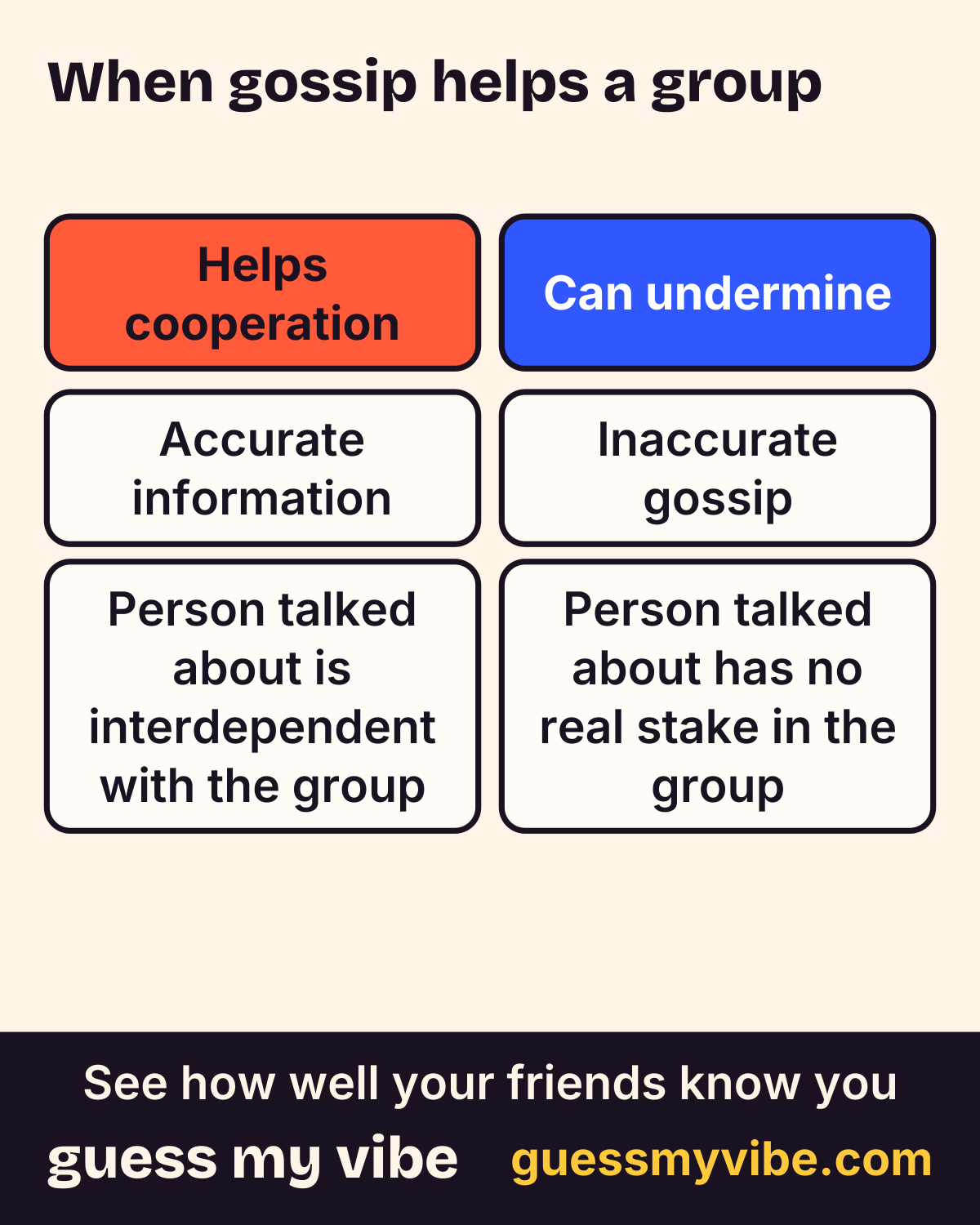
None of this means gossip is simply good, and a review pulling together this whole research area is careful about exactly where the line falls. Gossip increases prosocial, cooperative behavior mainly under three conditions: when the information being shared is accurate rather than inaccurate, when the person being talked about is actually interdependent with, rather than independent from, the people hearing it, and when that person anticipates they might be gossiped about rather than when they've actually been on the receiving end of negative gossip themselves [4]. Outside those conditions, inaccurate gossip, gossip about someone with no real stake in the group, or gossip someone has already been directly hurt by, the review notes the same behavior can instead undermine desirable behavior. Gossip isn't a single force pushing one direction; its effect depends heavily on the specifics.
Cite this figure
Figure: "When gossip helps a group." Guess My Vibe (guessmyvibe.com). https://guessmyvibe.com/learn/why-do-people-gossip#figure-when-gossip-helps
A plainer way to think about why gossip persists
Put the prosocial-gossip research and the five-motive research together and a simpler picture shows up underneath all the nuance. Most groups, a friend group, a workplace, a dorm floor, have no formal rulebook and no one specifically assigned to enforce good behavior. Gossip is one of the few tools people actually have for keeping track of who's reliable and who isn't, without needing an official system to do it. That's not a flattering way to describe a conversation about who flaked on plans again or who covered for a coworker, but it's closer to what the research above is actually describing than either "gossip is petty" or "gossip is harmless fun." It's informal, decentralized bookkeeping that groups of people, which people build without anyone deciding to build it on purpose. That's an interpretation of the findings, not something any one study measured.
So, is gossiping actually bad?
The honest answer sits between the two extremes people usually reach for. Gossip isn't a moral failing; the research above treats it as a normal, common behavior that's mostly neutral and sometimes genuinely useful for keeping a group honest. It also isn't automatically harmless; the negative-influence motive is real, and even well-intentioned gossip can go wrong when the information shared is wrong or when it reaches someone it shouldn't. What matters more than whether you gossip is which of the five motives above is actually driving a specific conversation, and whether what's being said is something you'd be comfortable having said about you.
A more direct way to find out what a friend really thinks
A lot of casual gossip is really just an indirect way of checking in on what other people think, which is one of the five motives the research above identified. Guess My Vibe skips the indirect route: a friend rates you directly on an honest take, and you see their actual, specific answer instead of trying to piece together what people might be saying about you when you're not in the room.
Key takeaways
- A study that had people wear acoustic recorders for several days found frequent gossipers tended to be more extraverted, and that most gossip overall was neutral in tone and about everyday social information, not negative [1].
- Women in that same study engaged in more neutral gossip than men did, and younger people gossiped more negatively than older people, patterns that complicate the usual stereotype of who gossips and why [1].
- A validated questionnaire found five distinct reasons people gossip: social enjoyment, gathering and checking information, undermining someone on purpose, protecting the group, and venting an emotional experience [2].
- "Prosocial gossip," warning a vulnerable person about someone who behaved selfishly, measurably reduces the gossiper's own distress and can deter selfish behavior and encourage cooperation in a group [3].
- This isn't therapy, a diagnosis, or a substitute for professional care.
Questions people ask
Is gossiping actually bad for you or your friendships?
Not automatically. Research recording real conversations found most everyday gossip is neutral, not mean, and one specific kind, warning a vulnerable person about someone's selfish behavior, measurably helps groups cooperate [1] [3].
Why do I feel the urge to gossip?
Research identifies five distinct motives: social enjoyment, gathering or checking information, negative influence, protecting the group, and venting an emotional experience. The study validated the five motives; it didn't rank how common each one is [2].
Do extroverted people gossip more?
A study using wearable recorders on real conversations found frequent gossipers tended to be more extraverted, consistent with extraverted people simply talking more in general [1].
What is 'prosocial gossip'?
It's gossip used to warn a vulnerable person about someone who's behaved selfishly or antisocially. Research found people are motivated to share this kind of warning, that doing so reduces their own distress, and that it can measurably deter selfish behavior in a group [3].
Do women gossip more than men?
Not more overall, according to one naturalistic study: women engaged in more neutral gossip specifically than men did, and the reported difference wasn't about gossip overall, which complicates the common stereotype [1].
When does gossip actually cause harm?
A review found gossip's prosocial effect depends on the information being accurate, the person being talked about actually being connected to the group, and the person anticipating gossip rather than having already been hurt by it directly; outside those conditions, gossip can undermine good behavior instead of encouraging it [4].
See how well your friends know you.
Free. Answer 10 quick questions about you, then send your link. Friends play in their browser, no app needed.
Start freeReferences
- [1] Robbins, M. L., & Karan, A. (2020). Who Gossips and How in Everyday Life?. Social Psychological and Personality Science, 11(2), 185-195. doi.org/10.1177/1948550619837000 (opens in a new tab)
- [2] Dores Cruz, T. D., Balliet, D., Sleebos, E., Beersma, B., Van Kleef, G. A., & Gallucci, M. (2019). Getting a Grip on the Grapevine: Extension and Factor Structure of the Motives to Gossip Questionnaire. Frontiers in Psychology, 10, 1190. PubMed: 31178801 (opens in a new tab)
- [3] Feinberg, M., Willer, R., Stellar, J., & Keltner, D. (2012). The virtues of gossip: Reputational information sharing as prosocial behavior. Journal of Personality and Social Psychology, 102(5), 1015-1030. PubMed: 22229458 (opens in a new tab)
- [4] Nieper, A. S., Beersma, B., Dijkstra, M. T. M., & van Kleef, G. A. (2022). When and why does gossip increase prosocial behavior?. Current Opinion in Psychology, 44, 315-320. PubMed: 34875505 (opens in a new tab)
How we find and check these sources: how we write. Spotted an error? Report a correction.
Related
Want to try it with your own friends? Make a friendship quiz for your friend group
Cite this article
- Title
- Why Do People Gossip? What the Research Actually Found
- Publisher
- Guess My Vibe
- Updated
- URL
- https://guessmyvibe.com/
learn/ why-do-people-gossip
Copy this citation
Guess My Vibe. (2026, October 3). Why Do People Gossip? What the Research Actually Found. Guess My Vibe. https://guessmyvibe.com/
To point at one section, add that section's anchor (the # link on its heading) to the URL.