Psychologists studying humor styles sort how people use humor into four types: affiliative (jokes to bond with others), self-enhancing (keeping your own perspective light), aggressive (humor at someone else's expense), and self-defeating (humor at your own expense to win approval) [1]. Two meta-analyses tying these styles to the Big Five agree on the clearest pattern: affiliative humor goes with higher extraversion and lower neuroticism [2] [3]. The questionnaire that measures all this also has real, published critics worth knowing about [4].
"What's your sense of humor like" sounds like a personality question with no real answer, the kind of thing that depends entirely on who's asking. Psychologists who study this for a living disagree. There's a specific, validated questionnaire behind the idea of humor styles, two separate meta-analyses tying those styles to the Big Five personality traits, and an honest, ongoing debate about how solid the underlying measurement actually is. All three parts are worth knowing before you decide which style describes you or a friend.
The four humor styles psychologists actually study
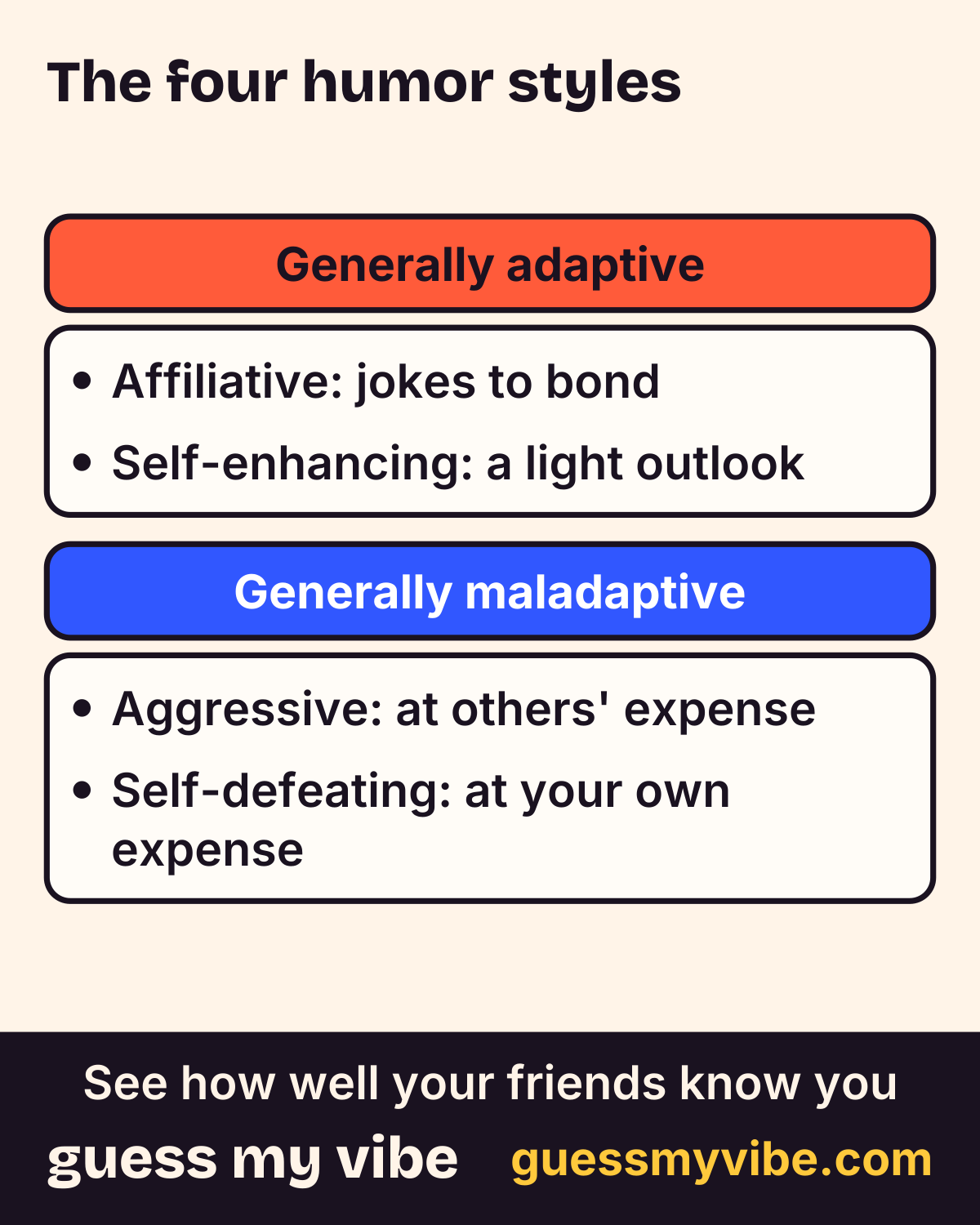
The modern framework comes from a 2003 paper that introduced the Humor Styles Questionnaire, a 32-item scale built to separate humor use into four distinct styles rather than treating "sense of humor" as one single trait [1]. Affiliative humor is the type most people picture first: telling jokes, trading banter, using humor to bond with people and smooth over tension. Self-enhancing humor is quieter, a habitually light, amused way of looking at your own life's ups and downs, used mainly to manage your own mood rather than entertain others. Those two are generally classed as adaptive styles. The other two lean maladaptive: aggressive humor uses sarcasm, teasing, or put-downs at someone else's expense, and self-defeating humor goes the other direction, making yourself the butt of the joke to win approval or avoid conflict. In the paper's validation samples, the first two styles tracked with better psychological well-being measures and the latter two tracked with worse ones.
Cite this figure
Figure: "The four humor styles." Guess My Vibe (guessmyvibe.com). https://guessmyvibe.com/learn/humor-styles#figure-four-humor-styles
How humor styles map onto the Big Five
Once a validated scale existed, the obvious next question was how it relates to the Big Five personality traits. A 2015 meta-analysis pooling 15 studies found one especially strong, consistent pattern: affiliative humor correlated with higher extraversion and lower neuroticism, and that relationship held up more reliably across studies than any of the other style-trait pairings tested [2]. That tracks with intuition: the person whose humor is mainly about bonding with a room tends to also be the person who's energized by people and relatively even-keeled under pressure.
A larger, more recent meta-analysis backed up and broadened that picture. Pooling 24 studies across 13 countries and nearly 12,000 people, it found the two generally adaptive styles (affiliative and self-enhancing) correlated positively with extraversion, agreeableness, conscientiousness, and openness, and negatively with neuroticism, while the two generally maladaptive styles (aggressive and self-defeating) ran the opposite direction: positively linked to neuroticism, negatively linked to agreeableness and conscientiousness [3]. Worth saying plainly: these are correlations across groups of people, not rules about any one person, and the researchers themselves noted real heterogeneity between studies, meaning the exact strength of these links varied noticeably depending on the sample. The broad direction of each pattern was consistent; the precise size wasn't.
Curious how your friends would answer?
Free. Answer 10 quick questions about you, then send your link. Friends play in their browser, no app needed.
Start freeIs the questionnaire itself solid science?
Part of being honest about this research means not stopping at the correlations. A 2023 critique took a direct look at the Humor Styles Questionnaire's own construct validity, the question of whether it's really measuring what it claims to measure [4]. The concerns raised include item wording that may not cleanly separate each style from the others, a rating scale that may need revision, and non-humor content inside some items (context, tone, intent) that could be doing more of the work than the humor content itself. The critique also found that the same nominal style can serve different functions for different people, connection-seeking for one person, self-protection for another, even when they score the same way on the scale. None of this means the Big Five correlations above are made up. It does mean the instrument behind them is an active area of methodological debate, not a settled, uncontested measurement, and a good-faith summary of the research says so rather than treating every correlation as a hard fact.
Most people use more than one style
A common mix-up is treating the four humor styles as a single scale, as if being high in one automatically means being low in the others, or as if everyone has one dominant style and sticks to it. The questionnaire doesn't actually work that way: it measures four separate scores, and most people land somewhere in the middle on each rather than scoring extremely high on exactly one. Someone can be genuinely affiliative with close friends and still lean self-deprecating in a group of strangers, or use a sharper, more aggressive edge of humor only with the one sibling who can take it. The Big Five correlations describe average tendencies across large groups of people, which traits go with which style more often than chance, not a rule that locks any one person into a single humor type across every situation they're in. Guessing a friend's "one true humor style" is really guessing which style shows up most, in the situations where you actually see them.
What this actually means day to day
Put together, the clearest, most reliably replicated finding here is narrow but real: affiliative humor, bonding with people through jokes and banter, tends to go with being more outgoing and more emotionally steady. The maladaptive styles, aggressive and self-defeating humor, tend to go with higher neuroticism and lower agreeableness or conscientiousness, though those links are noisier across studies. None of the four styles is purely good or bad in every situation; a little self-deprecating humor used well can build closeness, and affiliative humor used constantly, with no room for anyone else to talk, can get exhausting fast. The research gives a rough map of tendencies, not a verdict on anyone's character.
Guess My Vibe doesn't score humor styles directly, but the same personality traits behind them, how outgoing someone is and how easily they get rattled, are exactly what the game's daily rounds are built around, so a friend who nails your affiliative, bond-the-room humor is usually also reading your extraversion correctly elsewhere in the game, since the two tend to travel together.
Key takeaways
- The Humor Styles Questionnaire splits humor use into four types: affiliative and self-enhancing (generally linked to better well-being), and aggressive and self-defeating (generally linked to worse well-being) [1].
- A meta-analysis of 15 studies found affiliative humor has a strong, consistent link to higher extraversion and lower neuroticism, the clearest personality pattern in the humor-styles research [2].
- A larger, more recent meta-analysis (24 studies, nearly 12,000 people) confirmed the overall pattern: the two generally adaptive styles track with extraversion, agreeableness, conscientiousness, and openness, and the two generally maladaptive styles track with neuroticism [3].
- The questionnaire itself has a real, published critique: concerns about item wording, what the rating scale actually captures, and whether the same style can mean different things for different people [4].
- This isn't therapy, a diagnosis, or a substitute for professional care.
Questions people ask
What are the four humor styles?
Affiliative (jokes used to bond with others), self-enhancing (a generally light, amused outlook on your own life), aggressive (humor at someone else's expense), and self-defeating (humor at your own expense to win approval), from the Humor Styles Questionnaire [1].
Which humor style is linked to being outgoing?
Affiliative humor has the strongest, most consistent link to extraversion of any of the four styles, along with a link to lower neuroticism, across two separate meta-analyses [2] [3].
Is aggressive or self-defeating humor always a bad sign?
The research links both to higher neuroticism and lower agreeableness or conscientiousness on average across studies, not to any individual person's character. A critique of the questionnaire itself also notes the same style can serve different functions for different people, so one score doesn't tell the whole story [4].
Is the Humor Styles Questionnaire good science?
It's a widely used, validated scale with real research behind it [1], but it also has a real, published critique questioning parts of its construct validity, including item wording and what the rating scale actually captures [4]. Both things are true at once.
See how well your friends know you.
Free. Answer 10 quick questions about you, then send your link. Friends play in their browser, no app needed.
Start freeReferences
- [1] Martin, R. A., Puhlik-Doris, P., Larsen, G., Gray, J., & Weir, K. (2003). Individual differences in uses of humor and their relation to psychological well-being: Development of the Humor Styles Questionnaire. Journal of Research in Personality, 37(1), 48–75. doi.org/10.1016/S0092-6566(02)00534-2 (opens in a new tab)
- [2] Mendiburo-Seguel, A., Páez, D., & Martínez-Sánchez, F. (2015). Humor styles and personality: A meta-analysis of the relation between humor styles and the Big Five personality traits. Scandinavian Journal of Psychology, 56(3), 335–340. PubMed: 25786353 (opens in a new tab)
- [3] Plessen, C. Y., Franken, F. R., Ster, C., Schmid, R. R., Wolfmayr, C., Mayer, A.-M., Sobisch, M., Kathofer, M., Rattner, K., Kotlyar, E., Maierwieser, R. J., & Tran, U. S. (2020). Humor styles and personality: A systematic review and meta-analysis on the relations between humor styles and the Big Five personality traits. Personality and Individual Differences, 154, 109676. doi.org/10.1016/j.paid.2019.109676 (opens in a new tab)
- [4] Galloway, G. (2023). The Humor Styles Questionnaire: a critique of scale construct validity and recommendations regarding individual differences in style profiles. HUMOR, 37(1), 27–51. doi.org/10.1515/humor-2023-0086 (opens in a new tab)
How we find and check these sources: how we write. Spotted an error? Report a correction.
Related
Cite this article
- Title
- Humor Styles: What the Four Types Say About Your Personality
- Publisher
- Guess My Vibe
- Updated
- URL
- https://guessmyvibe.com/
learn/ humor-styles
Copy this citation
Guess My Vibe. (2026, October 3). Humor Styles: What the Four Types Say About Your Personality. Guess My Vibe. https://guessmyvibe.com/
To point at one section, add that section's anchor (the # link on its heading) to the URL.