Sarcasm is saying the opposite of what you mean to make a point, and research finds it's a trust test as much as a joke: the same sarcastic line that boosts creativity and bonding between friends who trust each other reads as flat-out contempt between people who don't [1]. It's a close cousin of teasing, a playful provocation that can land as affectionate or hostile depending on who's saying it and how familiar you are [2]. Some people do lean on a sharper, more cutting style of humor more than others, and it correlates with personality [3].
"I love waiting in line for an hour" is sarcasm: saying the opposite of what you mean, usually to land a joke or make a point sting a little more. It shows up constantly in friend groups and group chats, and it has a strange reputation. Some people treat it as the sharpest, funniest form of talk there is; others treat it as a thin disguise for an insult. Both reactions turn out to be backed by real research, and the thing that decides which one you get isn't the joke itself. It's whether the two people already trust each other.
What sarcasm actually does, according to the research
A set of four studies put sarcasm under an actual experimental microscope instead of just arguing about whether it's rude. In the first two, people either had a simulated sarcastic conversation or recalled a real sarcastic exchange, then took a short creativity test. Compared to a sincere or neutral conversation, both the person being sarcastic and the person on the receiving end reported more conflict, but also did measurably better on the creativity test right afterward [1]. A third study found the mechanism: sarcasm nudges people into more abstract thinking, since understanding or constructing "the opposite of what I mean" takes an extra interpretive step that sincere language skips. That extra step seems to be what sharpens creative thinking afterward, not the insult itself.
The most useful finding, for anyone wondering why sarcasm works with one friend and bombs with another, was the fourth study. Here, researchers manipulated whether participants were imagining the conversation with someone they already trusted or someone they didn't. When the sarcastic exchange happened between people with an established trusting relationship, the creativity boost held steady, but the jump in perceived conflict vanished entirely. Among people who didn't trust each other, sarcasm reliably raised both conflict and creativity. Among people who did, it raised creativity without the relational cost [1]. Trust is doing the actual work here: it's the variable that turns sarcasm into something closer to a shared joke format instead of a dig.
Cite this figure
Figure: "Trust changes what sarcasm does." Guess My Vibe (guessmyvibe.com). https://guessmyvibe.com/learn/sarcasm#figure-trust-and-sarcasm
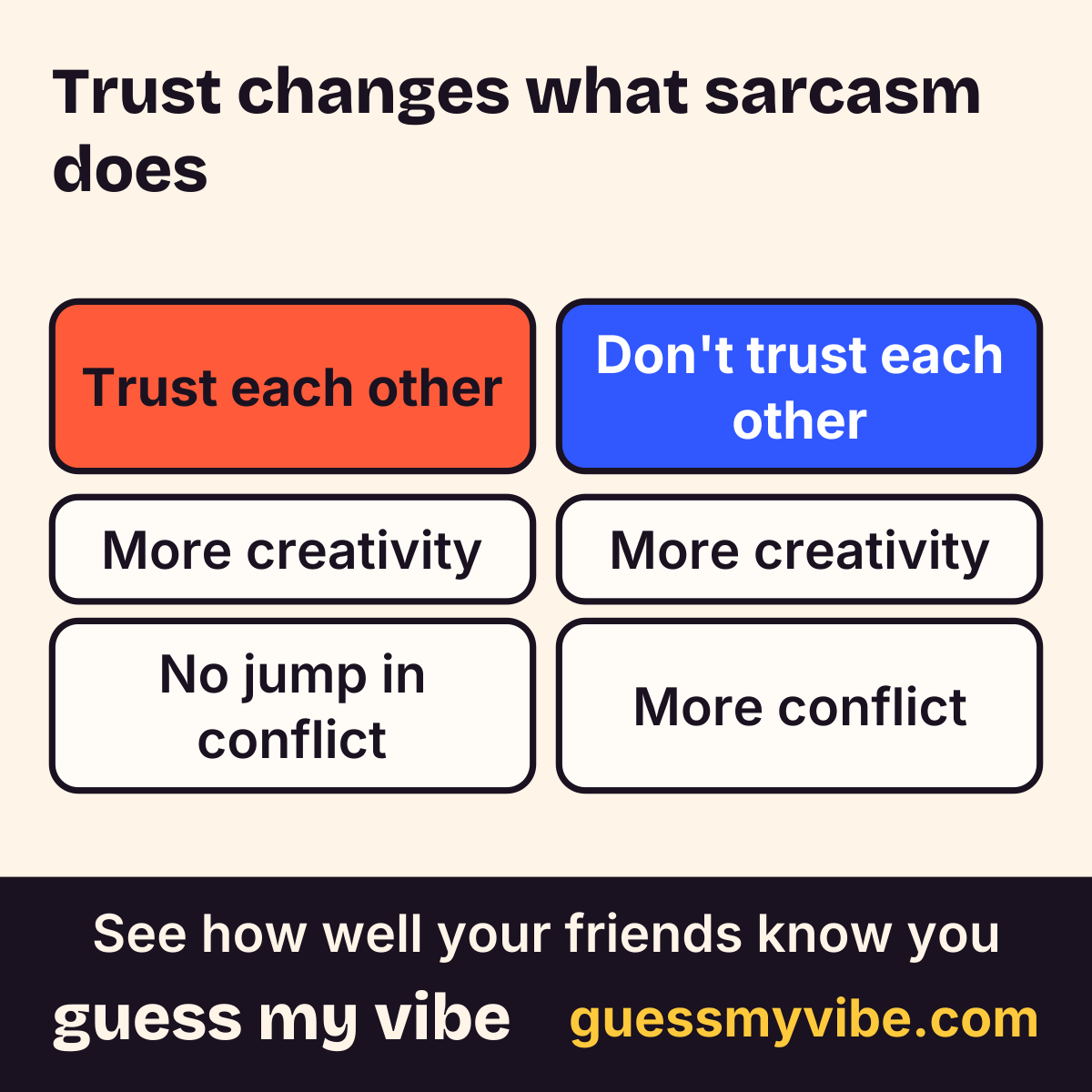
Sarcasm is a cousin of teasing, and teasing has its own research base
Long before the creativity research, a major review defined teasing as a playful provocation, a comment on something true or relevant about the target, delivered in a way that signals (or doesn't) that it's meant affectionately rather than as a real attack [2]. Sarcasm usually counts as a form of this: it comments on something real (the terrible line, the broken plan, the friend's own words moments earlier) by inverting it. The review found teasing tends to get triggered by actual norm violations or minor conflicts in the moment, which lines up with how sarcasm tends to show up, right after something mildly annoying or absurd happens.
One finding from that review matters a lot for reading your own friend group accurately: teasing (and by extension sarcasm) was more frequent and more likely to land as hostile when it was initiated by someone higher-status or more familiar, and somewhat more often by men, though the gender gap in the data was smaller than most people assume [2]. The review also tracked how teasing develops with age, kids get noticeably better at both giving and correctly reading it, especially around 11 to 12 years old.
Curious how your friends would answer?
Free. Answer 10 quick questions about you, then send your link. Friends play in their browser, no app needed.
Start freeSome people really do lean on it more than others
A validated humor-styles questionnaire splits the ways people use humor into four categories: affiliative and self-enhancing humor, generally bonding and good-natured, versus aggressive and self-defeating humor, generally sharper-edged [4]. Aggressive humor (jokes, sarcasm included, that land at someone else's expense) is the closest formal match to the sharper end of sarcasm. A large meta-analysis of studies using that questionnaire, spanning 24 studies and nearly 12,000 people across 13 countries, found this edgier humor style correlates with higher neuroticism and lower agreeableness and conscientiousness on average, the opposite pattern from the warmer, bond-building humor styles [3]. That's a correlation, not a destiny: it describes a statistical tendency across large samples, not a rule for reading any one sarcastic friend. Plenty of warm, agreeable people are sarcastic with their closest friends specifically because the relationship can absorb it, which loops right back to the trust research above.
Reading it in your own group chat
Put the two research threads together and a practical read emerges. Sarcasm between friends who already trust each other works almost like a private shorthand: it signals "we both know this isn't real criticism," and the research suggests it can come with a genuine creative perk, more associative, flexible thinking right in the moment. The same line from someone newer, or someone the relationship is shakier with, loses that shared context and reads as what it would literally mean if taken straight: a criticism. If a joke in your group chat keeps getting read two different ways by two different people, that's not a sign one of them has no sense of humor. It's closer to a trust-calibration mismatch, exactly the variable the research points to. Asking a friend "were you joking?" costs a few seconds, and it is usually a better move than quietly deciding what they meant.
What this means for figuring out who gets your sense of humor
Most friend groups have an unspoken map of who can say what to whom, and sarcasm is one of the clearest tests of whether two people actually share that map or just think they do. Guess My Vibe is built around a version of the same question in a more structured form, a friend guessing your honest answers instead of assuming they already know your sense of humor, which is a quick way to find out whether your read on each other matches reality before you find out the hard way in the group chat.
Key takeaways
- Sarcasm isn't just a communication quirk: experiments found both the person being sarcastic and the person hearing it report more conflict, but also solve more creativity tests afterward, than after a sincere exchange [1].
- Trust changes the equation entirely. When the sarcastic exchange happened between people who trusted each other, the creativity boost stayed but the conflict spike disappeared [1].
- Sarcasm overlaps heavily with teasing, a playful provocation that comments on something relevant to the target; the same tease can read as warm or hostile depending on status, familiarity and how it's delivered [2].
- A large meta-analysis found humor styles with an edge to them, the category sarcasm often falls into, go with lower agreeableness and higher neuroticism on average, while warmer, bonding humor goes the other way [3].
- This isn't therapy, a diagnosis, or a substitute for professional care.
Questions people ask
Why is sarcasm funny to some people and offensive to others?
Research manipulating trust directly found sarcasm between people who already trust each other kept its creativity boost without raising perceived conflict, while the same sarcasm between people without that trust raised both [1]. The joke doesn't change; the relationship it's delivered inside of does.
Does sarcasm actually make you more creative?
In controlled studies, yes, on short-term creativity tests: both expressing and receiving sarcasm led to better performance on word-association and insight-problem tasks right afterward, an effect tied to the extra abstract thinking sarcasm requires [1].
Is sarcasm a form of teasing?
It's a close cousin. A major review defines teasing as a playful provocation commenting on something relevant to the target, and sarcasm typically fits that definition by inverting the literal meaning of a real comment [2].
Are sarcastic people less agreeable?
A large meta-analysis found the "aggressive" humor style, the closest formal category to cutting sarcasm, correlates with somewhat lower agreeableness and higher neuroticism on average [3], but that's a group-level tendency, not a label that fits any one person.
Why do kids get sarcasm later than adults?
Research on teasing, sarcasm's close relative, found children become noticeably more skilled at both giving and understanding playful provocations around ages 11 to 12, which is a reasonable guess for when sarcasm starts to make sense as a social tool, though the review is about teasing, not sarcasm itself [2].
See how well your friends know you.
Free. Answer 10 quick questions about you, then send your link. Friends play in their browser, no app needed.
Start freeReferences
- [1] Huang, L., Gino, F., & Galinsky, A. D. (2015). The highest form of intelligence: Sarcasm increases creativity for both expressers and recipients. Organizational Behavior and Human Decision Processes, 131, 162–177. doi.org/10.1016/j.obhdp.2015.07.001 (opens in a new tab)
- [2] Keltner, D., Capps, L., Kring, A. M., Young, R. C., & Heerey, E. A. (2001). Just teasing: A conceptual analysis and empirical review. Psychological Bulletin, 127(2), 229–248. PubMed: 11316012 (opens in a new tab)
- [3] Plessen, C. Y., Franken, F. R., Ster, C., Schmid, R. R., Wolfmayr, C., Mayer, A.-M., Sobisch, M., Kathofer, M., Rattner, K., Kotlyar, E., Maierwieser, R. J., & Tran, U. S. (2020). Humor styles and personality: A systematic review and meta-analysis on the relations between humor styles and the Big Five personality traits. Personality and Individual Differences, 154, 109676. doi.org/10.1016/j.paid.2019.109676 (opens in a new tab)
- [4] Martin, R. A., Puhlik-Doris, P., Larsen, G., Gray, J., & Weir, K. (2003). Individual differences in uses of humor and their relation to psychological well-being: Development of the Humor Styles Questionnaire. Journal of Research in Personality, 37(1), 48–75. doi.org/10.1016/S0092-6566(02)00534-2 (opens in a new tab)
How we find and check these sources: how we write. Spotted an error? Report a correction.
Related
Cite this article
- Title
- Sarcasm: Why Some Friends Speak It Fluently
- Publisher
- Guess My Vibe
- Updated
- URL
- https://guessmyvibe.com/
learn/ sarcasm
Copy this citation
Guess My Vibe. (2026, October 3). Sarcasm: Why Some Friends Speak It Fluently. Guess My Vibe. https://guessmyvibe.com/
To point at one section, add that section's anchor (the # link on its heading) to the URL.