Instagram vs reality isn't as wide a gap as the phrase suggests. People do curate what they post, but a self-report study of Facebook users found people reported presenting their real self more than an idealized or false one, and strangers reading real profiles reach meaningful agreement with the account owner's actual personality [1] [2]. Curated doesn't mean fake. It means selected, and what gets selected still tracks who someone actually is.
"Instagram vs reality" usually gets framed as a gotcha: the filtered photo next to the unfiltered one, the perfect vacation shot next to the argument that happened an hour before it was taken. That framing assumes a profile is basically a performance with no real connection to the person behind it. The actual research on self-presentation and personality accuracy tells a more boring, more useful story: profiles are selective, not fabricated, and the selecting still leaves a real, readable trace of who someone actually is.
How curated are profiles really?
Start with what people themselves say they're doing when they post. A study of 261 emerging adults, average age 22, asked directly how much of their Facebook presence reflected their real self versus an idealized self (a better version of who they are) versus a false self (someone they're not) [1]. Across the group, people reported presenting their real self more than either of the other two. People with a more coherent, settled sense of their own identity reported more real-self presentation specifically; people with a less coherent identity and lower self-esteem reported leaning more on a false self. That's not the same as "nobody ever curates anything." It's evidence that the baseline assumption, that a profile is mostly performance, doesn't match what the people running the accounts say they're actually doing.
Worth being precise about what this particular study measured: Facebook presence specifically, in 2015, not Instagram. Platforms differ (Instagram leans harder on photos and shorter captions, Facebook mixes in more text and life updates), so the exact numbers from one platform don't automatically transfer to the other. The underlying finding, that most people describe themselves as presenting their real self rather than a fabricated one, is about a general psychological tendency in how people manage self-presentation online, not a claim specific to one app's interface, which is why it's reasonable to expect a similar pattern holds on Instagram even without a study measuring Instagram users on exactly this question.
Does curation actually hide your personality? The evidence says not much
Self-report is one kind of evidence; whether outside observers can actually see through to someone's real personality is another, and arguably the more interesting test of the curation question. A study had 100 strangers judge the Big Five, self-esteem, and narcissism of 102 real Instagram users using nothing but screenshots of their profiles [2]. If curation genuinely hid personality behind a polished mask, this is exactly the setup where it should show up as low accuracy, strangers fooled by the highlight reel. Instead, the observers' judgments significantly matched the account owners' actual self- and informant-rated personality, with accuracy running from a real, moderate r=.44 for extraversion down to a weaker but still real r=.25 for conscientiousness. A curated, selectively posted account still let strangers land meaningfully closer to the truth than chance would.
One reasonable way to make sense of that result: even a flattering or idealized post is usually still an exaggerated version of something real about the poster, not an invention out of nothing. Someone who leans extraverted might post more group photos and more frequently than someone who doesn't, and a touch of curation (picking the best shot from the group outing, not inventing an outing that never happened) doesn't erase that underlying difference; it just polishes it. That's an interpretation of why the accuracy numbers above came out the way they did, not something either study measured directly, but it fits the pattern: curation changing which moments get shown seems to leave the broader signal largely intact, rather than replacing it with something disconnected from who someone actually is.
A separate line of evidence backs this up from a different angle: whether people act like a different person online than they do offline. Research tracking real Facebook use found more extraverted people showed more social media activity (more friends, more engagement), the exact same pattern you'd expect from someone outgoing at an actual party [3]. The researchers' own framing is worth repeating directly: people extend their offline personality into social media rather than escaping it or compensating for it there. A broader meta-analysis of studies forecasting personality, well-being, and intelligence from digital footprints found the same thing holds at scale, with what the researchers called remarkable accuracy, and the forecast got sharper, not weaker, as more kinds of digital traces were added [4].
Curious how your friends would answer?
Free. Answer 10 quick questions about you, then send your link. Friends play in their browser, no app needed.
Start freeSo, do people actually judge you by your Instagram? Yes, and it's not wildly off
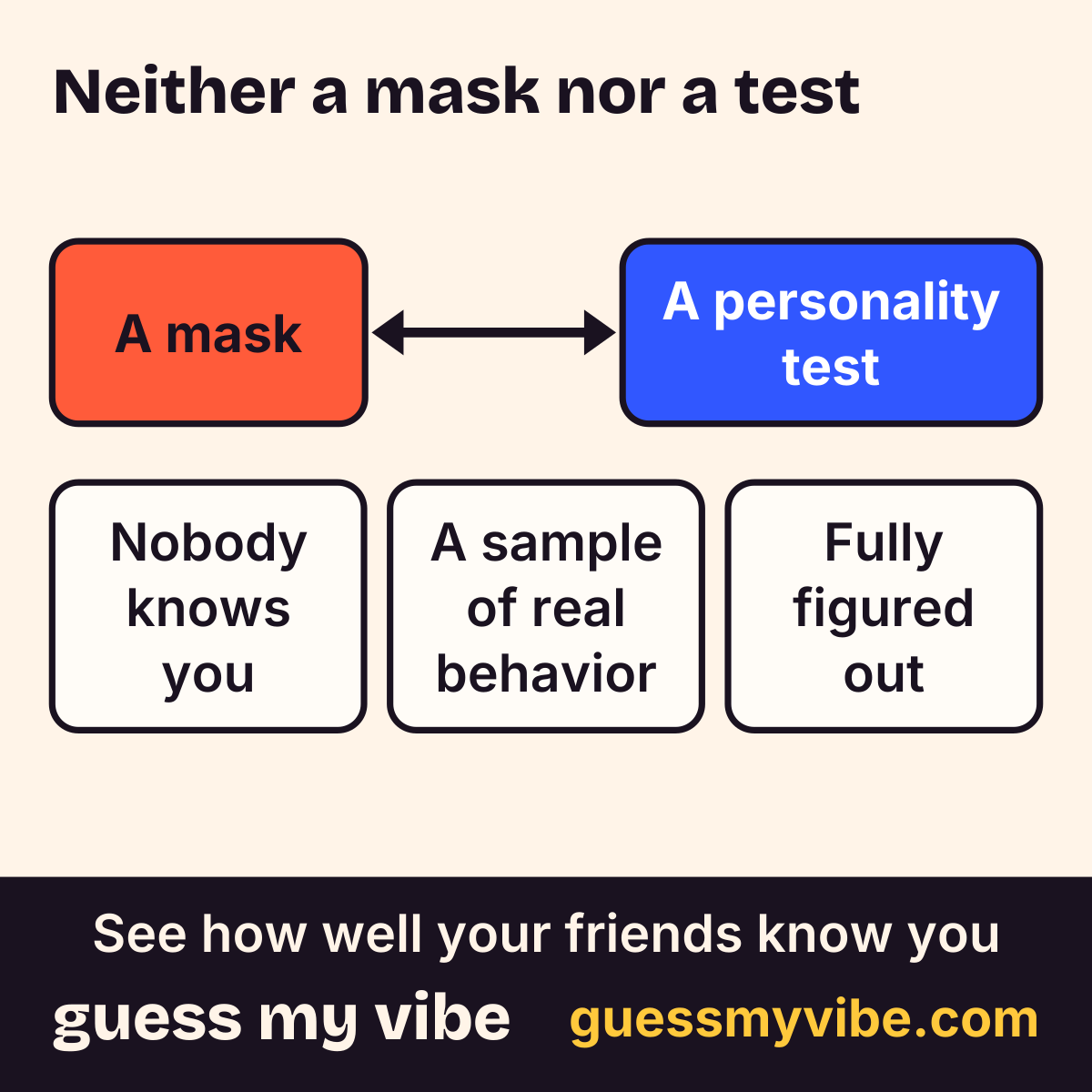
Put the self-report and the stranger-accuracy findings together, and the honest answer to "do people judge you by your Instagram" is: yes, constantly, and their judgment is connected to something real rather than floating free of it. That's a genuinely different claim from either extreme people usually land on. "Your Instagram is a mask, nobody who's only seen it actually knows you" overstates the distance, and so does "your Instagram is basically a personality test, anyone scrolling it has you fully figured out." The evidence lands in between: a curated profile is still a sample of real behavior, chosen under real constraints, and a careful observer, human or algorithmic, can pull a genuine, moderate-accuracy signal out of that sample. The curation changes which moments get shown. It doesn't appear to change what those moments, in aggregate, actually reveal.
Cite this figure
Figure: "Neither a mask nor a test." Guess My Vibe (guessmyvibe.com). https://guessmyvibe.com/learn/instagram-vs-reality#figure-mask-or-test
What curation does still hide
None of this means a profile shows everything, or that "instagram vs reality" is a non-issue. The accuracy numbers above are real but moderate, not near-perfect, and they describe a pattern across many accounts, not a guarantee about any single profile someone happens to be scrolling. A profile also has zero access to context: the argument before the vacation photo, the bad week behind a caption that reads as upbeat, the mood someone was actually in when they hit post. A friend who's watched someone across real, uncurated days has information a profile structurally can't contain, no matter how accurately the profile's general pattern reads. Curated doesn't mean fake. It also doesn't mean complete.
A cleaner way to compare your real self to what gets seen
If the actual question behind "instagram vs reality" is whether the people around you see the real you, a feed is a roundabout way to find out. Guess My Vibe skips the inference entirely: a friend answers real personality questions about you directly, based on what they actually know, and you see exactly where their read lines up with your own answers and where it doesn't, trait by trait, instead of wondering what your grid happens to be telling people.
Key takeaways
- People do judge you by your Instagram, and reasonably well: strangers reading real accounts from screenshots alone reached real agreement with account owners' actual personality, from r=.44 for extraversion down to r=.25 for conscientiousness [2].
- The "curated self" worry may overstate how fake profiles actually are: in one self-report study of Facebook users, people reported presenting their real self more often than either an idealized or a false version of themselves [1].
- More outgoing people show more social media activity, the same pattern as their offline behavior, which is evidence that online behavior extends an existing personality rather than replacing it with a performance [3].
- A meta-analysis of studies forecasting personality, well-being, and intelligence from digital activity found real, meaningful accuracy, and more digital traces or added demographic information sharpened the forecast still further [4].
- This isn't therapy, a diagnosis, or a substitute for professional care.
Questions people ask
Is Instagram a fake version of who you actually are?
Not according to the self-report data: in one self-report study of Facebook users, people reported presenting their real self more than an idealized or false version of themselves [1]. Curation is real; wholesale fabrication may be less common than the "instagram vs reality" framing suggests.
Do people actually judge your personality from your Instagram?
Yes, and with real accuracy. Strangers judging actual Instagram accounts from screenshots alone reached meaningful agreement with the account owners' real personality, strongest for extraversion and weaker for conscientiousness [2].
Does a curated profile hide your real personality?
Not much, based on the accuracy research. If curation fully masked personality, strangers reading only screenshots should perform close to chance; instead they reached real, moderate accuracy across multiple traits [2].
Do outgoing people act differently online than offline?
No, based on the research: more extraverted people showed more social media activity, matching their offline behavior rather than contradicting it, which researchers interpreted as people extending their offline personality online instead of escaping it [3].
What can't an Instagram profile tell you about someone?
Context. A profile has no access to mood, the specific day someone was having, or inside jokes that explain an odd post, the kind of knowledge a friend who's actually spent uncurated time with someone has and a feed structurally can't contain.
See how well your friends know you.
Free. Answer 10 quick questions about you, then send your link. Friends play in their browser, no app needed.
Start freeReferences
- [1] Michikyan, M., Dennis, J., & Subrahmanyam, K. (2015). Can you guess who I am? Real, ideal, and false self-presentation on Facebook among emerging adults. Emerging Adulthood, 3(1), 55–64. doi.org/10.1177/2167696814532442 (opens in a new tab)
- [2] Osterholz, S., Mosel, E. I., & Egloff, B. (2023). #Insta personality: Personality expression in Instagram accounts, impression formation, and accuracy of personality judgments at zero acquaintance. Journal of Personality, 91(3), 566–582. PubMed: 35837861 (opens in a new tab)
- [3] Gosling, S. D., Augustine, A. A., Vazire, S., Holtzman, N., & Gaddis, S. (2011). Manifestations of Personality in Online Social Networks: Self-Reported Facebook-Related Behaviors and Observable Profile Information. Cyberpsychology, Behavior, and Social Networking, 14(9), 483–488. PubMed: 21254929 (opens in a new tab)
- [4] Settanni, M., Azucar, D., & Marengo, D. (2018). Predicting Individual Characteristics from Digital Traces on Social Media: A Meta-Analysis. Cyberpsychology, Behavior, and Social Networking, 21(4), 217–228. PubMed: 29624439 (opens in a new tab)
How we find and check these sources: how we write. Spotted an error? Report a correction.
Related
- Social Media Personality: Does It Show the Real You?
- What Your Instagram Says About You
- Positive Illusions: Why Idealizing Your Partner Helps
- Self-Awareness: What the Research Says It Actually Takes
- Impression Management: What It Is and Why We All Do It
- Authentic Self on Social Media: Linked to Well-Being
Cite this article
- Title
- Instagram vs Reality: How Fake Are Curated Profiles?
- Publisher
- Guess My Vibe
- Updated
- URL
- https://guessmyvibe.com/
learn/ instagram-vs-reality
Copy this citation
Guess My Vibe. (2026, October 3). Instagram vs Reality: How Fake Are Curated Profiles?. Guess My Vibe. https://guessmyvibe.com/
To point at one section, add that section's anchor (the # link on its heading) to the URL.