A finsta ("fake Instagram") is a second, usually private account kept alongside a main one, a rinsta ("real Instagram"), and shown to a much smaller, closer group of friends. The name is misleading: research finds people report presenting their ideal, impressive and even deceptive selves more on the rinsta than on the finsta, so the rinsta carries more of the polished, audience-conscious performance [1]. One study even found finsta accounts skew more extraverted, less conscientious and less agreeable than rinsta accounts, the opposite of what you'd expect if "fake" meant less authentic [2].
What is a finsta, really?
A finsta, short for "fake Instagram," is a second account most finsta users keep alongside their main one, usually locked to a much smaller, closer group of followers than the main, public-facing account (often called a rinsta, "real Instagram"). The name suggests the finsta is where the performance, the fakeness, happens. Actual research on how people use these two accounts finds close to the opposite.
The finsta is where less performing happens, not more
A survey of 149 college Instagram users who maintained both a rinsta and a finsta asked them directly about their motivations and self-presentation on each [1]. Users rated several motivations, including social interaction, self-expression, escapism, checking in on other people's posts, and archiving memories, higher for the rinsta than for the finsta. When asked why they kept a finsta at all, the top reasons were posting fun daily updates and staying close with a small circle of trusted friends, not reinventing themselves as someone else. Most tellingly, users reported presenting their actual self, their ideal self, a deliberately deceptive self, and an impressive version of themselves all more on the rinsta than on the finsta. In plain terms: whatever self-presentation performance is happening, happens more on the account the name calls "real."
That finding reframes what "finsta" actually means in practice. It isn't a fictional persona built for an audience of strangers. It's closer to the opposite: a smaller, lower-stakes space where there's less need to manage an impression, because the audience is already close enough not to need one managed.
Finsta accounts score differently on measured personality
A separate, more detailed study pushed this further by having raters assess the actual personality traits that came through in 88 people's rinsta and finsta content, then comparing both to participants' own offline self-reported personality [2]. The findings were, as the researchers put it, counterintuitive given the accounts' names: finsta accounts came across as more extraverted, less conscientious, and less agreeable than rinsta accounts from the same people, while both account types were read as about equally neurotic as participants' offline self-reports. If "finsta" meant a fabricated, flattering persona, you'd expect it to look more socially desirable than the real account, not less. Instead, the finsta more often showed exactly the kind of less-flattering, less put-together traits a carefully managed public profile tends to edit out.
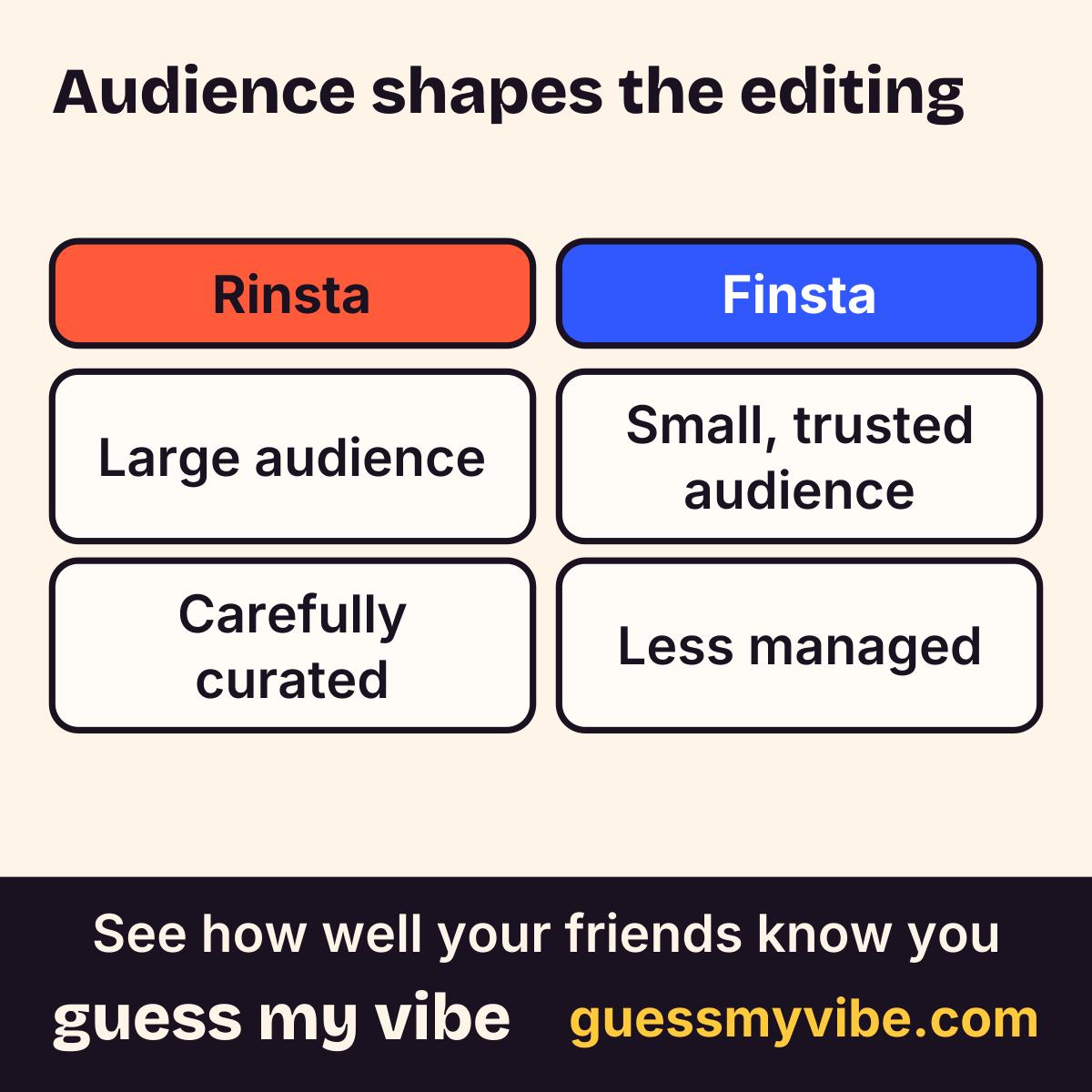
Interviews in the same study explained this with a straightforward mechanism: audience size and familiarity. A rinsta's audience is large and includes a lot of people who don't know the user well, acquaintances, extended network connections, sometimes near-strangers, which pushes toward a carefully curated, broadly acceptable self-presentation. A finsta's audience is small and already trusted, which lowers the stakes of posting something unpolished, unflattering, or just honestly mundane. The researchers' conclusion lines up directly with Kang and Wei's survey findings above: less audience pressure produces more authentic, if less impressive, self-presentation, not a fictional alter ego.
Curious how your friends would answer?
Free. Answer 10 quick questions about you, then send your link. Friends play in their browser, no app needed.
Start freeWhy "fake Instagram" is the wrong name for what it does
Put together, these two studies paint a consistent, specific picture that cuts against the slang term's literal meaning. A rinsta is curated for a broad, less-known audience, and research finds more of the deliberate self-presentation work, including some outright deception, actually happens there [1]. A finsta is shared with a small, trusted circle, and research finds it reflects a less managed, sometimes less flattering version of the same person, not a fabricated one [2]. This fits a broader pattern in self-presentation research: how much someone edits themselves tracks the size and familiarity of the audience watching, not a fixed, stable gap between someone's "real" and "fake" selves. A smaller audience of people who already know you well simply requires less editing.
That tracks with a broader finding about online behavior generally: people's social media activity tends to extend their existing offline personality rather than invent a separate one from scratch [3]. A finsta isn't an exception to that pattern. It's closer to a second data point on the same underlying personality, shown to a different, smaller audience, which is exactly why close friends with finsta access sometimes say they feel like they know someone better there than through the main account alone.
Cite this figure
Figure: "Audience shapes the editing." Guess My Vibe (guessmyvibe.com). https://guessmyvibe.com/learn/finsta#figure-audience-shapes-editing
What this means for who actually knows you best
There's a useful parallel here to how personality researchers think about audience and self-knowledge more broadly: the people closest to someone sometimes have access to real, accurate information about them that a wider audience simply never sees [4]. A finsta is a small-scale version of exactly that setup: fewer eyes, less curation pressure, and, according to the research above, a more candid version of the account owner as a result. That doesn't make a finsta a complete read on anyone, any more than a single account of any kind is. But it's a reasonable, research-backed reason close friends with finsta access often feel like they're seeing something genuinely closer to the real thing.
A finsta isn't one fixed thing across every account
Both studies above describe averages across groups of people (the Kang and Wei survey sampled college students), not a fixed rule every finsta follows. The Kang and Wei survey specifically found a range of individual motivations behind a finsta, not one single universal reason, and the Taber and Whittaker interviews found the personality gap between someone's two accounts traced back to audience size and trust, not to some property inherent in the word "finsta" itself [1] [2]. That matters because it means the real variable worth paying attention to isn't which account label something carries, it's who's actually watching. A so-called "finsta" shared with hundreds of loosely-known followers wouldn't be expected to show the same candid self-presentation the research above describes, and a heavily curated "rinsta" limited to five close friends might behave more like a typical finsta. The account's name is a social convention; the audience behind it is what the research says is actually doing the work.
See if your closest friends know the real you
Guess My Vibe works on the same logic the research above describes: it's built for the people who already know you, not a broad audience you're managing an impression for. You answer honest questions about your actual personality, a friend guesses your answers, and you see how close they actually get, no curation required.
Key takeaways
- In a survey of 149 college Instagram users with both account types, users rated motivations like self-expression and social interaction higher for the rinsta than the finsta, and said the finsta mainly existed for fun daily updates and bonding with close friends [1].
- The same study found users reported presenting their actual, ideal, deceptive, and impressive selves more on the rinsta than the finsta, meaning the curated performance happens on the "real" account, not the "fake" one [1].
- A separate study of 88 people's accounts found finsta profiles scored more extraverted, less conscientious, and less agreeable than rinsta profiles from the same people, while both were about equally neurotic as participants' offline self-reports [2].
- Interviews in that same study traced the personality gap to audience size: a large, mostly-unfamiliar rinsta audience encourages a carefully managed self, while a small, trusted finsta audience allows a less polished, more candid one [2].
- This isn't therapy, a diagnosis, or a substitute for professional care; it's a plain-English summary of research on self-presentation across multiple accounts, not advice about what to post.
Questions people ask
What does finsta mean?
Short for "fake Instagram," a finsta is a second account, usually private, shared with a much smaller, closer group of followers than someone's main account (their rinsta, or "real Instagram") [1].
Is a finsta actually more fake than a rinsta?
Research finds the opposite of what the name implies. Users report presenting their actual, ideal, deceptive, and impressive selves more on the rinsta than the finsta [1], and finsta content measured as less conventionally polished, not more fabricated, than rinsta content [2].
Why do people keep a finsta at all?
Mainly for fun, low-stakes daily updates and staying close with a small circle of trusted friends, according to a survey of college Instagram users with both account types, who rated all five other motivations measured (including self-expression and social interaction) higher for the rinsta [1].
Do finsta and rinsta accounts show different personalities?
Yes, measurably. One study found finsta accounts scored as more extraverted, less conscientious and less agreeable than rinsta accounts from the same people, while both were about equally neurotic as participants' offline self-reports [2].
Why does a smaller audience change how someone posts?
Interview data suggests a large, less-familiar audience (a typical rinsta) encourages careful self-presentation, while a small, trusted audience (a typical finsta) lowers the stakes of posting something unpolished or candid [2].
See how well your friends know you.
Free. Answer 10 quick questions about you, then send your link. Friends play in their browser, no app needed.
Start freeReferences
- [1] Kang, J., & Wei, L. (2020). Let me be at my funniest: Instagram users' motivations for using Finsta (a.k.a., fake Instagram). The Social Science Journal, 57(1), 58–71. doi.org/10.1016/j.soscij.2018.12.005 (opens in a new tab)
- [2] Taber, L., & Whittaker, E. (2020). "On Finsta, I can say 'Hail Satan'": Being authentic but disagreeable on Instagram. Proceedings of the 2020 CHI Conference on Human Factors in Computing Systems (CHI '20), 1–14. doi.org/10.1145/3313831.3376182 (opens in a new tab)
- [3] Gosling, S. D., Augustine, A. A., Vazire, S., Holtzman, N., & Gaddis, S. (2011). Manifestations of Personality in Online Social Networks: Self-Reported Facebook-Related Behaviors and Observable Profile Information. Cyberpsychology, Behavior, and Social Networking, 14(9), 483–488. PubMed: 21254929 (opens in a new tab)
- [4] Vazire, S., & Carlson, E. N. (2011). Others sometimes know us better than we know ourselves. Current Directions in Psychological Science, 20(2), 104–108. doi.org/10.1177/0963721411402478 (opens in a new tab)
How we find and check these sources: how we write. Spotted an error? Report a correction.
Related
Cite this article
- Title
- Finsta vs Rinsta: What Research Says About Two Accounts
- Publisher
- Guess My Vibe
- Updated
- URL
- https://guessmyvibe.com/
learn/ finsta
Copy this citation
Guess My Vibe. (2026, October 3). Finsta vs Rinsta: What Research Says About Two Accounts. Guess My Vibe. https://guessmyvibe.com/
To point at one section, add that section's anchor (the # link on its heading) to the URL.