What your phone says about you, according to actual research, is real but modest. A study that logged 624 people's smartphone behavior (app use, communication patterns, mobility, music, overall activity) for 30 straight days built a model that worked out their Big Five personality traits with real but far-from-perfect accuracy [1]. That's a genuine signal hiding in ordinary phone use, not noise, but it's nowhere near a complete read, and a close friend who actually knows you can still pick up on things 25 million logged data points can't.
What your phone actually reveals about your personality
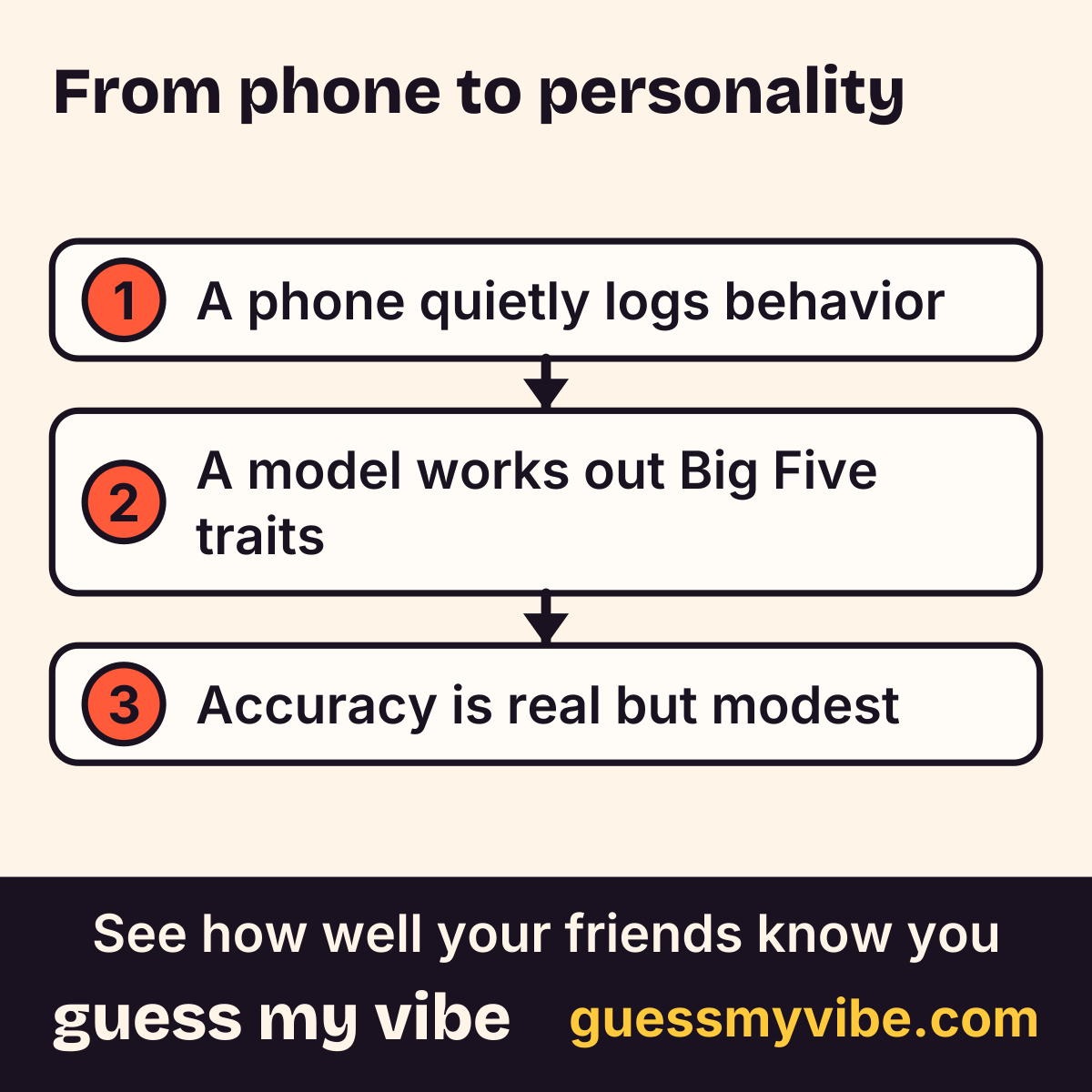
What your phone says about you isn't a metaphor, it's been directly tested. Researchers recruited 624 volunteers and had their phones quietly log behavioral data for 30 consecutive days: who they communicated with and how often, which apps they opened and for how long, what music they listened to, where they physically went, how active their phone was overall, and how their activity split between day and night [1]. That added up to 25,347,089 logged events, an enormous, passive record of ordinary phone use that nobody had to consciously report or perform for a researcher.
Using that raw behavioral data, a machine-learning model worked out each person's Big Five personality traits, both at the broad trait level (extraversion, conscientiousness, and the rest) and at the level of narrower facets underneath each trait. The estimates for broad traits were real and meaningfully better than chance, and the estimates for the narrower facets were, if anything, slightly more accurate still. The six categories of behavior weren't interchangeable either: specific patterns within communication habits, music choices, app usage, mobility, overall phone activity, and day-versus-night activity each carried distinctive, separate information about different traits, not one single "personality score" that any category could equally reveal.
How accurate is this, in plain terms?
"Real but modest" is the honest way to describe accuracy like this. A model that works out personality meaningfully better than a random guess, using nothing but passive phone logs, is a genuinely striking result. It is not the same as a confident, specific read on any one person, the kind you'd expect from a friend who's actually spent years around you. The researchers themselves frame the result carefully: it demonstrates the possibility of extracting real information about private traits from phone data, not a claim that the model has fully captured who someone is.
This finding also isn't happening in isolation. It lines up closely with earlier, separate research on forecasting personality from social media activity. One widely cited study built a statistical model from more than 58,000 people's Facebook Likes, nothing but which pages someone had clicked "like" on, and found its accuracy for the trait openness came close to the test-retest reliability of an actual personality questionnaire, meaning the model's estimate was nearly as consistent as giving the same person the same test twice [2]. A broader meta-analysis pulling together the research on forecasting personality, well-being, and intelligence from digital traces on social media (a different data source than phone sensors) found this kind of modeling works with what the researchers called remarkable accuracy, and gets sharper when more different kinds of digital traces, or basic demographic information, get added to the model [3]. Working out personality from phone sensor data isn't an isolated curiosity; it's one more entry in a consistent, replicated pattern: ordinary digital behavior carries real, measurable personality signal, across more than one kind of data source.
Cite this figure
Figure: "From phone to personality." Guess My Vibe (guessmyvibe.com). https://guessmyvibe.com/learn/what-your-phone-says-about-you#figure-phone-to-personality
Curious how your friends would answer?
Free. Answer 10 quick questions about you, then send your link. Friends play in their browser, no app needed.
Start freeA friend may still beat it
None of this means a phone's sensor data has out-read the people who actually know you. Research on how accurately outside observers judge personality finds accuracy varies a lot depending on the trait and, especially, on how much real, close contact the observer has had [4]. A phone logs behavior with enormous volume but zero context: it has no idea why you went somewhere, what mood you were in, or what a particular late-night scroll session actually meant that day. A close friend has both the behavioral pattern (less precisely logged, but observed over years) and the context a dataset structurally cannot have. The honest comparison isn't "machine versus human"; it's two different, both-real sources of information, one built on enormous scale and zero context, the other on direct, long-term, contextualized observation.
There's also a scale difference worth naming plainly. The smartphone study's model needed over 25 million logged events across 624 people, collected with specialized tracking software running continuously for a month, to reach its accuracy [1]. A close friend reaches comparable, often better, accuracy on many traits without any of that instrumentation, just ordinary attention paid over months or years of actually being around someone. That's not a knock on the research, which is genuinely valuable precisely because it works without a person's conscious cooperation. It's a reminder that the two approaches aren't competing on the same terms: one trades enormous automated data collection for a modest, averaged accuracy; the other trades ordinary human attention for a messier but often richer and more contextual one.
The privacy side of this is worth taking seriously
The same researchers who built this phone-behavior model are explicit about the other side of this finding: a method that can extract a real personality signal from ordinary phone use is also a method that enables what they call psychological targeting, using someone's own passive data to infer private traits they never consciously chose to share [1]. That's not a reason to panic about owning a smartphone, but it is a reason to take "it's just my phone data" less lightly than it might feel in the moment. The same basic approach that works out openness or conscientiousness from app usage and mobility patterns doesn't stop politely at personality; it's the same category of inference that powers more commercially and politically loaded uses of behavioral data. Knowing that a real signal exists in ordinary phone use is useful information in itself, independent of whatever you decide to do with it.
Skip the sensor data and ask a friend directly
Guess My Vibe takes the opposite approach from a phone-data model: instead of inferring your personality from 30 days of passive logs, it asks the people who actually know you to guess directly. You answer honest questions about yourself, a friend guesses your answers, and you compare. It's a fun, direct way to see how a real relationship's read on you stacks up against what the research above says even a machine-learning model can and can't pick up.
Key takeaways
- Over 30 days, 624 volunteers' smartphones logged 25,347,089 behavioral events across six categories: communication and social behavior, music listening, app usage, mobility, overall phone activity, and day/night activity patterns [1].
- A machine-learning model worked out broad Big Five domains with real, moderate accuracy and worked out narrower personality facets slightly better still; specific patterns in each of the six behavior categories were distinctly tied to different traits [1].
- That accuracy is similar in size to earlier work forecasting personality from social media activity, like a widely cited study where Facebook Likes alone came close to the accuracy of retaking a personality test for the trait openness [2].
- A broader meta-analysis of studies using digital traces from social media to forecast personality, well-being, and intelligence found this kind of data-driven model works with what researchers called remarkable accuracy, and gets sharper with more data sources [3].
- This isn't therapy, a diagnosis, or a substitute for professional care, and nothing here is advice about phone settings or what to install or avoid.
Questions people ask
Can your phone really work out your personality?
To a real, moderate degree. A study logging 624 people's smartphone behavior for 30 days built a model that worked out Big Five traits with accuracy meaningfully better than chance, though far from a complete read [1].
What kind of phone data reveals personality best?
The research found six categories each carried distinct signal: communication and social behavior, music listening, app usage, mobility, overall phone activity, and day/night activity patterns, with different patterns tied to different traits [1].
Is working out personality from a phone the same as from social media?
They're separate data sources with similarly sized accuracy. A well-known study found Facebook Likes alone came close to a personality test's own test-retest reliability for openness [2], and a meta-analysis found social media digital traces forecast personality with real accuracy [3].
Does a friend know me better than my phone data does?
Often, yes, especially for traits that need real context to judge. Outside-observer accuracy improves with closeness and real contact [4], and a friend has context (why you did something, how you were feeling) that raw phone logs structurally can't capture.
Is it a privacy risk that phone data can reveal personality?
The researchers behind this specific study say so directly: the same method that reveals a real personality signal from ordinary phone use also enables inferring private traits someone never chose to share, which they describe as a genuine privacy and psychological-targeting risk [1].
See how well your friends know you.
Free. Answer 10 quick questions about you, then send your link. Friends play in their browser, no app needed.
Start freeReferences
- [1] Stachl, C., Au, Q., Schoedel, R., Gosling, S. D., Harari, G. M., Buschek, D., Völkel, S. T., Schuwerk, T., Oldemeier, M., Ullmann, T., Hussmann, H., Bischl, B., & Bühner, M. (2020). Predicting personality from patterns of behavior collected with smartphones. Proceedings of the National Academy of Sciences, 117(30), 17680–17687. PubMed: 32665436 (opens in a new tab)
- [2] Kosinski, M., Stillwell, D., & Graepel, T. (2013). Private traits and attributes are predictable from digital records of human behavior. Proceedings of the National Academy of Sciences, 110(15), 5802–5805. PubMed: 23479631 (opens in a new tab)
- [3] Settanni, M., Azucar, D., & Marengo, D. (2018). Predicting Individual Characteristics from Digital Traces on Social Media: A Meta-Analysis. Cyberpsychology, Behavior, and Social Networking, 21(4), 217–228. PubMed: 29624439 (opens in a new tab)
- [4] Connelly, B. S., & Ones, D. S. (2010). An other perspective on personality: Meta-analytic integration of observers' accuracy and predictive validity. Psychological Bulletin, 136(6), 1092–1122. PubMed: 21038940 (opens in a new tab)
How we find and check these sources: how we write. Spotted an error? Report a correction.
Related
Cite this article
- Title
- What Your Phone Says About Your Personality
- Publisher
- Guess My Vibe
- Updated
- URL
- https://guessmyvibe.com/
learn/ what-your-phone-says-about-you
Copy this citation
Guess My Vibe. (2026, October 3). What Your Phone Says About Your Personality. Guess My Vibe. https://guessmyvibe.com/
To point at one section, add that section's anchor (the # link on its heading) to the URL.