The attractiveness halo effect is the tendency to assume that good-looking people have better personalities and better lives. A meta-analysis found the effect is real but moderate, varies a lot from study to study, and is much smaller for traits like integrity and concern for others than for social skills [1].
What the attractiveness halo effect is
The attractiveness halo effect is the habit of assuming that someone who looks good must also be kind, smart, capable and happy. Researchers often call it the "what is beautiful is good" stereotype. The research on it says two things at once. The pattern is real, and it is smaller and more specific than the saying suggests. A meta-analysis found that the average effect was moderate and varied considerably from study to study, and that it was not as strong or general as the phrase implies [1]. This article walks through where the idea came from, how big it is, and what it does and doesn't tell you about a person's personality.
If you want the general idea of one good trait coloring every other rating, that is covered in our article on the halo effect. This one stays with looks specifically.
Where "what is beautiful is good" came from
The saying comes from a 1972 experiment. The researchers wanted to know whether physically attractive people, male and female, are assumed to have more socially desirable personality traits, and whether they are expected to lead better lives, for example as spouses and in their careers. The findings indicated a "what is beautiful is good" stereotype, and the authors found no interaction between the sex of the judge and the sex of the person being judged [2].
That is a classic finding. But it is one experiment from over fifty years ago. The abstract does not report effect sizes, so it can't tell us how large the stereotype is, which is the question that matters most. For that you need a meta-analysis, which pools many studies.
How big is the effect? The meta-analysis
In 1991, a team pooled the research on the physical attractiveness stereotype. They found that people did ascribe more favorable personality traits and more successful life outcomes to attractive targets than to unattractive ones. But the average size of that beauty-is-good effect was moderate, and it varied considerably from study to study. The authors concluded that the stereotype was not as strong or general as the often-used phrase suggests [1].
In plain words, a moderate effect means the bias is noticeable, but it won't tell you much about any one person. It is a nudge in how people rate others, not a switch.
Which traits the halo covers, and which it doesn't
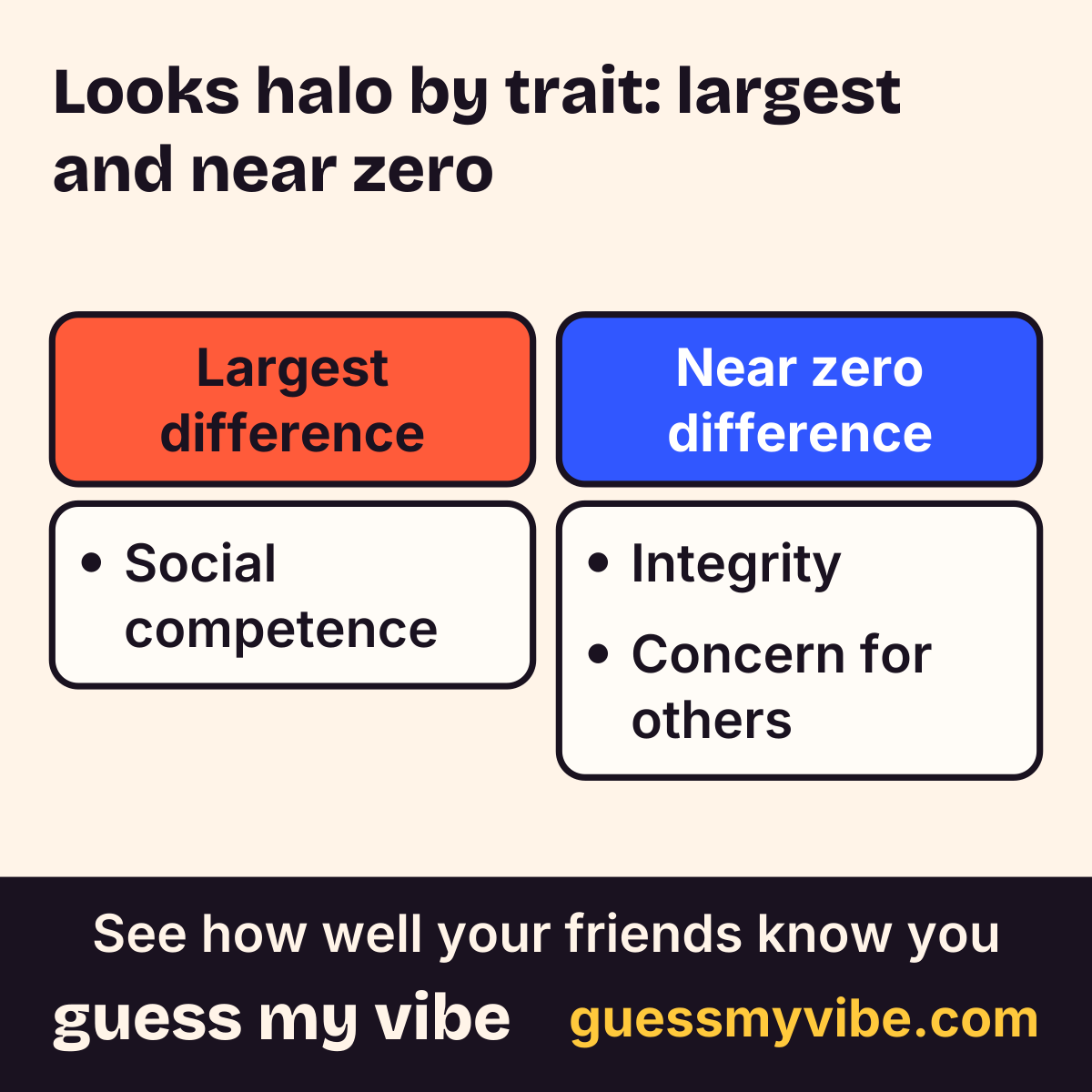
The most useful part of that meta-analysis is the pattern across traits. Differences in how people rated attractive and unattractive targets were largest for social competence, intermediate for potency, adjustment and intellectual competence, and near zero for integrity and concern for others [1]. So the halo is not a blanket assumption that attractive people are better in every way. It is mostly an assumption that they are socially skilled, and, to a smaller degree, perceived potency, adjustment and intellectual competence.
That matters for how you read other people and for how others read you. Whether someone is honest or cares about others is exactly the kind of trait people care about most in a friend, and the research found little difference in how those traits were rated. Looks seem to mostly color first guesses about social ease. Our own gentle suggestion is not to treat a first impression of someone's charm as evidence about their character.
Cite this figure
Figure: "Looks halo by trait: largest and near zero." Guess My Vibe (guessmyvibe.com). https://guessmyvibe.com/learn/attractiveness-halo-effect#figure-halo-by-trait
Curious how your friends would answer?
Free. Answer 10 quick questions about you, then send your link. Friends play in their browser, no app needed.
Start freeWhat changes the size of the halo
The same meta-analysis found that the strength of the stereotype also varied with other features of the studies, including whether people had individuating information, meaning real details about the specific person beyond how they looked [1]. The abstract does not say how much it varied or in which direction in each study, so we can't give a number. But the idea fits common sense: the more you know about a specific person, the less you need to lean on a stereotype.
Here we need to be careful not to overpromise. It is tempting to say that getting to know someone makes the bias disappear. We did not find a paper that shows that. In fact, another meta-analysis found that attractive children and adults were judged more positively than unattractive ones even by people who know them [3]. So knowing someone may reduce the stereotype in some studies without erasing the pattern.
Is there any truth to it? The research disagrees a little
Here is where the evidence gets interesting. A separate set of eleven meta-analyses found that raters agree about who is and isn't attractive, both within and across cultures, that attractive children and adults are judged and treated more positively, even by those who know them, and that attractive children and adults exhibit more positive behaviors and traits [3]. That last point is a claim that the stereotype may have some real basis, a different emphasis from the 1991 review.
The abstract does not give effect sizes, so we can't say how large the difference in actual traits is, and these are group averages, not forecasts about a person. The two reviews were written about nine years apart and ask somewhat different questions, which is one reason they read differently. A fair summary is this. Looks do seem to affect how people are judged and treated. Whether they also reflect real differences in behavior and traits is debated, and the abstract gives no size for any real difference, so treat these as group averages and not as a guide to any one person.
Why do people lean on looks at all? The studies above don't test the reasons, so this is our own reasoning. A face is the first thing you see, it is available in a second, and it takes no effort to form a feeling about it. Personality, by contrast, takes time and conversation to see. When information is scarce, the mind tends to fill in the gaps with whatever is at hand. That would explain why the effect shows up most clearly in broad social judgments, where there is the least to go on.
When the halo hides useful information
There is a cost to the halo even if it has a grain of truth. In a study using faces of 100 university students, the researchers noted that literature suggests an attractiveness halo overshadows valid facial cues. People's judgments of academic performance got more accurate once the influence of attractiveness on those judgments was controlled for [4]. That is one study on one kind of judgment, so it is a pointer and not a general law. But it matches the broader idea: when looks do the talking, they may drown out cues that carry real information.
How to see past the halo, in either direction
The halo works on you in two ways. You may rate others more generously because of how they look, and others may rate you that way too. The research suggests a few modest habits. Ask about specific behaviors rather than overall impressions, since the stereotype was largest for social competence [1]. Get more individuating information about a person before you settle your view, since the strength of the effect varied with it. And don't assume that more information will remove the bias entirely [3].
This is where friends help. A friend who knows how you actually act can tell you things a photo or a first meeting can't. Guess My Vibe is built on that idea. Friends guess your answers to specific personality questions, so the result reflects what they have seen you do, not just how you look. The gap between their guess and your answer is the interesting part.
Key takeaways
- A 1972 experiment reported a "what is beautiful is good" stereotype: attractive people were assumed to have more socially desirable personality traits and better lives [2].
- A later meta-analysis found the effect was moderate, varied considerably across studies, and was near zero for integrity and concern for others, so the folk version overstates it [1].
- The meta-analysis found the effect was largest for social competence, and it also varied with whether people had individuating information about the person [1].
- A set of meta-analyses found attractive people were judged and treated more positively even by people who know them, and showed more positive behaviors and traits, so the evidence isn't one-sided [3].
- This isn't therapy, a diagnosis, or a substitute for professional care.
Questions people ask
What is the attractiveness halo effect?
It is the tendency to assume attractive people have better personalities and better lives, often summed up as "what is beautiful is good." A meta-analysis found the effect moderate and not as strong or general as the phrase suggests [1].
Where did "what is beautiful is good" come from?
From a 1972 experiment reporting that physically attractive people were assumed to have more socially desirable personality traits and to lead better lives [2].
Does the halo apply to every trait?
No. The differences were largest for social competence and near zero for integrity and concern for others [1].
See how well your friends know you.
Free. Answer 10 quick questions about you, then send your link. Friends play in their browser, no app needed.
Start freeReferences
- [1] Eagly, A. H., Ashmore, R. D., Makhijani, M. G., & Longo, L. C. (1991). What is beautiful is good, but...: A meta-analytic review of research on the physical attractiveness stereotype. Psychological Bulletin, 110(1), 109-128. doi.org/10.1037/0033-2909.110.1.109 (opens in a new tab)
- [2] Dion, K., Berscheid, E., & Walster, E. (1972). What is beautiful is good. Journal of Personality and Social Psychology, 24(3), 285-290. doi.org/10.1037/h0033731 (opens in a new tab)
- [3] Langlois, J. H., Kalakanis, L., Rubenstein, A. J., Larson, A., Hallam, M., & Smoot, M. (2000). Maxims or myths of beauty? A meta-analytic and theoretical review. Psychological Bulletin, 126(3), 390-423. PubMed: 10825783 (opens in a new tab)
- [4] Talamas, S. N., Mavor, K. I., & Perrett, D. I. (2016). Blinded by beauty: Attractiveness bias and accurate perceptions of academic performance. PLoS ONE, 11(2), e0148284. PubMed: 26885976 (opens in a new tab)
How we find and check these sources: how we write. Spotted an error? Report a correction.
Related
- The Halo Effect: Why One Good Trait Colors Everything
- First Impressions: How Fast and How Accurate They Are
- Snap Judgments: How Accurate Are They, Really?
- Personality From Photos: How Accurate Are First Guesses?
- The Better-Than-Average Effect: Why Friends Check You
- Are You a Good Judge of Character? What Research Finds
Cite this article
- Title
- Attractiveness Halo Effect: Is What's Beautiful Good?
- Publisher
- Guess My Vibe
- Updated
- URL
- https://guessmyvibe.com/
learn/ attractiveness-halo-effect
Copy this citation
Guess My Vibe. (2026, October 4). Attractiveness Halo Effect: Is What's Beautiful Good?. Guess My Vibe. https://guessmyvibe.com/
To point at one section, add that section's anchor (the # link on its heading) to the URL.