A first impression from a face forms in about 100 milliseconds, a tenth of a second, according to a widely cited lab study. Judgments made after that brief exposure correlated highly with judgments made with no time limit at all, so more looking time didn't meaningfully change the verdict [1]. The popular "7 seconds" figure doesn't come from that research. How fast an impression forms and how accurate it is are two separate questions, and speed is the easy one to answer.
The actual number: about 100 milliseconds for a face
The most direct answer to how long does it take to form a first impression comes from a 2006 study that showed people unfamiliar faces for a fixed, very short amount of time and asked them to judge specific traits [1]. Across five separate experiments, each focused on one trait, attractiveness, likeability, trustworthiness, competence, or aggressiveness, judgments made after just 100 milliseconds of exposure, a tenth of a second, correlated highly with judgments made in the absence of time constraints. That's a striking result: a tenth of a second was enough for these judgments to line up closely with the unhurried ones. Giving people more time to study the same face didn't produce a meaningfully different judgment on most of the traits tested.
What extra viewing time does change (and what it doesn't)
The same study tracked what happened as exposure time increased from 100 milliseconds up to 500, and then up to a full 1,000 milliseconds [1]. Longer exposure made judgments measurably more negative, made people respond faster, and raised how confident people felt in their own judgment. Between 500 and 1,000 milliseconds, the trait judgments and response times mostly stopped changing at all, with confidence still ticking up a little. One thing did keep improving with more time: how differentiated the impressions were from person to person, meaning longer looking helped people tell individual faces apart from each other more clearly, even though it didn't change the basic verdict on any one face much. In plain terms, the first hundred milliseconds sets roughly what you think. The next several hundred mostly just firms up how sure you feel about it.
Where does "7 seconds" actually come from?
The "first impression forms in 7 seconds" line gets repeated constantly in career advice and dating content, but it isn't the number this research produced. The actual lab finding is about seventy times faster: a tenth of a second, not seven whole seconds, for the broad trait judgments tested above. Seven seconds is a rounder, more intuitive-sounding number for something that happens almost instantly and nonconsciously, which may be exactly why it spread, but it isn't backed by the exposure-time data above. If anything, the real finding is more striking than the popular version: an impression is largely in place after a tenth of a second.
How fast it forms and how accurate it is are different questions
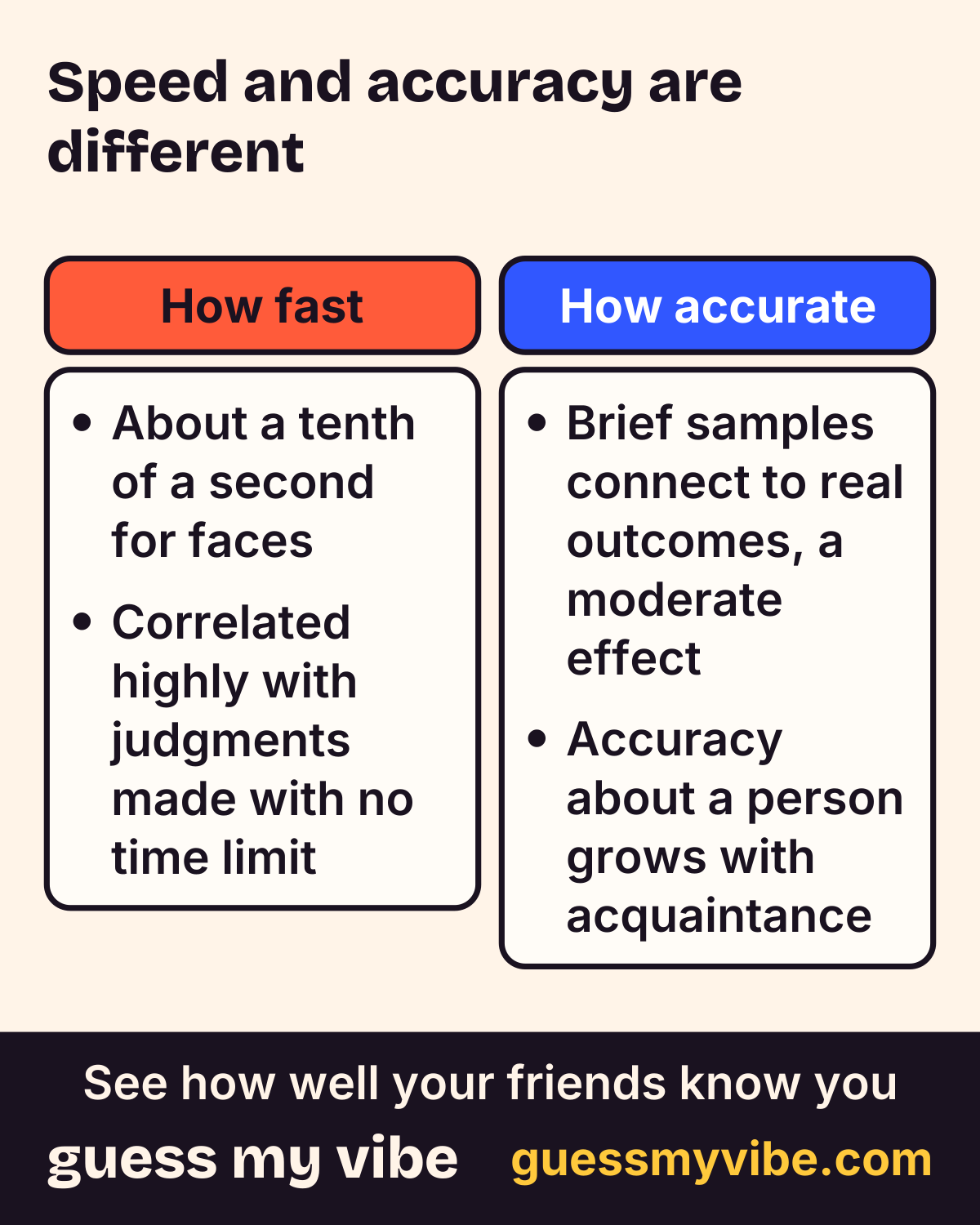
It's worth being precise about what the 100-millisecond finding does and doesn't claim. It's a finding about speed and consistency: how quickly a judgment forms, and how little that judgment changes with more looking time. It says nothing about whether the judgment is actually correct. Those are genuinely separate research questions, and the honest answer on accuracy is more mixed than the speed answer. A large meta-analysis of brief behavior samples, short clips of real behavior lasting well under a minute, not only faces, found these snap judgments connect to real outcomes at a moderate, real effect, and that longer clips, up to five full minutes, weren't reliably more accurate than much shorter ones [2]. A separate study that showed 600 people in 15 brief videotaped episodes each found something similar: strangers' impressions got closer to what the person's own close contacts actually said about them as judges saw more episodes, but those accuracy gains mostly leveled off after about 6 short clips, not after some fixed amount of time [4]. Speed, in other words, doesn't seem to be the bottleneck on accuracy either; more independent samples of someone's behavior help, up to a point, regardless of how quickly any single judgment forms. What does keep improving accuracy long after that point is something that has nothing to do with the first impression itself: actual time spent getting to know someone. As acquaintance lengthens, people get measurably better at reading what makes a specific person distinct, not just leaning on a generic stereotype of what most people are like [3]. A first impression forms almost instantly and, in that study, changed little after the first fraction of a second except in confidence and detail; accuracy about what's distinctive in a specific person grows with acquaintance afterward, through a completely different process.
Cite this figure
Figure: "Speed and accuracy are different." Guess My Vibe (guessmyvibe.com). https://guessmyvibe.com/learn/how-long-to-form-a-first-impression#figure-speed-vs-accuracy
Curious how your friends would answer?
Free. Answer 10 quick questions about you, then send your link. Friends play in their browser, no app needed.
Start freeWant the fuller accuracy picture?
This article focuses narrowly on the timing question, since that's what "how long does it take" is actually asking. For the fuller picture of how accurate a first impression really is, including which specific traits strangers read well and which they read badly, the first impressions and thin slicing articles on this site go deeper into that separate, more complicated question.
Why it's worth knowing an impression forms this fast
Knowing the actual number, a tenth of a second rather than seven whole seconds, changes how you think about the moment itself. Seven seconds is long enough that it feels like it should involve some conscious weighing: a once-over, a read of the room, a few seconds of real evaluation. A tenth of a second leaves very little room for slow, deliberate weighing of evidence. The study didn't measure whether the process is conscious, so treat "reflex" as a fair description of the speed, not a finding about the mind. What it does show is that the broad shape of the judgment is in place almost immediately.
What this means for how a friend actually gets to know you
The speed of a first impression is almost beside the point for an actual friendship. A new friend forms some kind of snap read on you within a tenth of a second of seeing your face, the research above suggests a face can do that much in so little time, but that fast read isn't what ends up mattering months or years later. What can turn a rough first impression into a more accurate read on you is the slow accumulation of real information over real time, the exact process the first impression itself skips entirely. Guess My Vibe is built around that slower, fuller process: a friend guesses how you'd actually answer real questions about yourself, built from genuinely knowing you, not from the fast, hard-to-shake read that forms in the first tenth of a second of meeting you.
Key takeaways
- A lab study found face-based trait judgments (attractiveness, likeability, trustworthiness, competence, aggressiveness) made after just 100 milliseconds of exposure correlated highly with judgments made with unlimited time to look [1].
- More exposure time, up to a full second, made judgments more negative, faster, more confident, and more differentiated between people, but didn't significantly change most of the correlations themselves [1].
- The often-repeated "first impression in 7 seconds" claim isn't the figure this research actually found; 100 milliseconds was enough to lock in the broad shape of a judgment.
- Forming an impression fast and forming an accurate one are different questions: short video clips of real behavior are about as accurate as much longer ones, and self-other agreement and accuracy about what's distinctive in a person grow with real acquaintance, long after the first impression itself has already formed [2] [3].
- This isn't therapy, a diagnosis, or a substitute for professional care; it's a plain-English summary of what personality research says about how first impressions form.
Questions people ask
How long does it actually take to form a first impression?
About 100 milliseconds, a tenth of a second, for face-based trait judgments like attractiveness and trustworthiness. Judgments made that fast correlated highly with judgments made with no time limit at all [1].
Is the "first impression in 7 seconds" claim real?
Not based on the exposure-time research. The actual lab finding is a tenth of a second, far faster than seven seconds, for the broad trait judgments that study tested [1].
Does looking at someone longer change your first impression of them?
A little, but not much. Exposure up to a full second made judgments somewhat more negative, faster, and more confident, but didn't significantly change most of the underlying trait judgments themselves [1].
If first impressions form so fast, are they accurate?
Speed and accuracy are separate questions. Brief behavior samples connect to real outcomes at a moderate, genuine level, but a first impression's accuracy is a different, more complicated question than how quickly it forms [2].
Does a first impression ever get more accurate over time?
The first impression itself changes little after it forms, but accuracy about what's distinctive in a specific person grows the longer someone actually gets to know you, through a separate process than the fast initial read [3].
See how well your friends know you.
Free. Answer 10 quick questions about you, then send your link. Friends play in their browser, no app needed.
Start freeReferences
- [1] Willis, J., & Todorov, A. (2006). First impressions: Making up your mind after a 100-ms exposure to a face. Psychological Science, 17(7), 592–598. PubMed: 16866745 (opens in a new tab)
- [2] Ambady, N., & Rosenthal, R. (1992). Thin slices of expressive behavior as predictors of interpersonal consequences: A meta-analysis. Psychological Bulletin, 111(2), 256–274. doi.org/10.1037/0033-2909.111.2.256 (opens in a new tab)
- [3] Biesanz, J. C., West, S. G., & Millevoi, A. (2007). What do you learn about someone over time? The relationship between length of acquaintance and consensus and self-other agreement in judgments of personality. Journal of Personality and Social Psychology, 92(1), 119–135. PubMed: 17201547 (opens in a new tab)
- [4] Borkenau, P., Mauer, N., Riemann, R., Spinath, F. M., & Angleitner, A. (2004). Thin slices of behavior as cues of personality and intelligence. Journal of Personality and Social Psychology, 86(4), 599–614. PubMed: 15053708 (opens in a new tab)
How we find and check these sources: how we write. Spotted an error? Report a correction.
Related
Cite this article
- Title
- How Long Does It Take to Form a First Impression?
- Publisher
- Guess My Vibe
- Updated
- URL
- https://guessmyvibe.com/
learn/ how-long-to-form-a-first-impression
Copy this citation
Guess My Vibe. (2026, October 3). How Long Does It Take to Form a First Impression?. Guess My Vibe. https://guessmyvibe.com/
To point at one section, add that section's anchor (the # link on its heading) to the URL.